About Tradescantia longipes E.S.Anderson & Woodson
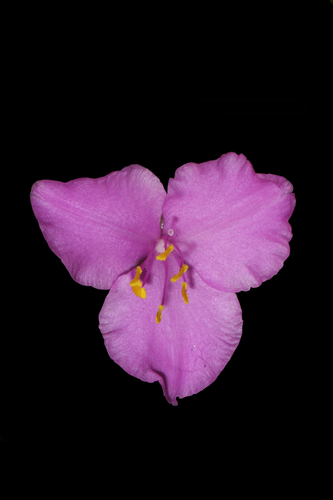
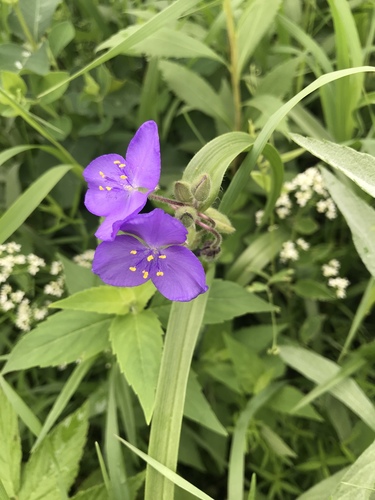
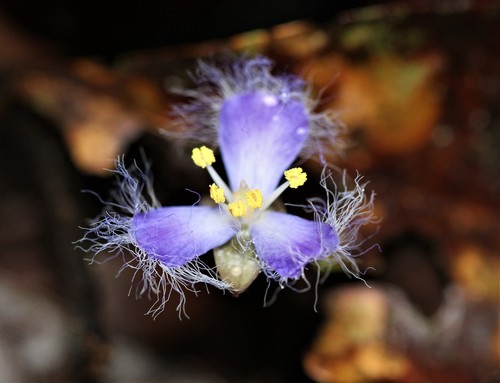
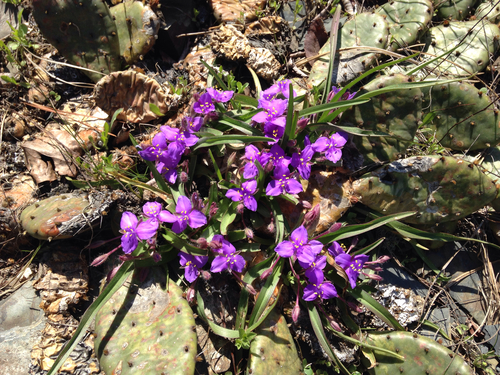
Tradescantia longipes, commonly called wild crocus, is not closely related to plants in the genus Crocus. It is a perennial herbaceous plant belonging to the dayflower family. This species is found only in the Ozark Mountains of southern Missouri and northern Arkansas, located in the Midwest United States. It blooms in spring, and its flowers can be seen from April to May. It typically grows in its preferred habitat: wooded slopes on rocky hillsides. Most other members of the Tradescantia genus native to North America have stems that grow at least a few inches above the soil. However, the flowering shoots of Tradescantia longipes are produced essentially at ground level. Some individuals of two closely related species, Tradescantia hirsuticaulis and Tradescantia virginiana, share this low-growing flowering shoot trait, though both species usually have obvious above-ground stems. Tradescantia longipes can be distinguished from Tradescantia hirsuticaulis by its longer pedicels and hairless bracts, and from Tradescantia virginiana by having at least some glandular hairs on its sepals. In addition, Tradescantia longipes is a tetraploid, meaning it has four sets of chromosomes, while Tradescantia hirsuticaulis is a diploid with only two sets of chromosomes. Tradescantia virginiana occurs in both diploid and tetraploid forms, and it is consistently tetraploid in areas where its range overlaps with Tradescantia longipes. A phylogenetic study used two commonly applied chloroplast DNA regions, trnL-trnF and rpL16, to investigate evolutionary relationships. The study could not convincingly resolve the recent evolutionary history of Tradescantia longipes, but it suggests that the species is closely related to the "erect Tradescantia" group (series Virginianae), which includes most other North American Tradescantia species. Tradescantia longipes can be grown as an ornamental plant for its showy flowers. It is considered especially suitable for rock gardens or native plant gardens, but can be grown in most settings as long as partial shade is provided. It tolerates nutrient-poor soils, but prefers acidic, medium-moist, well-drained soils. This plant grows in clumps that can be divided when desired. Its leaves usually die back after flowering stops, so it is recommended to cut the plant back to encourage new growth and potential autumn re-flowering.