About Tradescantia fluminensis Vell.
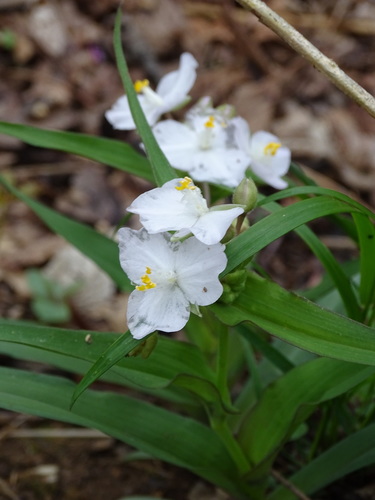
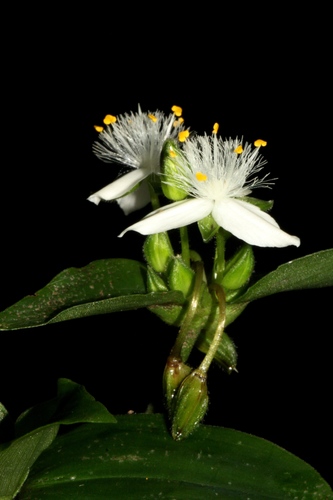
Tradescantia fluminensis Vell. is a perennial groundcover that spreads across the ground with soft, hairless stems and leaves. Its fleshy stems root at any node that touches the ground surface. The plant produces oval, pointed-tipped, dark green leaves that are shiny, smooth, and slightly fleshy, measuring 1.25–2.5 inches (32–64 mm) in length. Its white flowers grow terminally, sometimes opposite a leaf, on a 1.5 cm long stem. Each flower has three petals, and reaches approximately 0.5–1 inch (13–25 mm) in diameter. The sepals are 5–7 mm in size, while the three white petals are 8–9 mm in size. The anthers are detached. Flowers grow in small clusters during the summer, and can produce several seeds. Tradescantia fluminensis is cultivated as a garden plant or houseplant in many locations. Even in regions where it is considered a pest, variegated forms are often grown as houseplants. This species grows best in moist soil, and its growth is slowed by cold climates, especially areas that experience frost or snow. It tolerates heavy shade well. Because it requires consistent moisture, it grows weakly or not at all in sunny areas that dry out for long periods. However, as a fleshy plant that stores water, it can survive extended dry periods and resume growth once more favorable conditions return. According to the ASPCA, Tradescantia fluminensis is toxic to dogs, cats, and horses, and causes dermatitis in these animals. Numerous variegated-leaf cultivars are available; the 'Quicksilver' cultivar has received the Royal Horticultural Society's Award of Garden Merit.