About Trachypoma macracanthus Günther, 1859
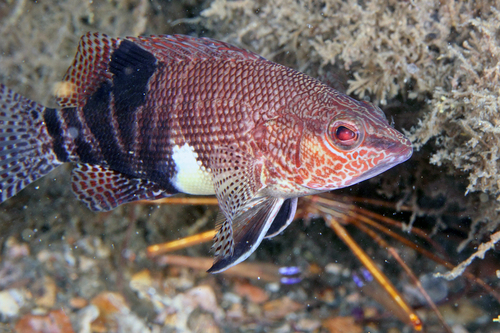
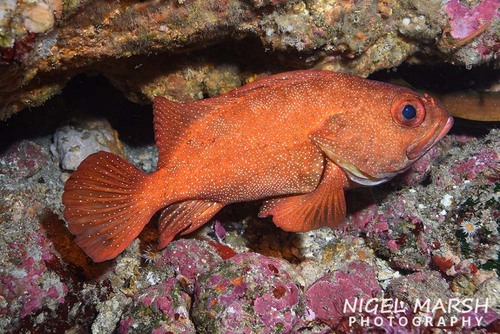
The toadstool groper (Trachypoma macracanthus Günther, 1859) has a bright orange or red body and fins covered in an irregular pattern of small white spots. It has large eyes positioned high on its head. The lower edge of its preopercular bone bears three upward-curving spines. Its dorsal fin contains 12 spines, while its anal fin holds 6 soft rays. This species reaches an approximate total length of 40 centimetres (16 in), though other sources cite a maximum length of 22 centimetres (8.7 in).
This species was first formally described in 1859 by German-born British ichthyologist Albert Günther, with its type locality given as Norfolk Island. The toadstool groper has been recorded from New Zealand, the Kermadec Islands, Easter Island, and Chile’s Desventuradas Islands. Around Australia, it occurs in southwestern and southeastern coastal waters, as well as at Lord Howe Island, Norfolk Island, and the Elizabeth and Middleton Reefs.
It inhabits rocky reefs and coral sand lagoon areas at depths between 10 and 50 metres (33 to 164 ft). It frequently hides in caves and under overhangs, and feeds on a range of benthic invertebrates and smaller fish. It is a nocturnal hunter, and one of its preferred prey items is crayfish; it leaves its shelter at night to hunt these crustaceans.