About Trachypithecus selangorensis Roos, Nadler & Walter, 2008
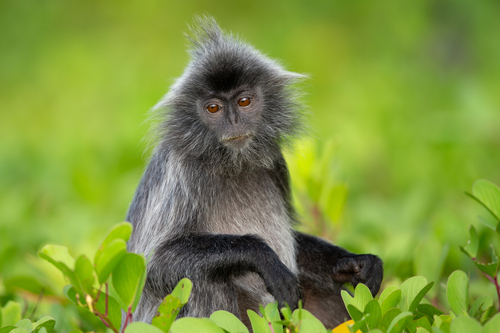
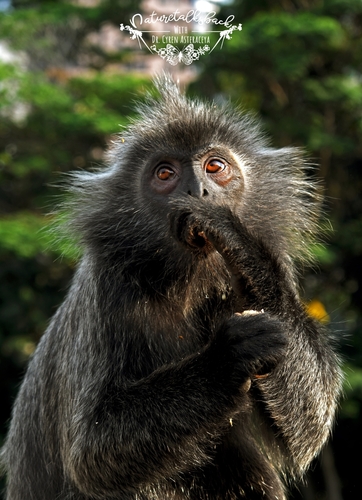
The Selangor silvered langur (Trachypithecus selangorensis) has a gray body, with black skin on its face, feet, and hands. The type specimen of this species measured 50.6 cm (19.9 in) from head to body, with a 70.4 cm (27.7 in) long tail. For the closely related silvery lutung, the average head and body length is 48.9 cm (19.3 in) in females and 54.4 cm (21.4 in) in males. The average body weight of the silvery lutung is 5.7 kg (13 lb) for females and 6.6 kg (15 lb) for males. The Selangor silvered langur can be distinguished from the silvery lutung by the shape of its whiskers: the Selangor silvered langur has long, straight whiskers, while the silvery lutung has mussel-shaped whiskers. The two species are also genetically distinct. Infant Selangor silvered langurs have a very different coat pattern than adult individuals. Infants are born with bright orange fur, and white skin on their faces, hands, and feet. Their coat color gradually shifts to the adult pattern over the first 3 to 5 months of life, with changes starting on the head, hands, and feet. All members of a Selangor silvered langur group take part in caring for infants, including females that are not the infant's mother, and the group's dominant male. One hypothesis about the bright orange coloration of infants suggests that this color may draw other females to help care for the newborn. This species of langur is found only along the west coast of Peninsular Malaysia, occurring in the states of Johor, Negeri Sembilan, Selangor, Melaka, Perak, and Kedah. It is an arboreal species that most often lives in mangrove and riparian forests, but it can sometimes also be found on plantations. Its diet consists mostly of leaves, but it also eats fruit, seeds, flowers, and even dried wood. Feeding Selangor silvered langurs is a popular tourist activity at Bukit Melawati. The population of Selangor silvered langurs at Bukit Melawati is one of the few wild leaf monkey populations that has become continuously habituated to humans. The langurs here will sometimes approach visitors to beg for food, and may even willingly touch or climb on people.