About Trachypithecus francoisi (de Pousargues, 1898)
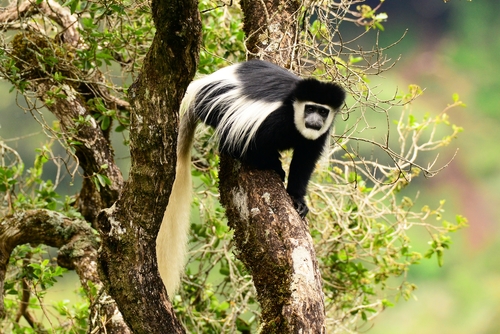
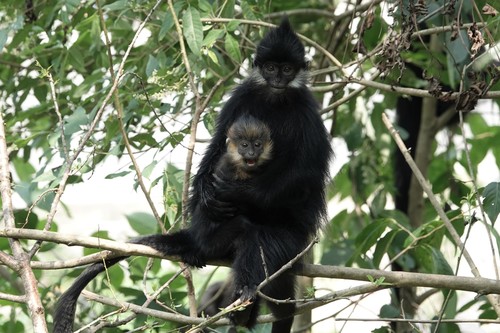
François' langur (Trachypithecus francoisi) is a medium-sized primate covered in black, silky hair, with very distinct white sideburns that extend from its ears down to the corners of its cheeks. This species displays sexual size dimorphism. Males have a head-body length of 55–64 cm (22–25 in), while females measure 47–59 cm (19–23 in) in head-body length. Males also have longer tails, ranging from 82–96 cm (32–38 in), compared to female tails of 74–89 cm (29–35 in). Males are significantly heavier than females, weighing 6.5–7.2 kg (14–16 lb) while females weigh 5.5–5.9 kg (12–13 lb). Infants weigh 0.45–0.50 kg (16–18 oz) at birth, and are born with bright orange fur that fades to black over the course of their several-month-long infancy. It is unknown why infant coats are so conspicuous, but current hypotheses suggest the bright color may elicit attention, protection, and caregiving from adult group members. As a folivore, François' langur has multiple morphological adaptations for digesting a leaf-based diet. It has large salivary glands that start breaking down tough leaf fibers. Its most notable evolutionary adaptation is a specialized sacculated stomach; the original description notes both a four-chambered complex stomach and a two-chambered sacculated structure, where bacteria in the upper chamber continue breaking down fibers started by saliva. The upper chamber maintains a relatively neutral pH to support favorable conditions for bacterial growth, while the lower chamber resembles the stomach of other mammals and contains acid to finish breaking down food components. The preferred habitat of François' langur is karst topography, specifically limestone cliffs and caves in tropical and subtropical zones. Living on these limestone cliffs gives the langur an advantage for sleeping: it sleeps on ledges or in caves, and prefers caves as sleeping sites. The species has also been recorded using sleeping sites in evergreen forests in areas with terrain temperatures above 16 °C (60 °F). By living and sleeping in these limestone caves and cliffs, far from flat lowland, François' langur has greatly reduced its risk of predation. It uses cryptic behavior and remains very vigilant when entering its cave to rest for the night, as a tactic to avoid predators. It also produces loud calls to mark its territorial boundaries. François' langur selects its sleeping habitat based on proximity to foraging areas, choosing sleeping sites close to potential foraging grounds to conserve energy and cut down on travel costs. Sleeping sites are not located within the core of foraging areas, but lie within reasonable proximity, as preferred nesting and foraging sites do not align completely. When traveling to forage, the species tends to follow the same route and returns to the same sleeping site on consecutive nights, another behavior that reduces predation risk. François' langur typically has around 6 to 10 regularly used sleeping sites that it uses at different times throughout the year as water and food resources change. François' langur has a restricted geographic range. It is primarily found in Southwest China and northern Vietnam. Most wild scientific research on this species is conducted in China's Guangxi Province, at the Nonggang Nature Reserve and Fusui Nature Reserve. The average home range size for the species is 19 hectares (230,000 square yards), and average daily range size is 341–577 square metres (3,670–6,210 square feet). In general, the low nutritional quality of its folivorous diet leads to nutritional stress, smaller home ranges, and reduced daily travel time. The largest recorded group of François' langurs numbered 500–600 individuals, found in Mayanghe National Nature Reserve. Average group size ranges from 4 to 27 individuals. In 2009, Fusui Nature Reserve reported that the local François' langur population had declined by 73% over the preceding five years, which further reduced the species' already limited distribution. Recent population censuses have found the species is now restricted to 14 localities across 10 different counties.