About Trachypithecus cristatus (Raffles, 1821)
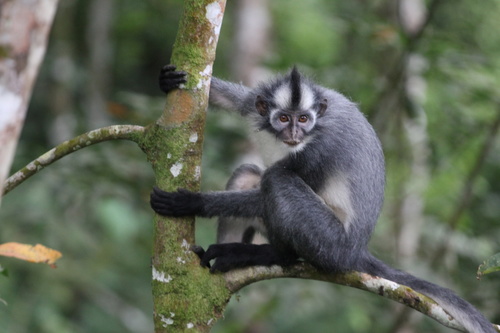
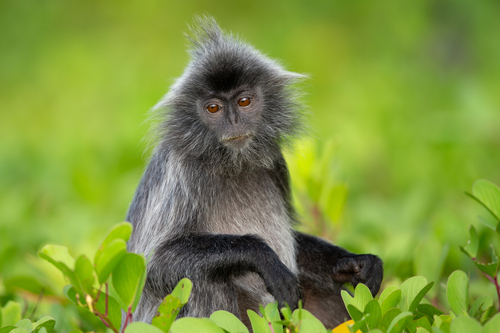
This species, commonly called the silvery lutung, is a medium-sized monkey with a long, non-prehensile tail. It has dark brown or black fur tipped with grey, which gives it an overall uniform silvery appearance. Unlike some related species, it has no paler markings on its face or body, with the only exception being a patch of whitish hair on the groin of adult females. A crest of fur runs along the top of its head, and the hair on its cheeks is long, often covering the ears completely. Its hands and feet are hairless, with dark-coloured skin, and have opposable thumbs and toes.
Female silvery lutungs have a head-body length between 46 and 51 centimetres (18 to 20 in), an average weight of 5.7 kilograms (13 lb), and a tail length between 67 and 75 centimetres (26 to 30 in). Males are slightly larger, with a head-body length between 50 and 58 centimetres (20 to 23 in), an average weight of 6.6 kilograms (15 lb), and the same tail length range as females: 67 to 75 centimetres (26 to 30 in).
Like other langurs, the silvery lutung has a large three-chambered stomach adapted to digest the cellulose in its herbivorous diet. This stomach supports food fermentation, and shares structural similarities with the stomach of ruminants. Even compared to other langurs, the silvery lutung has an unusually long intestine, with a number of pouches along its length that carry out additional fermentation of plant material. Its teeth have grinding ridges and other modifications that let it process tough leaves more efficiently.
The silvery lutung is distributed across Borneo, Sumatra, and Java, as well as parts of the southwestern Malay Peninsula, the Natuna Islands, and other nearby islands. It inhabits mangrove swamps and adjacent forest regions, and generally does not travel far from coasts or rivers.
Silvery lutungs are diurnal. They travel in groups of around 9 to 40 individuals, with a social structure of one adult male and multiple adult females that communally care for infants. The species rarely leaves the trees, which protect them from ground-dwelling predators, and they flee rapidly when they feel threatened. Each group occupies a home range of 20 to 43 hectares (49 to 106 acres), and these ranges may overlap with the home ranges of neighbouring groups. During the day, individual silvery lutungs may travel up to 500 metres (1,600 ft) through the forest, and some form all-female subgroups that separate from the male-containing main group. The entire group shelters together in a single tree at night.
The social structure of silvery lutungs is both matrilineal and harem-based. Females stay in their birth group for life, while males leave the group shortly after reaching adulthood. Dispersed males live in small all-male groups until they are able to take over an established harem. Within a group, males dominate females, and females with young dominate females without young. Even so, there is relatively little aggression within groups compared to some related species.
Because group home ranges often overlap, different groups encounter one another frequently. The adult male of a harem protects his group and territory from competing males, communicating his dominance to other males through vocalizations and fighting. When no males are present, however, females from different groups are more likely to interact peacefully. The most serious conflicts happen when a male intrudes directly onto another male’s territory; this can end with the intruder displacing the resident male and taking control of the group. In many other primates, this kind of displacement is typically followed by the new male killing any infants sired by the previous resident. While this behaviour may occur in silvery lutungs, it has never been directly observed, and is likely less common than in other primate species.
Although silvery lutungs are less vocal than other closely related species, they produce at least thirteen different vocalizations. The most common vocalization is used by adult males defending their territory. Other vocalizations communicate emotions such as fear, anger, excitement, and satisfaction, in addition to a variety of distinct calls made by infants.
Silvery lutungs breed year-round, with no distinct breeding season. Each female typically gives birth no more than once every 18 to 24 months. A female attracts a male by moving her head from side to side, and copulation may occur multiple times during a single mating encounter. Unusually for primates, wild female silvery lutungs have been reported to experience menopause, and may survive for up to nine years after their last birth.
Females give birth to a single offspring after a gestation period of 181 to 200 days. Newborns weigh about 400 grams (14 oz), measure about 20 centimetres (7.9 in), and are well developed, with a strong grip to hold onto their mother. Newborn silvery lutungs are born with orange fur and white hairless skin on their face, hands, and feet. The skin quickly changes to the dark colour of adult individuals, but the fur does not develop the adult silvery pattern until three to five months after birth. Young silvery lutungs receive communal care from all adult females in the group, and are not weaned until they are 18 months old, even though their biological mother stops lactating after just 12 months. Young individuals become sexually mature almost immediately after finishing weaning, and females give birth to their first offspring on average at 35 months of age. Silvery lutungs have been recorded living up to 31 years in captivity.