About Trachyphyllia geoffroyi (Audouin, 1826)
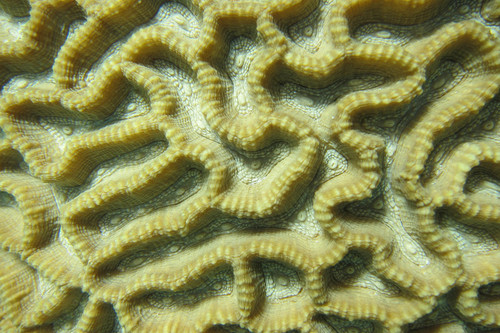
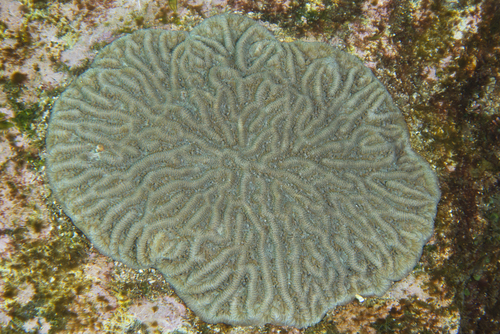
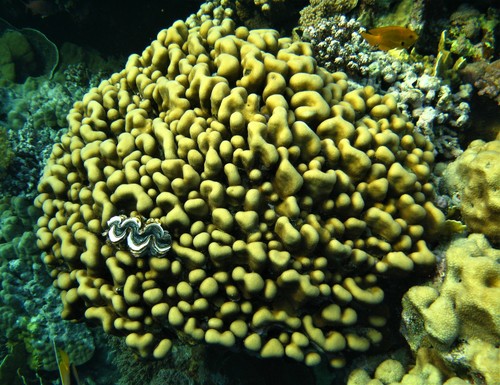
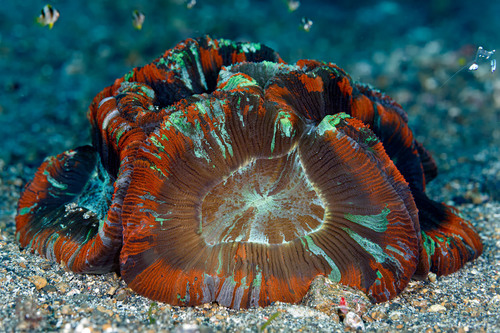
Trachyphyllia geoffroyi, commonly known as open brain coral, can grow as either solitary or small colonial corals, and rarely grow more than 20 centimeters in diameter. These corals are free-living and have a flabello-meandroid growth form, with distinct valley-shaped regions separated by walls. In colonial forms, each valley region can hold multiple individual polyps. The complexity of these valley regions varies: some are hourglass-shaped, while others are highly lobed. Open brain corals typically have bilateral symmetry. When polyps are closed during the day, the entire coral is covered by a fleshy mantle that extends beyond the skeleton. This mantle can retract when the coral is disturbed, and both the polyps and mantle have a very fleshy texture. Colonies come in blue, green, yellow, and brown, and are often vibrantly colored. This coral is known to host the gall crab species Lithoscaptus semperi. Open brain corals are distributed across the entire Indo-Pacific region, ranging from the Red Sea to New Caledonia. They live at depths down to a maximum of 40 meters. They are not very common within direct coral reef communities. Instead, they are most often found on sandy reef slopes, around continental islands, and in lagoons. They can frequently be found growing near other free-living corals. Large colonies of open brain corals are uncommon, and are typically only seen in marine protected areas.