About Trachypepla galaxias Meyrick, 1884
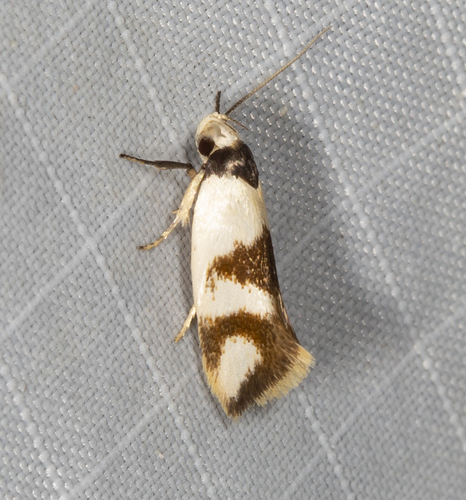
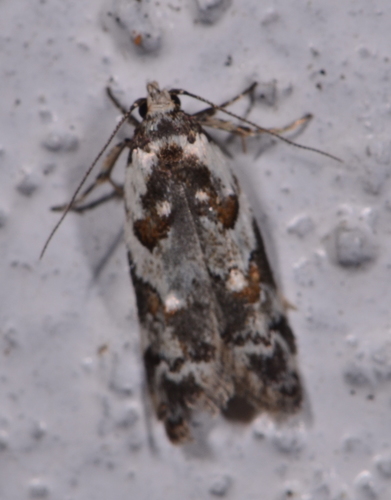
Trachypepla galaxias, first described by Meyrick in 1884, has a body length of 14 to 16 mm for both males and females. The head is white. The palpi are white; the second joint is dark fuscous on its outer surface, except near its apex, and the apex of the terminal joint is blackish. The antennae are grey. The thorax is dark grey, with irregular mixed white scaling. The abdomen is grey. The legs are dark fuscous; middle tibiae have whitish markings at the center and apex, posterior tibiae are grey-whitish, and all tarsi have whitish rings at the end of each joint. The forewings are elongated, with a moderately arched costa, rounded apex, and very obliquely rounded hindmargin. They are white, with a small number of scattered grey scales. There is a small dark fuscous spot at the base of the costa, and a dark grey transverse band near the base. The inner edge of this band is more or less close to the base and suffused into the ground color, while its outer edge runs from one-quarter of the costa to one-third of the inner margin. This outer edge is edged with blackish, and is almost rectangularly angled outwards at its middle. A black tuft of raised scales sits above and below the middle of this band, with some ferruginous scales between the two tufts. About the middle of the costa, there is a triangular dark grey patch; the apex of this patch touches a ferruginous, irregular spot with blackish margins in the disc. This patch is connected to the inner margin beyond the middle by a blackish line that is twice strongly dentate. There is a suffused grey spot on the costa at three-quarters, another on the middle of the hindmargin, and sometimes a larger suffused grey spot on the inner margin before the anal angle; sometimes all these spots are partially confluent. A slender, cloudy blackish transverse line runs from the three-quarters costal spot to the anal angle; it is irregularly sinuate, and strongly dentate inwards beneath the costa. The forewing cilia are whitish, with two cloudy dark grey lines. The hindwings are grey, with darker coloring at the apex and hindmargin. The hindwing cilia are grey-whitish, with a faint darker line. This species is endemic to New Zealand and occurs throughout the country. It lives in native forest. As of 2014, the life history of Trachypepla galaxias is not known. Larvae of the related species Trachypepla contritella feed and pupate on lichens in the genus Usnea, so it has been hypothesised that T. galaxias larvae share this habit.