About Trachypepla euryleucota Meyrick, 1883
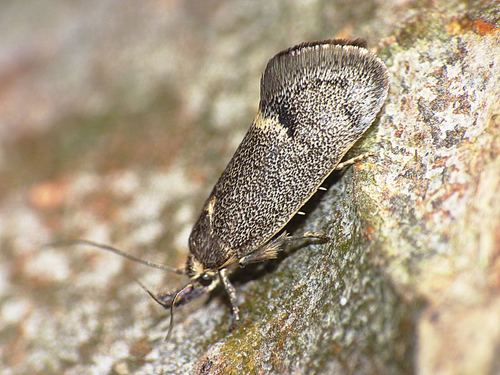
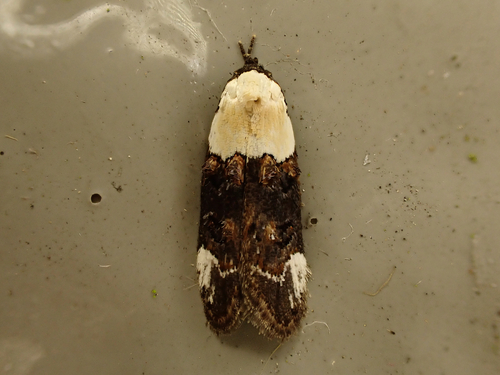
Trachypepla euryleucota was first described by Meyrick in 1883, with his original description as follows: Males and females of this species have a body length ranging from 14 to 17 mm. The head, palpi, and antennae are dark fuscous. The thorax is white, with a dark fuscous anterior margin. The abdomen is fuscous. The legs are dark fuscous, with the apex of each tarsal joint appearing obscurely pale. The forewings are elongate; the costa is arched towards the base and apex, and is nearly straight across its remaining length. The forewing apex is round-pointed, and the hindmargin is very obliquely rounded. The forewings are dark fuscous, with a large white basal patch slightly tinged with ochreous. The outer edge of this patch is slightly irregular, and it extends from 1/4 of the costa to before the middle of the inner margin. There is a small elongate blackish spot on the base of the costa. In the forewing disc, two large spots of raised ochreous-brown scales, partially bordered by black, sit before the middle, and two smaller similar spots sit beyond the middle. There is a small somewhat triangular, inwardly oblique white spot on the costa at 4/5; this spot emits a slender, outwards-angulated white line from its apex to the hindmargin above the anal angle, and the anterior side of this marking is bordered by blackish. The forewing cilia are fuscous-grey, with an obscure darker line. The hindwings are fuscous-grey, and become darker towards the apex; the hindwing cilia are also fuscous-grey, with an obscure darker line. This species is endemic to New Zealand, and can be found throughout the country. It inhabits native forest. Its larvae feed on leaf litter, and have also been recorded feeding on bird nest debris.