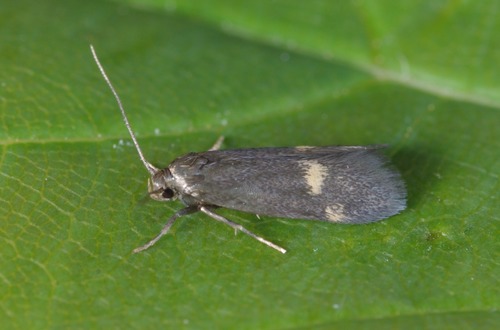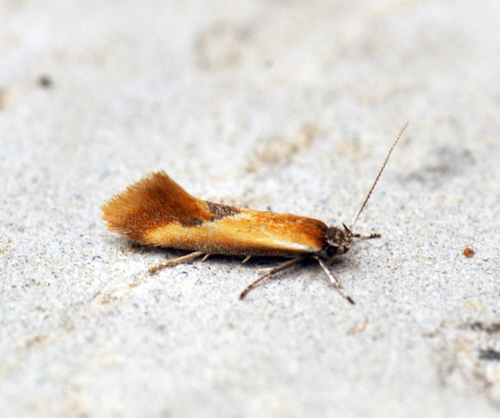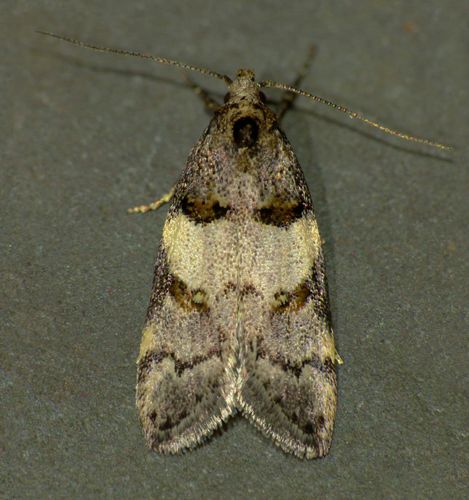
About Trachypepla contritella (Walker, 1864)
Trachypepla contritella was first described by Walker in 1864 from the female specimen, with the following description: The female is ash-colored. Palpi are much longer than the width of the head, lightly speckled with black; the third joint is lance-shaped and much shorter than the second. Antennae are slender, and much shorter than the forewings. Legs are slender. Wings are moderately broad and barely pointed. Forewings are covered in tiny black speckles, and have a broad whitish middle band that widens toward the rear and is incompletely bordered with black; there is an outer oblique black line that forms a sharp angle toward the front, where it is cut short; the outer edge is slightly convex and very slanted. Hindwings are shiny, lightly tinted with bronze; the fringe is long. Body length is 3 lines, wing length is 8 lines.
G. V. Hudson gave a later description of the species: The wingspan is around 5⁄8 of an inch. Forewings are elongated with a rounded apex and a very oblique outer margin; they are pale purplish-grey. At about 1⁄4 of the wing length, there is a noticeable outward-curved thick blackish transverse line marked with two tufts of raised scales, which is rather indistinct where it meets the costa and dorsum. Beyond this line, there is usually a paler central area. Another oblique transverse line sits on the costa at about half the wing length, and encloses two tufts of raised scales. A wavy transverse line runs from the costa at 3⁄4 of the wing length to the tornus, and there is a row of faint terminal dots along the outer edge. Hindwings are greyish-ochreous, and darker toward the apex. This species varies in the intensity of its ground color, the appearance of its forewing markings, and the distinctness of the paler forewing central area. Hudson believed the moth’s coloration mimics dull grey lichens.
This species was originally endemic to New Zealand, where it has been observed across the whole country. Since the 2010s, it has also been observed in the United Kingdom. It was first recorded in Eaton Ford in 2012, and has since also been found in Huntingdonshire.
T. contritella lives in native forest, and is common in beech forest in New Zealand’s South Island. Its larvae feed on leaf litter. This species also feeds and pupates on lichens from the genus Usnea.