About Trachypepla conspicuella (Walker, 1864)
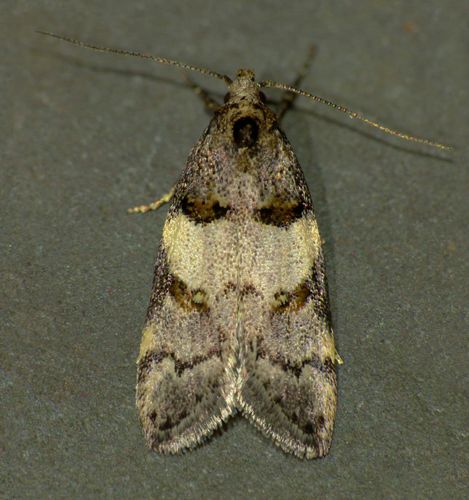
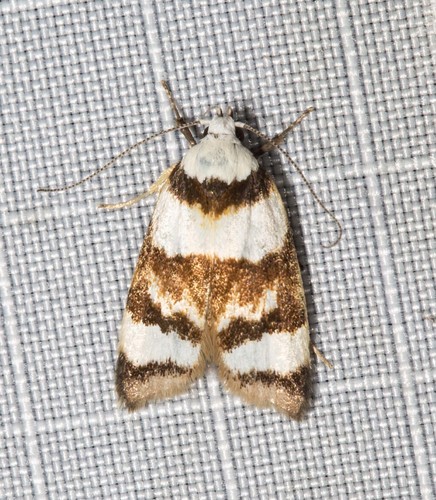
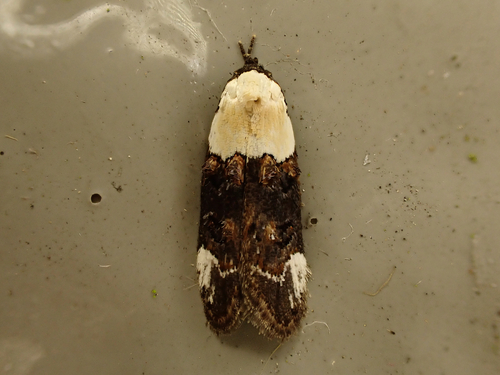
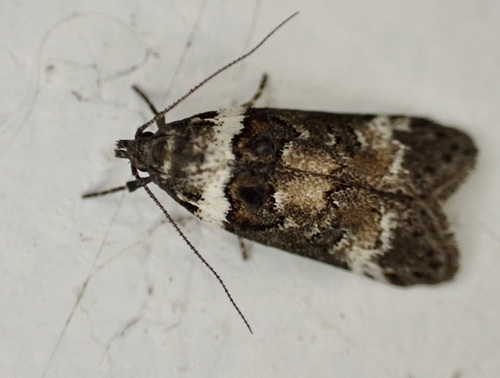
When Walker first described adult Trachypepla conspicuella, he characterised the male of this species as follows: The male is blackish, with a ash-grey underside, and is related to the genus Oecophora. Palps are blackish, stout, and much longer than the breadth of the head; the third joint is lanceolate and slightly shorter than the second. Antennae are smooth and much shorter than the fore wings. The thorax is white, except for the front area. The abdomen is ash-grey. Tarsi have blackish bands. Wings are rather broad, rounded at the tips, with long fringes. Fore wings are brownish ash-grey along the inner border (except towards the base) and over the full one-third of their length measured from the outer border. A white band on the fore wing widens along the inner border all the way to the base of the wing, and has two black spots on its outer edge. A whitish transverse line is located three-quarters of the way along the wing length, is much wider towards the front, and is edged with black on its inner side. The outer border is slightly convex and very oblique. Hind wings are bronze-ash-grey. Body length is 3 lines; wingspan is 9 to 10 lines. This species is variable in appearance, but can be recognised by its brown thorax and pale basal patch. Darker specimens of this species can be confused with individuals of T. euryleucota. Hudson held the opinion that the colouration of T. conspicuella imitates bird droppings. This species is endemic to New Zealand, where it can be found in both the North and South Islands. Besides its type locality of Nelson, it has also been collected at Wellington, Christchurch, and Lake Wakatipu.