About Trachylepis quinquetaeniata (Lichtenstein, 1823)
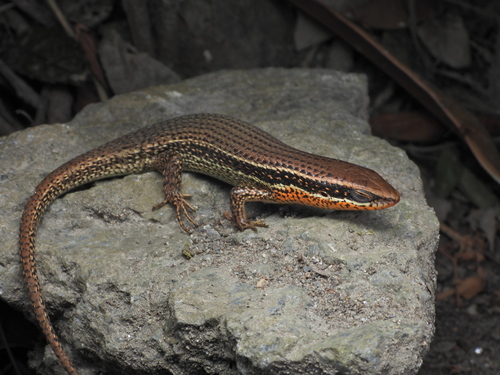
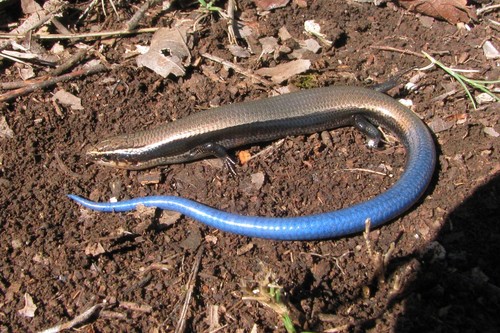
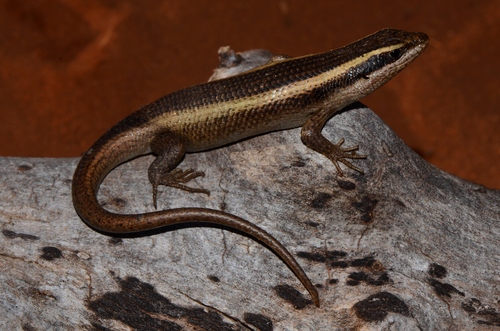
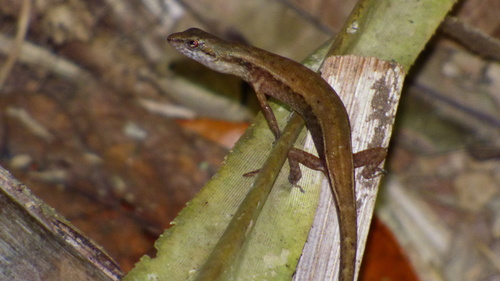
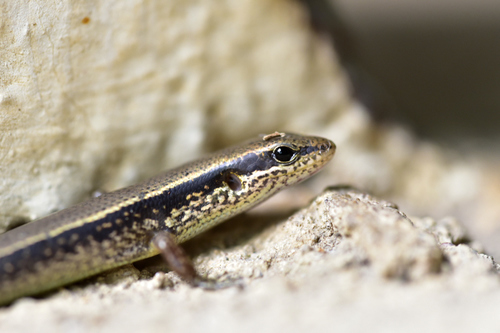
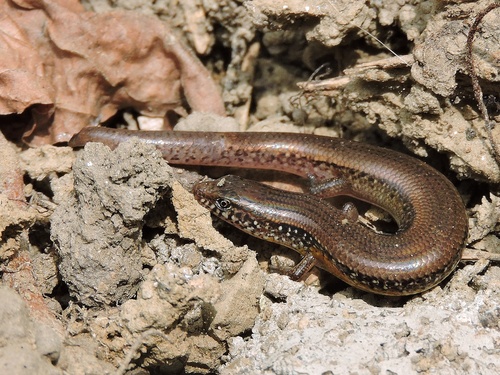
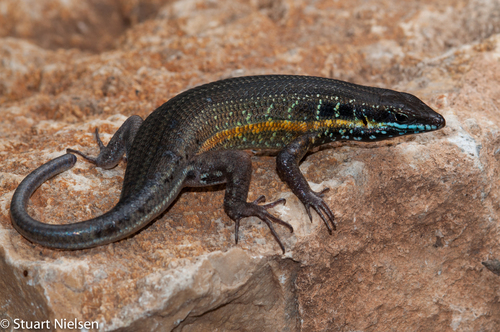
Trachylepis quinquetaeniata is a small to medium-sized skink that reaches a mature length of around 20 centimetres (7.9 in). The color of this species varies quite a bit based on the lizard's gender, age, and time of year. Like most skinks, it has glossy, shiny scales that give its body a smooth, metallic, reflective quality when touched. Its base scale color is most often olive-brown or dark brown, and it may sometimes have small pearly-whitish spots. Three light-olive or dark-brown stripes run from the head down to the lizard's bright electric-blue tail; these stripes often fade and become less distinct as the lizard ages. The head has a pointed snout and clearly visible ear openings, and small black spots are usually present just behind the ears. Its limbs are dark black or brown, short and strong, with relatively long toes. The flanks are mainly yellowish or beige, and the underside of the body is whitish. Its overall appearance is very similar to several types of North American blue-tailed and striped skinks, including Plestiodon skiltonianus, which is also called the western skink, five-lined skink, blue-lined skink, or Coronado's skink.
This species is distributed across Africa, ranging from Egypt to Mali in Northern Africa, with its range extending south into Southern Africa. It has been recorded in many countries and territories across the African continent, and it is also classified as an invasive species in Florida.
These skinks live in both rocky and grassland habitats. They typically make their homes on trees, but they will also use manmade structures as habitat.