About Trachylepis atlantica (Schmidt, 1945)
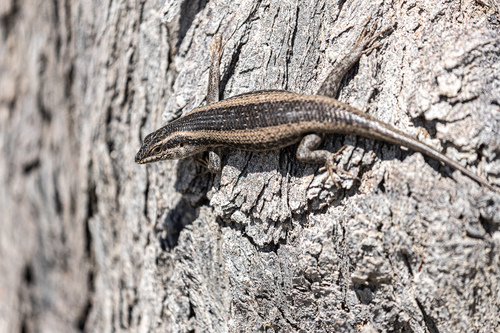
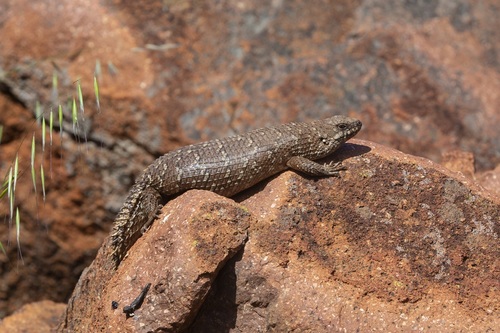
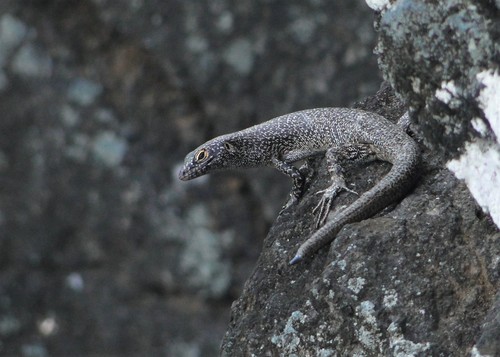
This species, commonly called the Noronha skink with the scientific name Trachylepis atlantica (Schmidt, 1945), has upperparts covered in light and dark spots, with substantial variation in exact colors, and no longitudinal stripes. Underside scales are yellowish or grayish, and eyelids range from white to yellow. It has a small head with small nostrils positioned far forward on the sides of the head. Its mouth holds small, conical teeth and a thin but well-developed tongue. The small eyes are placed laterally, with dark, rounded irises. Three to five well-developed small projections called auricular lobules are present in front of the ears; these lobules are absent in true Mabuya. The small forelimbs are shorter and weaker than the longer, stronger hindlimbs. The tail is longer than the body, muscular, very brittle, nearly cylindrical, and tapers towards its tip. Scale features are important for distinguishing reptile species and groups. In the Noronha skink, the supranasal scales located above the nose are in contact with each other, and the prefrontal scales behind the nose are also in contact in most individuals. The two frontoparietal scales, located above and slightly behind the eyes, are not fused. Unlike in T. maculata, the parietal scales that lie behind the frontoparietals are in contact with each other. Almost all specimens have four supraocular scales above the eyes, and five supraciliary scales positioned immediately above the eyes, below the supraoculars. The dorsal scales on the upperparts have three keels, which is two fewer than in T. maculata. Midbody scales, counted around the body midway between the forelimbs and hindlimbs, number 34 to 40 with a mode of 38; dorsal scales number 58 to 69 with a mode of 63–64; ventral scales on the underparts number 66 to 78 with a mode of 70. Mabuya species and T. maculata generally have fewer midbody scales, with counts up to 34. There are 21 to 29 subdigital lamellae under the fourth toe, more than the 18 found in T. maculata. The Noronha skink has 26 presacral vertebrae located before the sacrum, which matches the count seen in most Trachylepis, but differs from American Mabuya, which have at least 28. Though this species shows substantial measurement variation across individuals, no discrete groups can be detected, and it is not possible to unambiguously separate sexes using measurements alone. Among 15 males and 21 females collected in 2006, male snout to vent length ranged from 80.6 to 103.1 mm (3.17 to 4.06 in) and averaged 95.3 mm (3.75 in), while female snout to vent length ranged from 65.3 to 88.1 mm (2.57 to 3.47 in) and averaged 78.3 mm (3.08 in). Male body mass ranged from 10.2 to 26.0 g (0.36 to 0.92 oz) and averaged 19.0 g (0.67 oz), while female body mass ranged from 6.0 to 15.0 g (0.21 to 0.53 oz) and averaged 10.0 g (0.35 oz). Males are significantly larger than females. In 100 specimens collected in 1876, head length averaged 14.8 mm (0.58 in) with a range of 12.0 to 18.9 mm (0.47 to 0.74 in); head width averaged 9 mm (0.35 in) with a range of 7 to 14.4 mm (0.28 to 0.57 in); and tail length averaged 117 mm with a range of 93 to 170 mm (3.7 to 6.7 in). The Noronha skink is very abundant across Fernando de Noronha, where it is even common in houses, and also occurs on smaller islands surrounding the main island of the archipelago. Its abundance may result from the absence of ecologically similar competitors. Apart from T. atlantica, the Fernando de Noronha reptile fauna includes the indigenous amphisbaenian Amphisbaena ridleyi and two introduced lizards: the gecko Hemidactylus mabouia and the tegu Tupinambis merianae. This species occurs in several microhabitats, but is most often found on rocks. Although it is predominantly ground-dwelling, it is a good climber. Almost nothing is known about its reproduction: only that skinks studied in late October and early November, during the dry season, showed little evidence of reproductive activity. Like many Trachylepis, the Noronha skink is oviparous (egg-laying), which differs from all Mabuya, which are viviparous (give live birth). Trachylepis atlantica is active during the day. Its average body temperature is 32 °C (90 °F), a few degrees higher than the environmental temperature. Body temperature peaks at up to 38 °C (100 °F) around midday, and is lower earlier and later in the day. In the early morning, this lizard may bask in the sun. While foraging, it spends an average of 28.4% of its time moving, a relatively high proportion for a Trachylepis. A geologist who visited the island in 1876 recorded that the skink is curious and bold: when he sat on bare rocks, he often saw these small animals watching him with apparently as much curiosity as he felt for them, turning their heads from side to side as if trying to be observant. If he stayed still for a few minutes, they would creep toward him and eventually climb onto him; if he moved, they would run down the rock faces, then turn and stick their heads out above the rock edges to continue watching him.