About Trachusa byssina (Panzer, 1798)
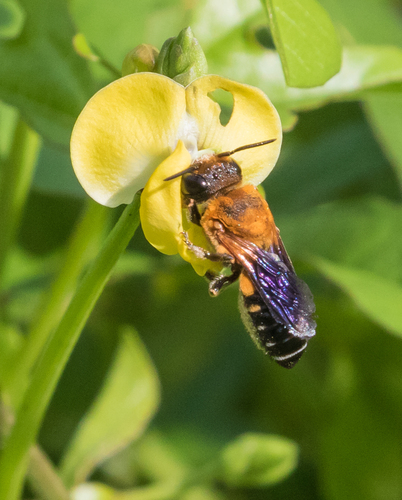
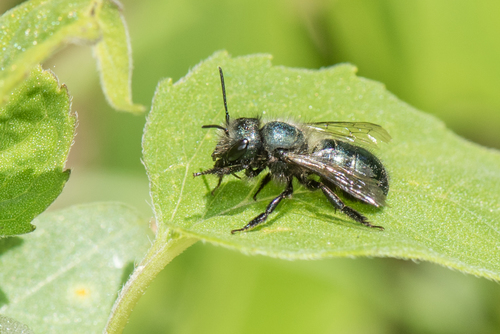
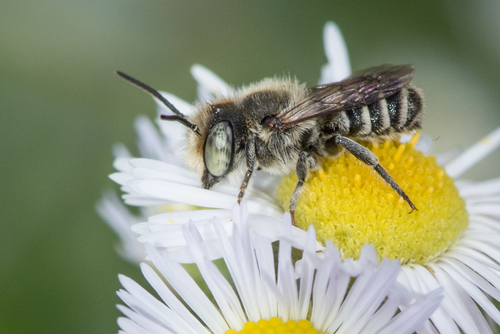
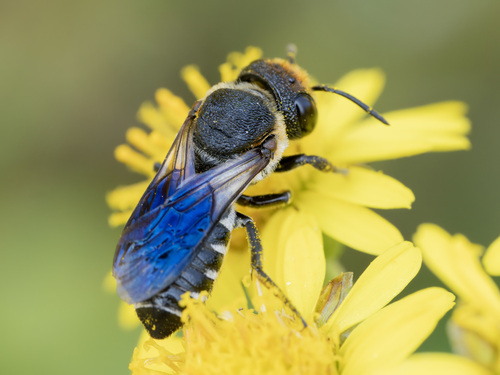
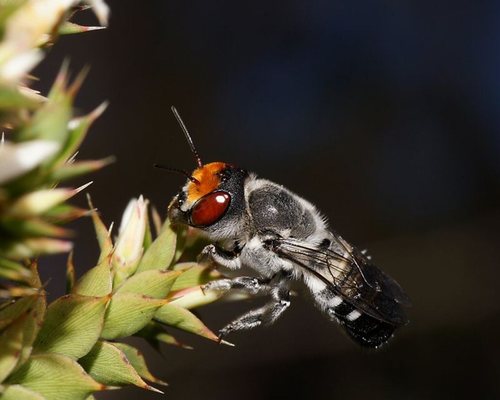
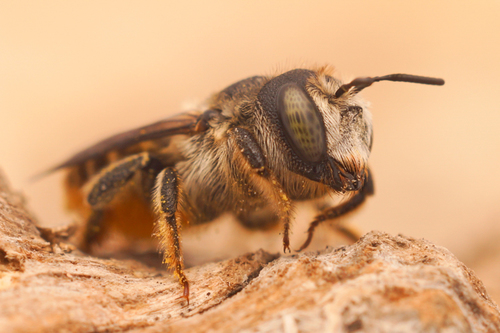
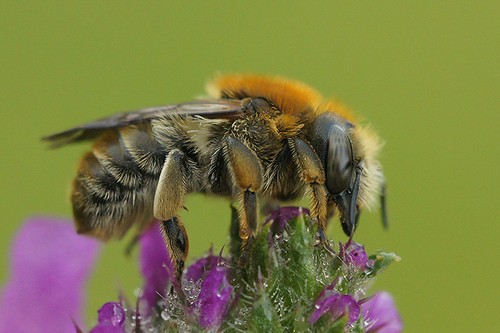
Trachusa byssina (Panzer, 1798) measures 11 to 12 mm in length. Males lack light spots on their bodies except for a yellow-colored face, and the end of their abdomen is not reinforced like it is in many other Anthidium species. Females have fox-red hairy thoraxes, their abdomens are sparsely covered in light brown hair with faint hair bands at the ends of the tergites, and their ventral pollen brush is white. Both sexes can be identified by experienced observers in the field. This species ranges from Portugal across Europe, through Asia Minor, the Caucasus, Central Asia, and Siberia, reaching east to Amur Oblast and the Jewish Autonomous Oblast. Its northern limit reaches 60° N in Oppland, Norway; 63° N in Sweden; 64° N in Kokkola, Central Ostrobothnia, Finland; and in Russia it extends north to Karelia, Kirov, and Perm. Its southern limit reaches Abruzzo, northern Greece (Mount Olympus and the Tymfi region), and northern Turkey. It is currently recorded from almost all regions of Central Europe, and is only known historically from Schleswig-Holstein, the Lake Geneva area, and southern Ticino. In Germany, it is widespread from lowlands to higher mountain areas and is moderately common. In Central Europe, Trachusa byssina is found primarily in low mountain ranges, on south-facing forest edges that directly adjoin poor meadows or have wide herbaceous borders. It also occurs on wide sunny forest paths, or clearings with large stands of Lotus. Additional habitats include inland dunes, sand heaths, old fallow vineyards, extensively grazed or fallow sheep pastures (juniper heaths), and abandoned sand pits and quarries. It is often found living in the same area as Anthidium strigatum. This species prefers to nest on slightly sloping, more or less south-facing locations that have little to no overgrowth, with at least somewhat compacted soil (compacted for example by foot traffic, moss, or grass roots). It will use many different soil types including humus soil, but most often nests in sandy soil or loess loam. Conifers (especially Pinus sylvestris pines) and deciduous trees must grow near nesting sites to supply building material for nests. Females sometimes collect resources 100–200 meters away from their nesting site. Trachusa byssina produces one generation per year. Its flight period runs from early June to mid-August, and it hibernates as a resting larva inside a cocoon. This bee is an oligolectic species that specializes on Fabaceae. Its primary pollen source is Lotus corniculatus. It also collects pollen from other Fabaceae, especially when Lotus corniculatus does not bloom or blooms only sporadically. Documented secondary pollen sources include Lotus uliginosus, Onobrychis viciifolia, Ononis repens, Ononis spinosa, Vicia cracca, Lathyrus heterophyllus, Lathyrus sylvestris, Lathyrus tuberosus, Lathyrus pratensis, Medicago sativa, and Securigera varia. Females usually stay with specific flowering plants during foraging, particularly when collecting from Lotus, but they often use two and occasionally three plant species during a single foraging flight. All of the listed pollen sources except Ononis and Securigera also provide nectar, which is added in large quantities to larval food stores. Males patrol flowering Lotus plants. Trachusa byssina digs its own nest cavities in the ground, nesting either alone or in small colonies of 10 to 50 clustered nests. Nests are 10–15 cm long branched earthen tubes. Two to four brood cells are arranged sequentially at the end of side branches. To build brood cells, females cut strips from the leaves of various trees and herbs to form the cell walls. Commonly used leaves come from birch (Betula), hawthorn (Crataegus), willowherb (Epilobium), beech (Fagus sylvatica), English oak (Quercus robur), roses (Rosa), and blackberries (Rubus fruticosus). After constructing the leaf walls, females collect small pieces of resin and deposit them at the end of the brood cell until enough resin is available to coat the inside of the leaf walls with a resin layer. The inside coating is most often pine resin from Pinus sylvestris, and may also come from spruce (Picea abies). The cuckoo bees Coelioxys quadridentata and Aglaoapis tridentata are suspected to be kleptoparasites that use Trachusa byssina as a host species.