About Trachurus trachurus (Linnaeus, 1758)
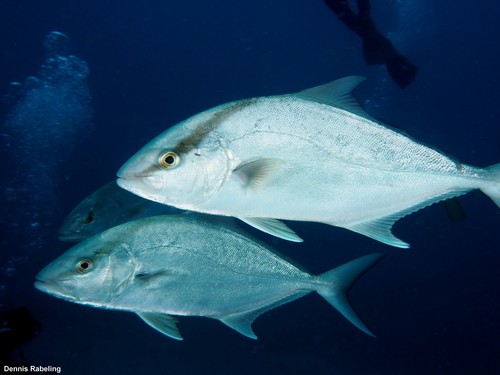
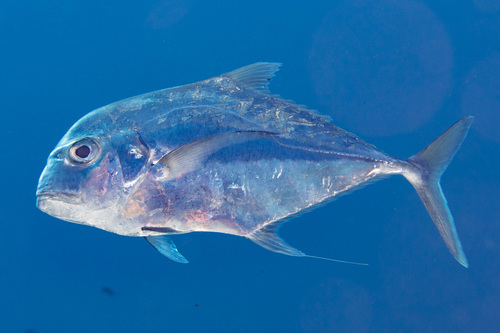
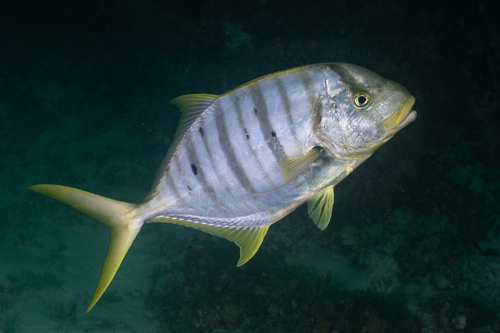
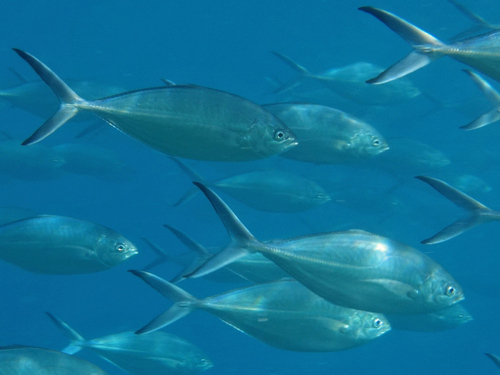
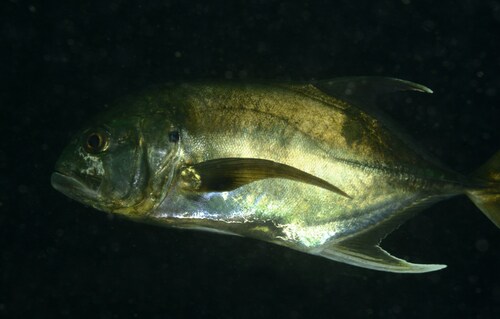
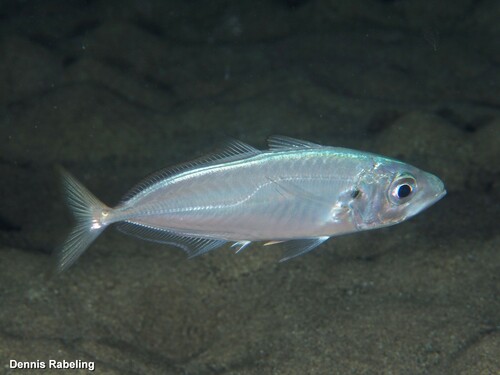
Atlantic horse mackerel, scientifically known as Trachurus trachurus (Linnaeus, 1758), has a slender, moderately compressed body and a large head. The rear of its upper jaw reaches the front of the eye, and its lower jaw projects past the upper jaw. It has a well-developed adipose eyelid covering the eye. It has two separate dorsal fins divided by a narrow gap. The first dorsal fin is tall, with seven thin spines, the last of which is much shorter than the others. The second dorsal fin is significantly longer than the first, holding 29–33 soft rays. The anal fin is roughly the same length as the second dorsal fin, and has two separate spines at its anterior end. The moderately sized pelvic fin has one spine and five soft rays, and its origin lies below the end of the pectoral fin base. A curved line of 33–40 bony scutes runs from the head to the tail; each scute has a small spine that increases in size and becomes bonier closer to the tail. The lateral line has a total of 66–67 scales, 31–36 of which are scutes. Its body is dark blue with silvery flanks and a white belly, and there is a dark spot on the operculum. This species reaches a maximum fork length of 60 centimetres (24 in), though most individuals are around 25 cm (10 in), with a maximum recorded weight of 1.5 kg (3 lb).
This species is found in the northern and eastern Atlantic Ocean, the Mediterranean Sea, the Sea of Marmara, and the Black Sea. In the Atlantic, it occurs from Norway to South Africa, and may extend around the Cape of Good Hope along southern Africa’s Indian Ocean coast as far as Maputo, Mozambique. If Trachurus capensis is recognized as a valid separate species, however, Trachurus trachurus is restricted to the northeast Atlantic. It has been recorded at Cape Verde but is thought to only occur there as a vagrant.
The Atlantic horse mackerel is a benthopelagic species that typically lives over sandy substrates at depths of 100–200 m (330–660 ft / 50–110 fathoms), though it has been found as deep as 1,050 m (3,440 ft / 570 fathoms) and sometimes occurs closer to the surface. It is a migratory species: it moves northward in summer, and returns south as sea temperatures drop. Two separate stocks are recognized in the northeast Atlantic. The western stock spawns across a broad area from Ireland to the Bay of Biscay in early spring, then moves north to the southern coasts of Norway and the northern North Sea in summer. The North Sea stock spawns in the southern North Sea during summer, then migrates north into the central North Sea, the Skagerrak, and the Kattegat. Off the coast of Mauritania, this species’ main spawning season runs from November to January, while the related Cunene horse mackerel (Trachurus trecae) spawns in June and August. Off Ireland, spawning happens irregularly through summer from June to August, peaking in July. Females spawn their eggs in batches of up to 140,000 eggs each, and newly hatched larvae measure 5 mm (3⁄16 in) in length. Spawning is indeterminate, meaning the total number of eggs a female can produce depends on factors that change over the course of a spawning season. Both eggs and larvae are pelagic.
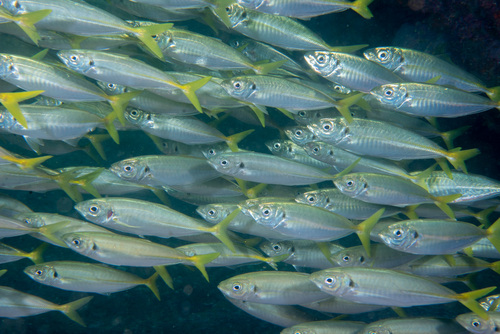
Juvenile Atlantic horse mackerel frequently shoal with juveniles of other fish species, most commonly Atlantic herring (Clupea harengus), and with other horse mackerel species including Mediterranean horse mackerel (T. mediterraneus) and blue jack mackerel (T. picturatus). Juveniles are also often found sheltering among the tentacles of jellyfish. In South Africa, the maximum recorded age of this species is 24 years, while individuals up to 40 years old have been recorded in the northeast Atlantic. Females are thought to reach reproductive maturity between two and four years old. Off Mauritania, juveniles are caught at depths of 200–300 m (660–980 ft / 110–160 fathoms), while mature fish are caught in shallower waters less than 100 m (330 ft / 55 fathoms) deep. Age and growth of Atlantic horse mackerel varies across its large range, and is affected by how heavily local stocks are fished.
Both juvenile and adult Atlantic horse mackerel feed on copepods, shrimps, small fish, and squids. A study of stomach contents from fish caught in the Aegean Sea identified 60 different prey species belonging to five major groups: polychaetes, crustaceans, molluscs, arrow worms, and bony fish. Copepods, euphausiids, and mysids made up the largest percentage of consumed food. Bony fish were the second most numerous prey ingested, while polychaetes and arrow worms were recorded infrequently. The diet showed very little seasonal variation: copepods and mysids made up the largest proportion of prey throughout the year, and fish were the most frequent prey except in spring. Larger fish measuring over 16.9 cm (6+5⁄8 in) feed largely on bony fish larvae. This study identified at least 45 copepod species, with Acartia clausi and Oithona media being abundant and important year-round. Overall, crustaceans were the most important prey for this species in all seasons, while bony fish were the most important prey for larger individuals.
Atlantic horse mackerel is eaten fresh, and can also be preserved by freezing, salting and drying, smoking, or canning. It may be cooked by frying, broiling, or baking. Its flesh is described as having a pleasant flavour and an oily, delicate texture, and is a good source of omega-3 fatty acids. Per 100g of flesh, it provides 97 kcal of energy, with the following nutritional composition: 77.4 g water, 19.8 g protein, 2 g fat, 64.4 mg cholesterol, 1.3 g total minerals, and 224 mg phosphorus. In Iberia it is often prepared as escabeche, and some catch is exported to Japan as aji for use in sushi. It is also an important ingredient in Sicilian cuisine.