About Trachurus mediterraneus (Steindachner, 1868)
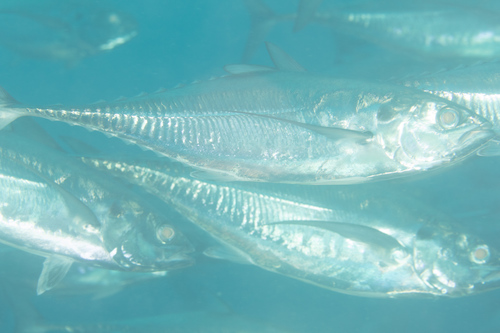
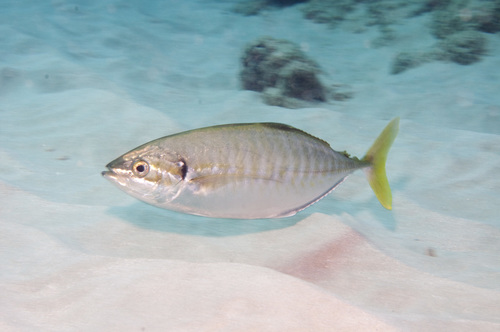
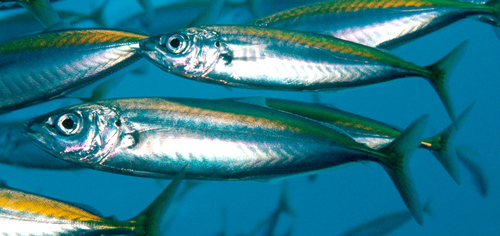
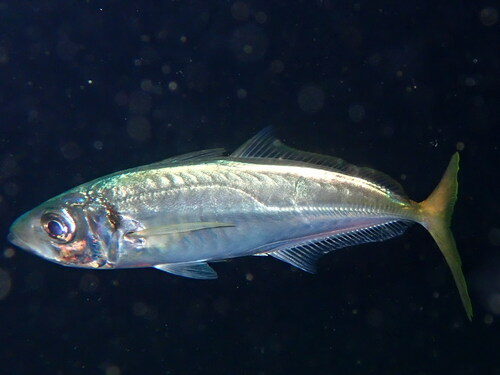
The Mediterranean horse mackerel (Trachurus mediterraneus) has an elongated, compressed body that reaches a maximum length of 60 cm (24 in), with a common length of 30 cm (12 in). It has a large head, a projected lower jaw, small, close-set nostrils, and eyes protected by a well-developed adipose eyelid. Its upper jaw, the maxilla, is also large and wide. The body has a dusky overall coloration: the dorsal side and top of the head are blue to grey to black, while the lower two-thirds of the body is white to silver. Its caudal fin is yellow, and it has a distinct black mark just behind the operculum. It has 36–41 gillrakers, and two separate spines sit before its anal fin. This species occurs in subtropical waters across the eastern Atlantic Ocean, ranging from the Bay of Biscay to Mauritania, and also in the Mediterranean Sea, Aegean archipelago, Black Sea, Sea of Marmara (also called Propontis), and southwestern Sea of Azov. Its latitudinal range spans from 49°N to 28°N, and its longitudinal range spans from 13°W to 43°E. There are two recognized subspecies: T. m. mediterraneus lives in the Mediterranean Sea, while T. m. ponticus, also known as the Black Sea scad, is native to the Black Sea, Sea of Marmara, and Sea of Azov. T. m. ponticus is found in the territorial waters of all countries that border the Black Sea: Bulgaria, Georgia, Romania, Russia, Turkey, and Ukraine. The subspecies do not have fully isolated populations, and limited migration between their resident seas occurs; hybrid offspring have been recorded in the wild. The Mediterranean horse mackerel typically lives at depths between 5 m (16 ft) and 250 m (820 ft), though it can be found as deep as 500 m (1,600 ft). It usually stays near the ocean floor, but will sometimes form schools near the surface. This is a marine species that favors brackish water and subtropical temperatures, and it is oceandromous, meaning it migrates within its native bodies of water. It feeds mainly on sardines, anchovies, and small crustaceans, and forms mixed shoals with other species in its genus, including T. trachurus and T. picturatus. Like other mackerels, the Mediterranean horse mackerel reproduces via oviparity. Its reproductive cycle is split into three distinct stages: prereproductive, reproductive, and postreproductive. The prereproductive stage runs from January to April, and the postreproductive stage runs from September to December; during both of these stages, gonads are much smaller than they are in the reproductive stage. Mating takes place in summer, from May to August, during which time testes and ovaries grow significantly in size. Mature ovaries turn dark orange, and eggs are visible on their surface. Embryonic development takes 24–26 hours. The eggs are pelagic, and measure 0.71–0.92 mm (0.028–0.036 in) in length. Both males and females reach sexual maturity at 2 years of age, at a length of around 16 cm (6.3 in). This species is parasitized by three species of monogeneans: Gastrocotyle trachuri, Pseudaxine trachuri, and Cemocotyle trachuri.