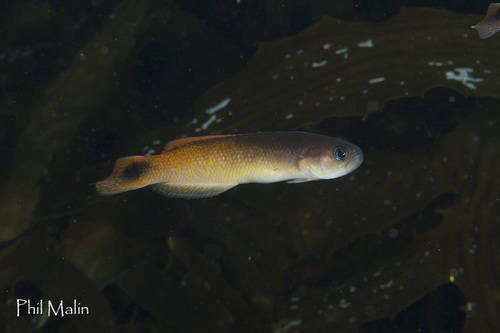
About Trachinops caudimaculatus McCoy, 1890
The southern hulafish, scientific name Trachinops caudimaculatus McCoy, 1890, is a small ray-finned fish that reaches a maximum length of 15 cm. Its body is long and slender, stretched along the rostral-caudal axis, and narrow in both lateral and dorsoventral directions. Like other hulafish, it has a lanceolate, leaf-like tail, with central fin rays that are longer than the more dorsal and ventral fin rays. Individual body color varies, but most individuals have a grey dorsal half of the head and body, a cool-toned tan ventral side, and transparent, colorless paired fins. This species can be easily distinguished from other similarly sized and shaped members of its genus by the prominent black spot at the base of its caudal fin, and its darkened central fin rays. Trachinops caudimaculatus inhabits temperate nearshore reefs off the coast of southern Australia, most commonly in waters surrounding Victoria, South Australia, and Tasmania, ranging west as far as the Great Australian Bight. The species is often found on small rocky reef patches within environments otherwise dominated by soft sediments. Southern hulafish prefer to live in large, dense shoals made up of hundreds or thousands of individuals, though groups as small as 20 individuals have been recorded. While larval southern hulafish may disperse far from their hatching site, adult southern hulafish are extremely unlikely to leave their home reef after settling, and have never been recorded traveling through more than 20 meters of open water.