About Trachelospermum jasminoides (Lindl.) Lem.
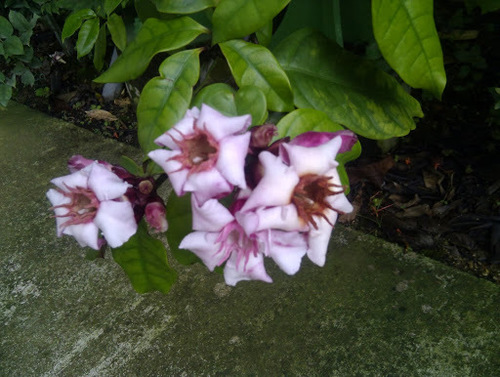
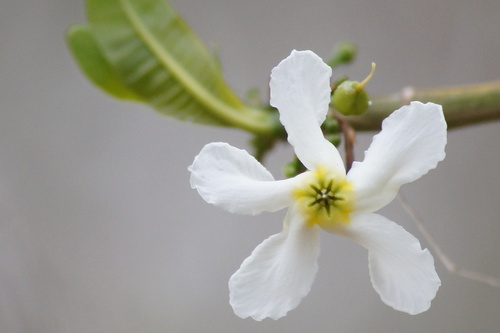
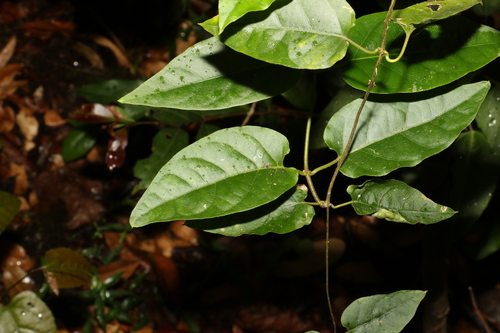
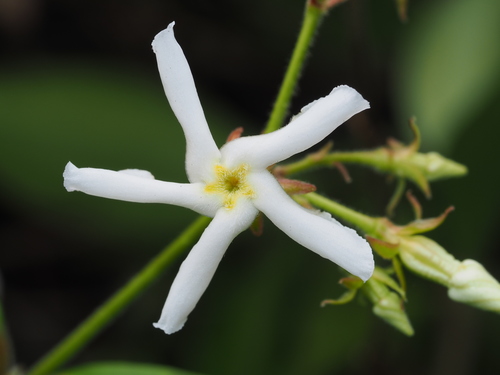
Trachelospermum jasminoides is an evergreen woody liana that grows up to 3 m (10 ft) high. When it encounters a wet surface, it produces aerial adventitious roots; without this, it twines around and wraps its supporting structure. Like most plants in the Apocynaceae family, it exudes a white, sticky milk-like latex when cut. Young twigs are initially covered in fine short hairs, and become hairless as they mature. Its leaves are arranged oppositely, ranging from oval to lanceolate in shape. They measure 2–10 cm (3⁄4–3+7⁄8 in) long and 1–4.5 cm (3⁄8–1+3⁄4 in) wide, with smooth entire margins and tapering pointed tips. Leaves are dark green in summer, and turn bronze in winter. Fragrant flowers are produced from spring to early summer; they are white, 1–2 cm (3⁄8–3⁄4 in) in diameter, with a tube-shaped corolla that opens out into five petal-like lobes. These white, flat, radially symmetrical flowers have a calyx made of five narrow, smooth, curved-back sepals 2–5 mm long, which are much shorter than the corolla tube. The corolla tube is swollen in its middle, measures 5–10 mm long, and ends in five overlapping obliquely oriented lobes. All lobes are curved, forming a counterclockwise spiral. The five stamens are inserted in the middle section of the corolla tube. Trachelospermum jasminoides is commonly grown as an ornamental plant and houseplant. In gardens, public landscapes, and parks, it is used as a climbing vine, a groundcover, and a fragrant potted plant for terraces and patios. It can flower when grown in full sun, partial shade, or full shade. It requires well-drained soil — if kept constantly damp, it may develop fatal fungal infections — plus moderate water and moderate fertilizer, and a climbing structure (whether this is a trellis or another plant does not matter greatly). Propagation is most often done via cuttings to produce clones. It is widely planted in California, and particularly in the Southeastern United States, where it is hardy only in USDA Zones 8–10. A valuable perfume oil can be extracted from the flowers through steam distillation or tincture processing, and this oil is used in high-end perfumery. In dilute form, tincture made from the flowers is widely used in Chinese, Vietnamese, and Thai incenses. A bast fiber can be produced from the plant's stems.