About Trachelophorus giraffa Voss, 1929
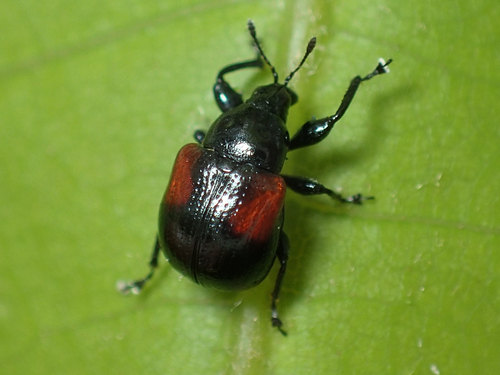
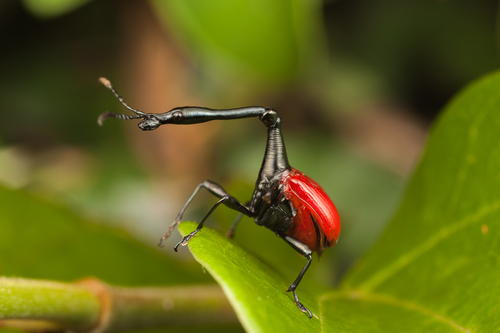
Trachelophorus giraffa, commonly called the giraffe weevil, is a small weevil species that is endemic to Madagascar. This species has a black body and bright red elytra that cover its wings. Giraffe weevils are well known for their elongated necks, and male individuals have necks 2 to 3 times larger than females of the species. Their elongated necks provide several advantages: they are used for combat, attracting mates, building nests, and acquiring resources. In coleopterology, giraffe weevils are studied with interest because they exhibit clear sexual dimorphism. Note that multiple other beetle species share the common name giraffe weevil, one example being the New Zealand giraffe weevil, Lasiorhynchus barbicornis. To attract a mating partner, male giraffe weevils perform elaborate displays that involve swaying their necks to show off their vibrant colors. The female evaluates this display, and if she approves, the male gains the opportunity to proceed with courtship. No quantitative research has been published on the reproductive habits of this species, but field observations have revealed some unique reproductive behaviors. After mating, the female will roll up a leaf, lay a single egg inside the resulting leaf tube, then snip the tube free so it falls onto the forest floor. The rolled leaf provides the newly hatched larva with food during its first days of life.