About Toxotes jaculatrix (Pallas, 1767)
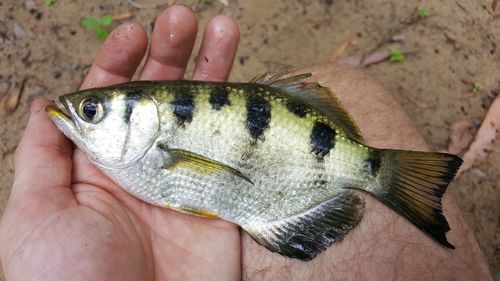
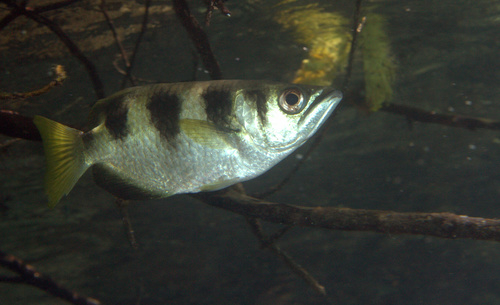
Banded archerfish (Toxotes jaculatrix) have four dorsal spines and 11 to 13 soft dorsal rays, along with three anal spines and 15 to 17 soft anal rays. Among the anal spines, the third is the longest, while the first spine of any of these spines is always the shortest, and all rays get shorter closer to the posterior end of the body. There are roughly 23 scales between the first dorsal spine and the posterior nostrils. Certain parts of the body carry a green tinge; the back is olive-green or brown. The yellowish-green dorsal fin sits toward the posterior end, and its base is shorter than the base of the anal fin, which is silver in color. The caudal fin is a muted "dirty green", and it is roughly consistent in height until it reaches its point of attachment to the body, where it becomes shallower. The body of the banded archerfish is oblong, with a raised profile on the posterior side. Its base body color is generally silver-white, though variant colorations including yellow have been recorded. Four to six wide black bars are often present on the dorsal side of the body. The first bar sits in front of the operculum (the bony plate that covers the gills), the second bar sits behind the operculum, the third bar sits below the point where the dorsal fin originates, the fourth bar sits below the soft dorsal section, and any fifth bar sits on the caudal peduncle, the area between the anal fin and caudal fin. These bars get shorter as the fish ages. The lateral line curves upward between the fourth and ninth lateral scales. Banded archerfish can grow to a maximum total length of 30 centimetres (12 inches), with an average length of around 20 centimetres (7.9 inches). They have large eyes that, unlike the eyes of many other fish species, are positioned to allow binocular vision. Their head is slightly shorter than their body, and they have a distinctly pointed snout. Juvenile banded archerfish are typically yellow-green to brown on their dorsal side and silvery on their ventral side, with grey-green flanks. Some adult individuals have irregular yellow patches between their black body bars. Research has not yet investigated whether banded archerfish have sexual dimorphism. This species lives in the Indo-Pacific region, including waters off northern Australia; it occurs less often along Australia's southern coast. Its range extends east from India to the Philippine Islands, south to Australia, and also includes waters near the Solomon Islands, the Indonesian Archipelago, and as far east as what is now Vanuatu (previously called the New Hebrides). Banded archerfish live mostly in brackish water, with mangrove estuaries as their primary habitat. They occasionally move upstream into freshwater rivers, and they are associated with reefs, and have been found near overhanging vegetation. While they can move between fresh and salt water over their life cycle, they do not make this movement to breed.