About Toxotes chatareus (Hamilton, 1822)
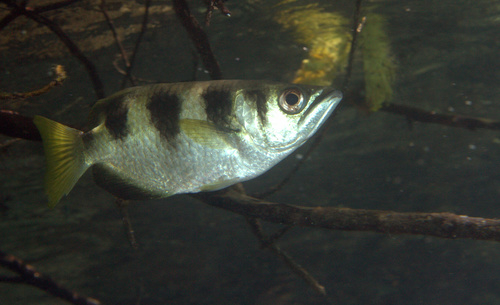
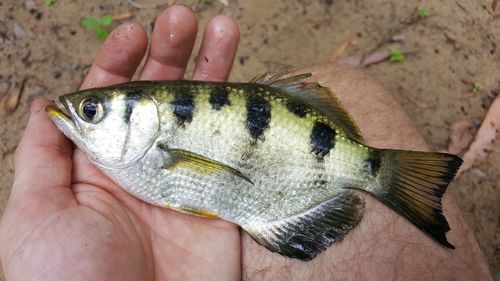
Toxotes chatareus (Hamilton, 1822) is a moderately sized archerfish, typically growing 15 to 20 centimetres (5.9 to 7.9 in) long, and rarely reaching a maximum length of 40 centimetres (16 in). The species can weigh up to 700 grams (25 oz), and is believed to have a lifespan of three to five years. This species has five or six dorsal spines, with the fourth spine being the longest; dorsal spines of specimens caught in freshwater are generally shorter than those from brackish water. It also has twelve or thirteen dorsal soft rays, three anal spines, and fifteen to seventeen anal soft rays. The third anal spine is the longest, and the anal fin remains undivided. T. chatareus has 33 or 34 lateral line scales, and its caudal (tail) fin is almost square in shape. The overall body colour is sooty, though it can sometimes appear silvery or gold, with a greenish brown dorsal side. The pectoral fins are clear or dusky, while pelvic fins are often darker and more heavily pigmented. The ventral side of the body is white, and six or seven dark, alternating long and short blotches run along the dorsal side, with an additional dark blotch at the base of the caudal fin. Blotch colour can change from darker to lighter based on time of day, environment, and stress: blotches on young fish are darker than those on older fish, startled or stressed fish are darker than unstressed individuals, and fish living in cloudy water may be completely white. It is currently unknown whether this species exhibits sexual dimorphism. Toxotes chatareus is distributed across India, Burma, Indonesia, New Guinea, and northern Australia. In Australia, it occurs in rivers of the Kimberley region of Western Australia, the Kakadu area and Arnhem Land of the Northern Territory, and the upper reaches of the Burdekin River, where individuals have successfully crossed Burdekin Falls. In eastern Australia, the species is distributed more patchily and occurs at lower abundances. Along the Mekong River, it can be found as far north as Thailand and Laos. The species generally inhabits waters with temperatures between 25 to 30 °C (77 to 86 °F); recorded extreme tolerance limits are an upper maximum of 36 °C (97 °F) in the Alligator Rivers region, and a lower minimum of 20.5 °C (68.9 °F) in the Burdekin River region. Its primary habitat is brackish mangrove swamps, but it can also be found in freshwater rivers and streams. Toxotes chatareus occupies shaded areas with overhead vegetation, most often in the top layer of the water column. It is only found in locations with intact riparian areas, which are the main source of its food, and it does not typically occur in fast-flowing streams.