About Toxostoma rufum (Linnaeus, 1758)
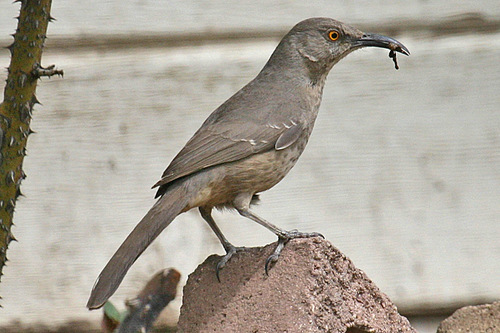
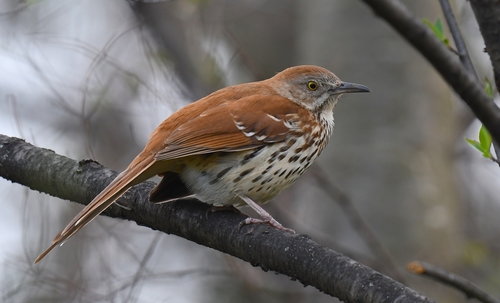
Toxostoma rufum (Linnaeus, 1758), commonly called the brown thrasher, has bright reddish-brown plumage on its upper body, with thin dark streaks across its buff-colored underparts. Its whitish chest features distinct teardrop-shaped markings. It has a long, rufous, rounded tail with paler corners, brilliant yellow eyes, and a long, downward-curving brownish bill. Males and females have identical appearance. Juvenile brown thrashers are not notably different from adults, differing only in plumage texture, less distinct upper body markings, and olive-colored irises. This species is a fairly large passerine bird, and it is moderate-sized for a thrasher: it is distinctly larger than the sage thrasher (Oreoscoptes montanus), but is similar to or somewhat smaller than other more brownish Toxostoma species found further west. Adult brown thrashers measure 23.5 to 30.5 cm (9.3 to 12.0 in) in length, have a wingspan of 29 to 33 cm (11 to 13 in), and weigh 61 to 89 g (2.2 to 3.1 oz), with an average weight of 68 g (2.4 oz). Standard measurements for the species are: wing chord 9.5 to 11.5 cm (3.7 to 4.5 in), tail 10.9 to 14.1 cm (4.3 to 5.6 in), culmen 2.2 to 2.9 cm (0.87 to 1.14 in), and tarsus 3.2 to 3.6 cm (1.3 to 1.4 in). There are two recognized subspecies. The nominate subspecies T. rufum rufum, the eastern brown thrasher, occurs across the eastern half of Canada and the United States. The western subspecies is T. rufum longicauda (Baird, 1858), the western brown thrasher, which lives in central United States east of the Rocky Mountains and southern central Canada. The western brown thrasher can be distinguished from the nominate subspecies by its more cinnamon-colored upper parts, whiter wing bars, and darker breast spots. Annual survival rates for the brown thrasher vary by age: first-year survival is 35%, survival between the second and third year is 50%, and survival between the third and fourth year is 75%. Disease and exposure to cold weather are known contributing factors limiting the species' lifespan. The longest recorded lifespan for a wild brown thrasher is 12 years, and captive brown thrashers have a similar maximum lifespan. The brown thrasher lives in a variety of habitats. It prefers woodland edges, thickets, and dense brush, and it typically searches for food in dry leaf litter on the ground. It can also live in agricultural areas and areas near suburbs, but it is less likely to live close to human housing than many other bird species. Males usually initiate competition for habitat and potential nesting grounds between brown thrashers and other bird species. The brown thrasher is a strong partial migrant: individuals in the southern part of the species' range remain year-round residents. The species' breeding range covers the United States and Canada east of the Rocky Mountains, though individuals are occasionally spotted west of the Rockies. Over the past century, fire suppression and tree planting have increased tree cover across the Great Plains, which allowed the brown thrasher to expand its range westward, alongside many other bird species. Migratory patterns differ by breeding location: brown thrashers that breed in New England, United States migrate to the Carolinas and Georgia; thrashers that breed east of the Mississippi River winter from Arkansas to Georgia; and thrashers that breed in the Dakotas and central Canadian provinces migrate to eastern Texas and Louisiana. When this species migrates, it typically travels short distances and moves at night. There are documented records of this species wintering in Mexico, as well as a single British record of a transatlantic vagrant individual.