About Toxostoma redivivum (Gambel, 1845)
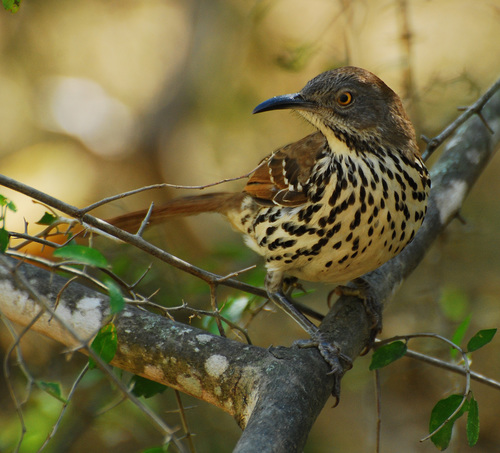
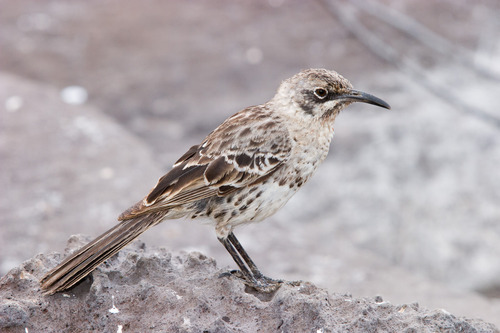
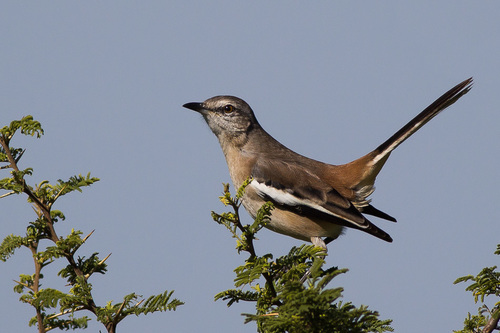
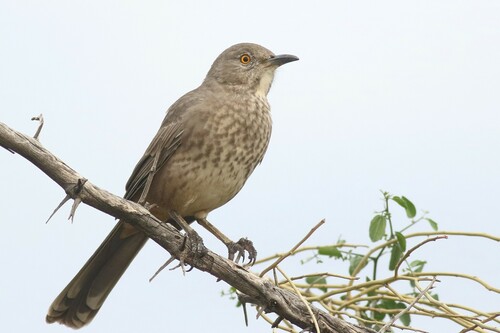
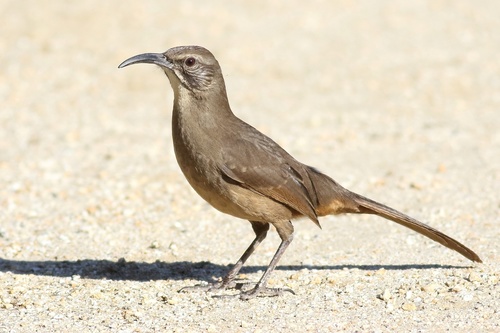
California thrasher (scientific name Toxostoma redivivum (Gambel, 1845)) is the largest thrasher species. It reaches about 32 cm (13 in) in length and can weigh up to 90 g (3.2 oz). It has a distinctive long, decurved beak and a long tail. Its upper body is generally deep grayish brown, with olive tones on the tail. It has a grayish buff supercilium, a dark cheek pattern and dark eye line, and unlike most thrashers, it has dark eyes. The underparts are mostly buffy to tawny brown, while the upper breast and flanks are smoky gray. There are two subspecies, which differ from each other only slightly. The nominate subspecies is distributed from Santa Cruz and Placer counties, California, south into northwestern Baja California, Mexico. The subspecies T. r. sonomae is found from Trinity and adjoining counties in northern California, extending south to the range of the nominate subspecies. There is a slight overlap between the two subspecies' ranges that allows gene flow between them. California thrasher is a year-round resident on both slopes of the California Coast Ranges and the western slope of the Sierra Nevada. It is only rarely seen in the Central Valley between these two mountain ranges. Its primary habitat is chaparral. It also lives in sagebrush, juniper bushland, and riparian and oak woodlands with a dense understory. It is sometimes found in suburban parks and yards that have dense cover. In most areas, it occurs at elevations up to 1,600 m (5,200 ft); in southern California mountains, it can be found as high as 2,000 m (6,600 ft). It primarily inhabits the great interior valleys of California, and forages mainly beneath dense, continuous cover. Around two-thirds of its foraging activity takes place on the ground. Its overall range is notably restricted, and extends only slightly beyond the state of California towards the south. California thrasher occupies a unique ecological niche, with a strong association with dense undergrowth and shrubbery that provides ample foraging opportunities and shelter. Its niche relationships include interactions with other bird species, making it a distinct part of Californian fauna. Its interactions with other bird species and other wildlife within its habitat contribute to the ecological dynamics of the regions it inhabits. Its role as a forager and its territorial behavior affect the distribution and behavior of other species within its habitat.