About Toxostoma lecontei Lawrence, 1851
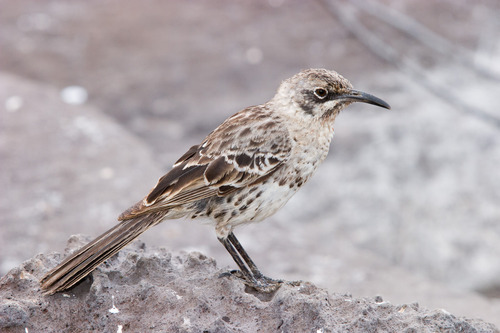
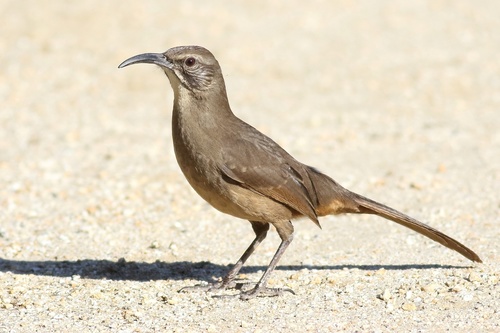
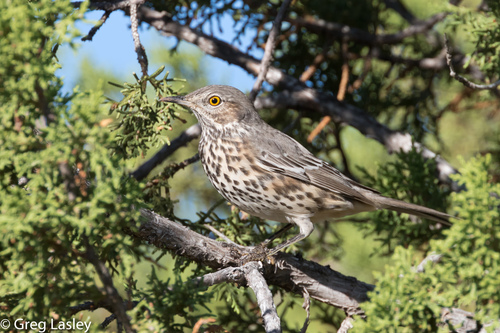
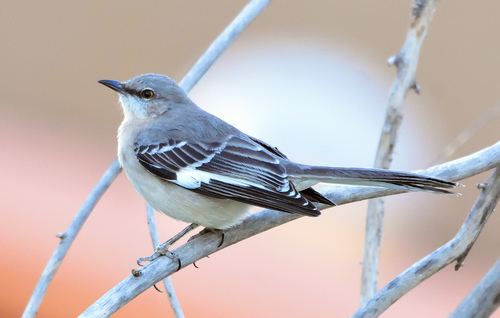
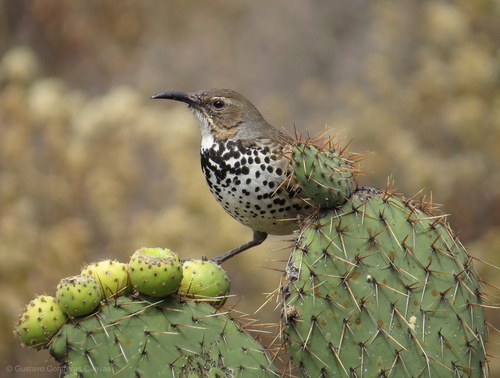
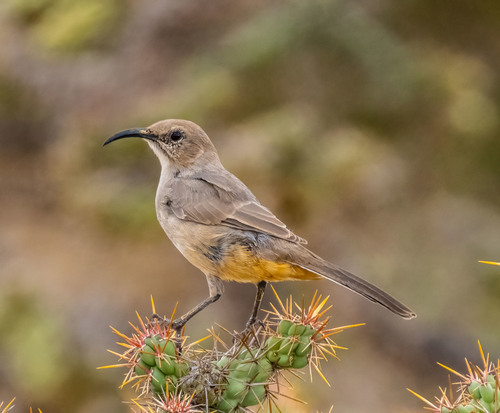
LeConte's thrasher (Toxostoma lecontei Lawrence, 1851) weighs 55 to 75 g (1.9 to 2.6 oz) and measures 24.5–29 cm (9.6–11.4 in) in length. This species shows no sexual dimorphism. Its wings are short and rounded, a typical trait for non-migratory sedentary birds. There are consistent differences in plumage and appearance between recognized subspecies. For the nominate subspecies T. l. lecontei, the crown, back, shoulders, and rump are a pale sandy gray. The primary and secondary flight feathers are grayish brown. The tail feathers (rectrices) are a darker grayish brown, which contrasts with the lighter body plumage. The lores and ear-coverts are mottled gray brown. The throat is off-white, marked with a darker stripe. The chest and belly are pale gray, while the vent and uppertail coverts are a warmer shade that contrasts with the paler underparts. The underwing is a mix of gray and buff. The species has a brown-chestnut iris, a sickle-shaped black bill, and nearly black legs. The subspecies T. l. arenicola has a darker chest and darker overall underparts, and a shorter tail. Juvenile LeConte's thrashers are darker brown than adults, with looser, fluffier feathers, particularly on the vent. This bird is a year-round resident throughout its range, which extends from the San Joaquin Valley in western California through southern Nevada, southwestern Utah, and central and southern Arizona. It lives in some of the harshest climates in this region, including the Sonoran Desert and the San Joaquin Valley, where average annual rainfall is only 4 to 20 cm. Its typical desert habitat includes dunes, alluvial fans, and flat to gently rolling hills with shallow washes and sparse vegetation. It uses low-growing native plants such as saltbush, creosote, cholla cacti, and Mojave yucca. Its elevation range extends from 80 m below sea level in Death Valley up to 1,600 m, with an average altitude of 500 m above sea level. It does not generally share habitat with other thrasher species, but its breeding range and general habitat overlap with the California thrasher in the higher desert regions of its range. Populations of LeConte's thrasher have declined in certain parts of its range, most notably the Coachella Valley, Imperial Valley, and San Joaquin Valley regions. Major causes of this decline include urbanization, land cultivation for livestock, oil and gas development, and increased fire linked to the spread of invasive grass species. Off-road vehicle use is a minor contributing factor. Impacts from military operations in the region have been proposed as a potential threat, but have not been properly researched. Notably, there are large areas of suitable habitat that are currently unused by the species, and populations in undisturbed regions remain relatively stable. While LeConte's thrasher has a small total global population for a passerine bird, and is listed as a species of concern within the state of California, its overall large range leads to its current global conservation status of least concern.