About Toxostoma curvirostre (Swainson, 1827)
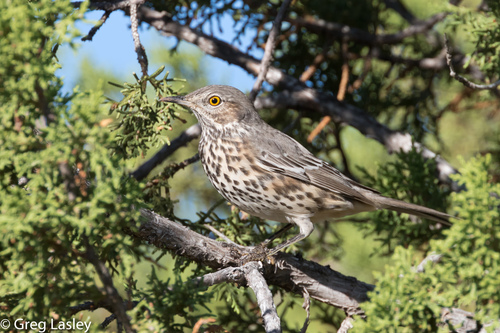
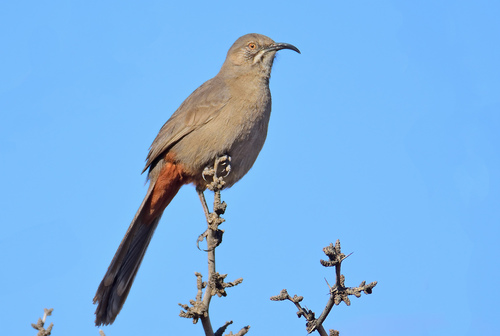
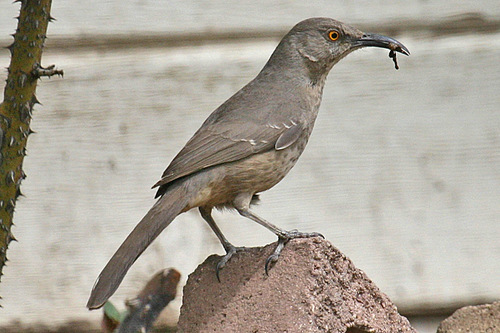
The curve-billed thrasher, with the scientific name Toxostoma curvirostre (Swainson, 1827), is immediately identifiable as a thrasher by its long tail and short wings. It is also known for its sickle-shaped, brownish black bill, which is almost as long as the width of its head. This species has a compact body with a large head, short wings, and a long tail, though the tail is shorter than that of most other thrasher species. Its chest is grayish brown with circular brown-gray spots, and its eyes are generally orange, darkening to golden as the bird reaches adulthood. Juvenile curve-billed thrashers lack pale tips on their rectrices, have unkempt abdominal feathers, and show a rufous wash across their upper parts and chest. Subspecies of Toxostoma curvirostre vary noticeably in physical traits. The eastern subspecies has more distinct chest spots, more white along the rectrice tips, and clearly visible wing bars. T. c. palmeri has paler chest spotting, paler rectrice tips, and less obvious wing bars. T. c. curvirostre has longer wings and tail than T. c. oberholseri, while T. c. insularum is paler and grayer than T. c. palmeri and has more visible spotting on its breast. A 2003 study proposed that the speciation of the curve-billed thrasher was driven by climate, a pattern that can be explained by differences in molt and feather wear. The same study also suggested that the Sierra Madre Occidental acts as a geographic barrier that triggers intraspecific differentiation.
Standard measurements for the species are: length 10.6–11.0 in (27–28 cm), weight 2.1–3.3 oz (60–94 g), wingspan 13.4–13.6 in (34–35 cm).
The curve-billed thrasher is widespread across the southwestern United States, ranging from Arizona's Sonoran Desert across New Mexico to west Texas, and also reaching southeastern Colorado and southwestern Kansas. It also occupies most of Mexico, from the Sonoran-Chihuahuan Deserts south through the Mexican Plateau into Central Tamaulipas, inland to Oaxaca, and along the Pacific coast from Sonora to Nayarit. Vagrant individuals have been recorded in states adjacent to its core range, and as far north as North Dakota, Alberta, and Manitoba, and as far east as Florida. T. c. palmeri vagrants have been observed in Florida, while T. c. curvirostre vagrants have been recorded in Iowa multiple times. Outside of these rare occurrences, the species is essentially non-vagrant.
Compared to other desert thrasher species, the curve-billed thrasher is less selective about its habitat, and can be found from sea level up to 3,000 m (9,800 ft) in elevation. It most commonly lives in areas where cholla and saguaro cacti, ocotillo, mesquites, palo verde, and creosote bushes are abundant. It can also be found along woodland edges, in piñon woodland, dry desert shrubland, and any area within its range that supports cacti. If sufficient desert vegetation is present near human settlements, along with access to bird feeders, the curve-billed thrasher can adapt successfully to these human-altered environments.
In terms of behavior and ecology, the curve-billed thrasher is usually seen running quickly between patches of cover, or flying low to the ground from bush to bush. Despite this preference for cover, the species is not shy about foraging or resting in open areas. It generally forages on the ground, but it can be very aggressive when chasing away potential food competitors at bird feeders, including species like the Inca dove and round-tailed ground squirrel.