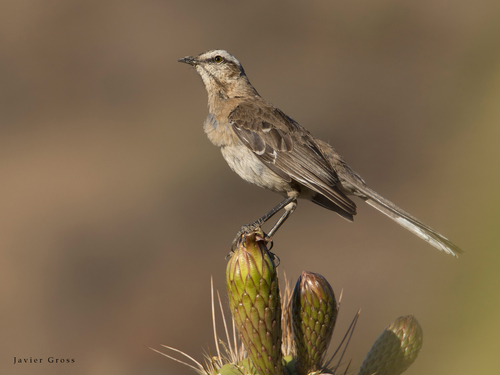
About Toxostoma bendirei (Coues, 1873)
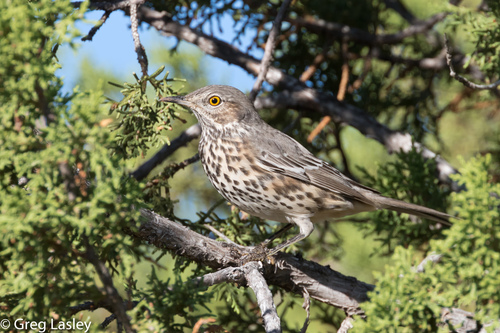
Identification: Bendire's thrasher (Toxostoma bendirei) is often confused with the curve-billed thrasher because the two species share similar coloration and body structure. When comparing mature individuals, Bendire's thrasher can be easily distinguished by its shorter bill. However, adult Bendire's thrashers can still be misidentified as young curve-billed thrashers, since young curve-billed thrashers have not yet grown their full mature beak length. Two additional marking features help separate Bendire's thrasher from curve-billed thrasher: its yellow eyes and pale base on the lower mandible. Distribution and habitat: Bendire's thrasher inhabits brushy deserts, valleys, and drylands in the southwestern United States. It occurs mainly along the shared southern border of Arizona, New Mexico, and Mexico, including the Madrean sky islands — the sky island mountain ranges of the northern Mexican Sierra Madre Occidental. This species is classified as polytypic, with two recognized subspecies in addition to the nominate form. The nominate subspecies Toxostoma bendirei (Coues, 1873) is found in Arizona, New Mexico, Colorado, Nevada, Utah, and California in the United States, and in Sonora, Sinaloa, and Baja California in Mexico. The subspecies Toxostoma bendirei candidum van Rossem, 1942 occurs in the desert of western Mexico, in western Sonora. The subspecies Toxostoma bendirei rubricatum van Rossem, 1942 occurs in the interior of southern and central Sonora, and in coastal areas near Isla Tiburón. There is also a 1988 documented record of this species from Alberta, Canada, supported by a photograph of the individual.