About Toxopneustes pileolus (Lamarck, 1816)
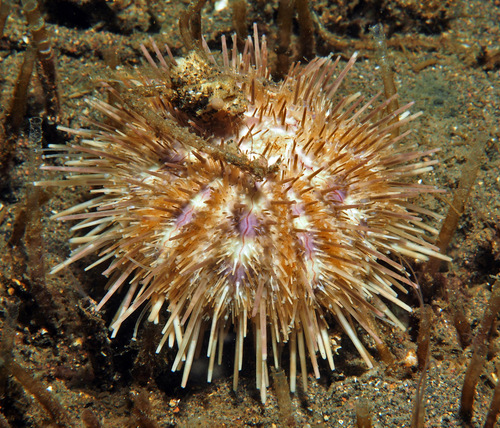
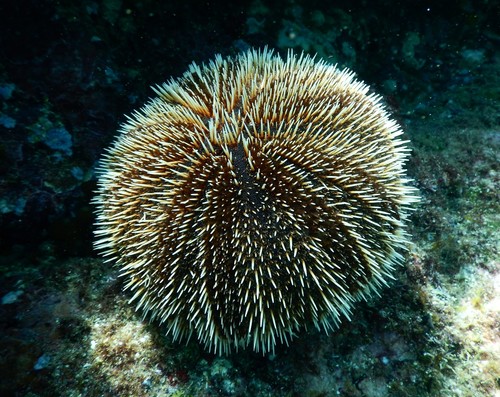
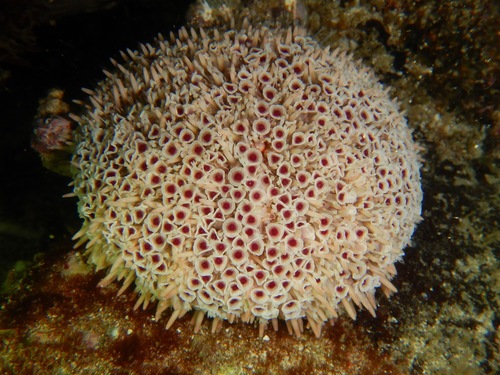
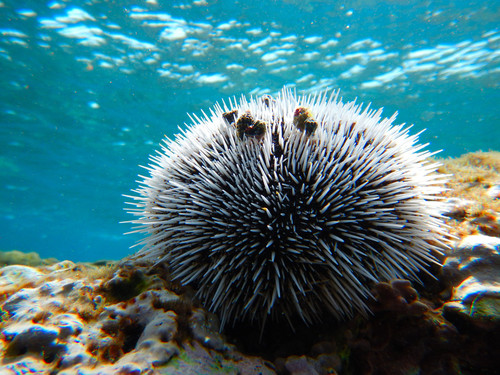
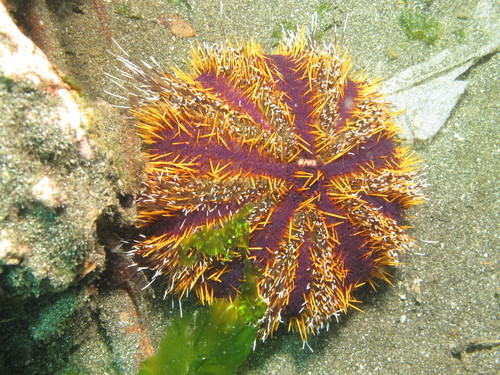
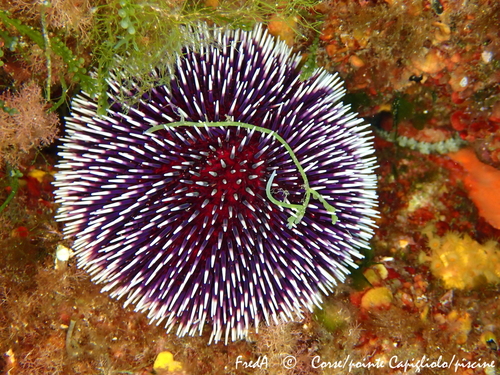
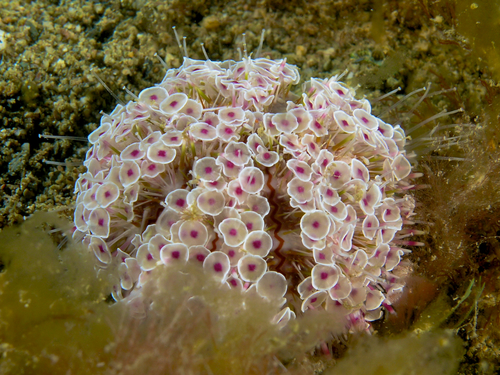
Toxopneustes pileolus, commonly known as the flower urchin, is a relatively large sea urchin. It can reach a maximum diameter of around 15 to 20 cm (6 to 8 in). Like most echinoderms, adult flower urchins have pentaradial symmetry: their body is split into identical segments arranged around a central axis, in multiples of five. Its rigid "shell", called a test, is made up of five interambulacral segments separated by five ambulacral segments. Each segment is composed of smaller, regularly interlocking plates, and covered by a thin layer of skin in living individuals. The test has a variegated color pattern, most often deep red and grey, though rare individuals may be green or pale purple. Each ambulacral segment has a large purple zigzag pattern running along its entire length. Two rows of tube feet emerge from grooves on either side of each ambulacral segment, for a total of ten rows overall. Each individual tube foot consists of a thin muscular stalk called a podia, tipped with a small suction cup called an ampulla. The mouth is located in the center of the bottom (oral) surface of the test. It is surrounded by a ring of small plates covered by softer tissue, known as the peristome. Five calcareous "teeth", collectively called Aristotle's lantern, are embedded in the peristome, and these are used to grind the urchin's food. The anus is positioned on the upper (aboral) surface of the test, directly opposite the mouth. Like the mouth, it is surrounded by a ring of small plates called the periproct. Five smaller genital pores that connect directly to the gonads inside the body cavity surround the anal opening. The most noticeable feature of flower urchins is their pedicellariae: stalked, grasping appendages. Flower urchins have four types of pedicellariae, distinguished by shape and function, but only two are abundant. The first abundant type are ophicephalous pedicellariae. These resemble tube feet, but end in three small claws called valves instead of suction cups. Their role is to clear algae, encrusting organisms, and unwanted debris from the urchin's body surface. The second abundant type are globiferous pedicellariae, which look superficially like flowers, giving the species its common name. These are more specialized, and are used for defense against predators and larger ectoparasites. Like ophicephalous pedicellariae, globiferous pedicellariae also end in a three-valved claw-like grasping appendage, but they are much larger. The valves are connected to each other by a distinct circular membrane around 4 to 5 mm (0.16 to 0.20 in) in diameter. They range from pinkish-white to yellowish-white in color, with a central purple dot and a bright white rim. Each valve ends in a sharp fang-like tip that can penetrate human skin. Venom glands are located at the base of the valves. Some authors further split globiferous pedicellariae into two subtypes based on size: trumpet pedicellariae and giant pedicellariae. The other two pedicellariae types — tridentate and triphyllous — are rare, or only found on specific areas of the test. The urchin's spines are relatively short and blunt, and are usually hidden underneath the flower-like pedicellariae. They can be white, pink, yellow, light green, or purple, with lighter-colored tips. Unlike most other venomous sea urchins, flower urchins and related toxopneustids do not deliver venom through their spines. Instead, venom is injected via the flower-like globiferous pedicellariae. When undisturbed, the tips of the globiferous pedicellariae are usually expanded into round cup-like shapes. They have tiny sensors on their inner surfaces that can detect threats via touch and chemical stimuli. When agitated or brushed against by a potential threat, the pedicellariae immediately snap shut and inject venom. The pedicellariae claws may also break off from their stalks and stick to the point of contact, and can continue injecting venom for several hours. The potency of the venom from pedicellariae is thought to be directly related to the size of the pedicellaria. This means individuals with larger globiferous pedicellariae are considered more dangerous than individuals with more numerous but smaller globiferous pedicellariae. Flower urchins are widespread and common in the tropical Indo-West Pacific. Their range extends north to Okinawa, Japan, and south to Tasmania, Australia; and west to the Red Sea and the East African coast, and east to Rarotonga in the Cook Islands. In Mexican Pacific waters, flower urchins are found everywhere except in waters north of Guerrero Negro (Bahia Tortugas), Baja California, along the central and northwest coasts of Baja. Different Toxopneustes species have similar appearances and are often misidentified, but can be told apart by coloration and geographic range. Toxopneustes roseus has uniformly pink, brown, or purple tests, and is restricted to the East Pacific, so it is not found in the same range as flower urchins. Toxopneustes elegans, which is only found around Japan, can be distinguished by a distinctive dark stripe just below the tips of its spines. Toxopneustes maculatus is a very rare species, only known from specimens collected from Réunion, Christmas Island, and the Palmyra Atoll. It can be identified by bright violet coloration on the bottom of its test and in a band around the middle of its test. T. pileolus inhabits coral reefs, coral rubble, rocks, sand, and seagrass beds at depths of 0 to 90 m (0 to 295 ft) below the water's surface. It may sometimes partially bury itself in the substrate. Flower urchins feed on algae, bryozoans, and organic detritus, and have few natural predators. They are known to be toxic to fish. One of the few organisms that can consume flower urchins without apparent adverse effects is the predatory corallimorph Paracorynactis hoplites, though it is unknown if flower urchins are among its natural prey. Flower urchins are dioecious, meaning they have separate male and female individuals, but it is nearly impossible to tell an individual's sex from external characteristics alone. Examining the external shape of the genital pores (gonopores) is one proposed method: in males, gonopores are generally short, cone-shaped, and protrude above the body surface, while in females they are usually sunken. However, this method is not reliable, as it gives the wrong result in around 15% of cases. All other external features, including test shape and size and spine color, are identical between the two sexes. Flower urchins have a diploid chromosome number of 2n = 42. Relatively little is known about the spawning behavior of flower urchins. Like other sea urchins, fertilization is external. Males and females release free-swimming gametes (eggs and sperm) directly into water currents during mass spawning events. A 1994 study in Okinawa, Japan found that flower urchin spawning season occurs in winter, at the same time as the closely related sympatric species Toxopneustes elegans. The study also recorded possible natural hybrids that form when eggs of Toxopneustes pileolus are fertilized by sperm of Toxopneustes elegans. A 2010 study in Taiwan observed flower urchin spawning in May during 2007 and 2009. Both spawning events occurred under very similar conditions: during afternoon low tide of the spring tide immediately after a new moon. During spawning, individuals remove debris that usually covers their bodies before releasing gametes into the water. A 2013 study of southern Taiwan flower urchin populations did not find an obvious link between lunar or tidal cycles and mass spawning behavior. The study noted that spawning patterns appeared non-random, with higher spawning rates during daytime on certain dates, though the study was only conducted over five months, from April to August 2010. In Okinawa, fishermen observed large numbers of the predatory crown-of-thorns starfish (Acanthaster planci) gathering around remains of the internal organs of flower urchins. A 2001 follow-up study by Japanese researchers confirmed that flower urchin viscera can attract crown-of-thorns starfish in both aquarium and open sea experiments. The attractant compounds were isolated and identified as arachidonic acid and α-linolenic acid. The study authors suggest this discovery may be used to improve population control measures for the crown-of-thorns starfish, which is highly destructive to coral reefs.