About Toxonevra muliebris (Harris, 1780)
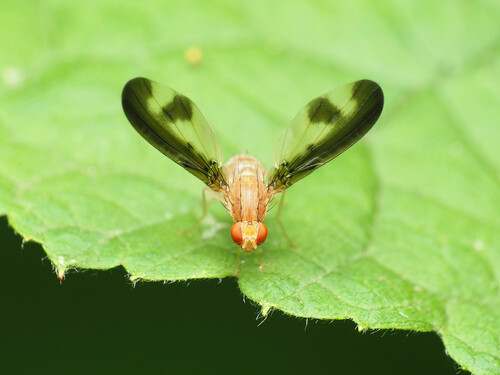
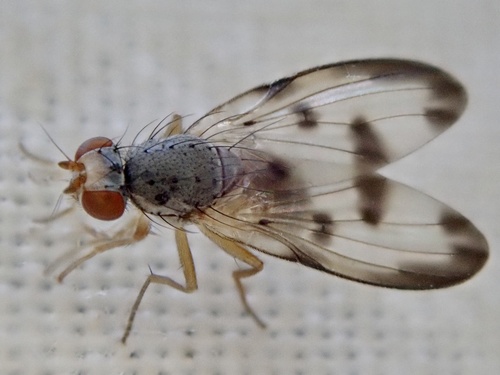
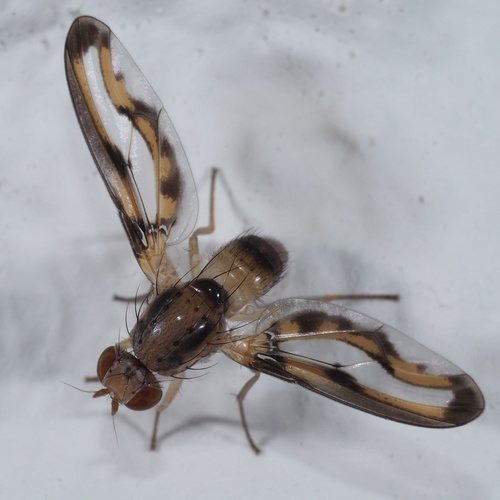
Morris originally described this species as measuring two lines long. The head, thorax, abdomen, and legs are a light, pleasing pale brown. The wings are clear, marked with two moderately wide brown stripes that run from the apex to the shoulder; one stripe sits along the sector edge, and the other passes through the center of the wing. This is a scarce attractive fly that vibrates its wings while walking, similar to the Vibrans, and is not easily scared away. The wing pattern of adult Toxonevra muliebris is distinctive, and acts as a diagnostic feature for identifying the species. This species is native to Europe, where it has been recorded in Spain, Italy, Austria, France, Belgium, Great Britain, and Ireland. It has recently been observed and collected in North America. Larvae of this species have been found under tree bark, and researchers have hypothesised that they feed on beetle larvae. In North America, adult Toxonevra muliebris have also been found inside residential homes. It has been proposed that this occurs because T. muliebris larvae prefer to prey on carpet beetle larvae, a common household pest in North America.