About Toxomerus geminatus Say, 1823
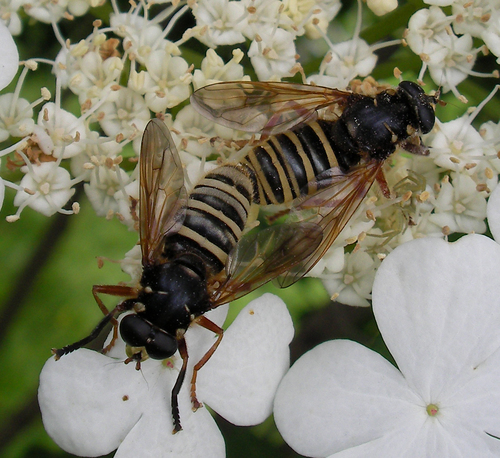
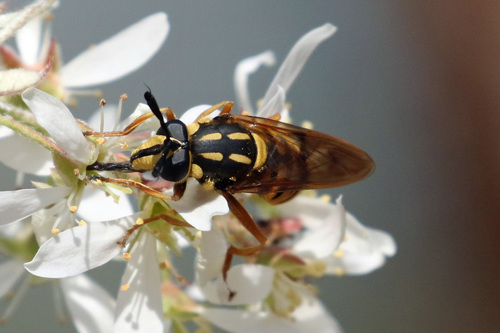
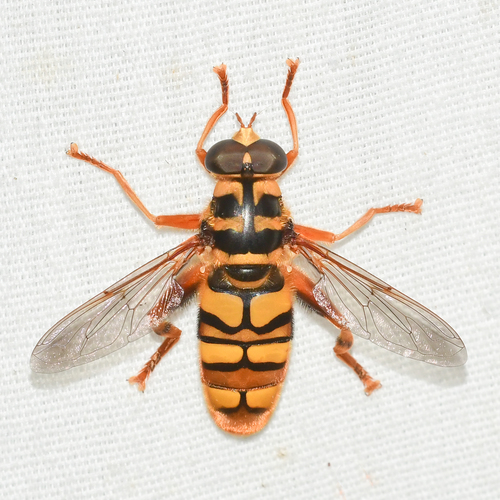
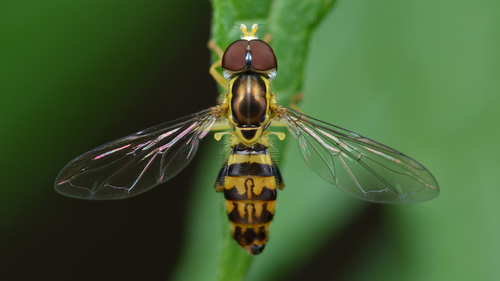
This description follows terminology from Speight's key to genera and associated glossary. Toxomerus geminatus ranges in length from 5–7.6 mm (0.20–0.30 in). For the head: the face, frontal triangle, and antennae are light yellow, with white pollen covering the sides of the face. Antennae can sometimes be slightly brownish. In females, the front is much narrower toward the top, is shining black, and has a narrow yellow line along the sides of its lower half. Posterior orbits are thickly covered in whitish dust, and the eye has a clear triangular notch on its posterior margin at or above the level of the antennae. For the thorax: the scutum is shining black, marked with opaque linear stripes. Lateral stripes are entirely yellow; the median stripe is ashy gray (cinereous) and only moderately distinct, with a faint gray submedian stripe present. The disc of the scutum is slightly brownish and pruinose. The scutellum has a black disc and a broad yellow margin. The pleurae are shining greenish black, with an oval yellow spot on the meso-pleurae, and a smaller, more whitish spot positioned below this yellow spot, with the two narrowly separated. The propleuron and anepimeron are entirely black, and the hairs on the female's anterior anepisternum are extremely short, barely discernible. The wings are nearly clear (hyaline) with mostly black veins. For the legs: most legs are yellow, except the hind femora which are black beyond the base; this black marking covers less area in females, often only appearing as a brown ring. Hind tibiae have two faint brown rings, and hind tarsi are brownish. The front and middle coxae are mostly or entirely black, while the hind coxae are yellow. For the abdomen: the female abdomen is broadly flattened and oval, widest at the tip of the third abdominal segment. It is typically shining black with yellow markings following this pattern: the first segment has a black band at its base; the second segment has a narrow median crossband, narrowed in the center and interrupted. The third and fourth segments have a slender median stripe that widens toward the front, plus a pair of large spots on the anterior margin that are expanded toward the back at their outer ends. The fourth segment has a rather deep notch along each side of its posterior margin, with rounded ends that extend backward. The fifth segment has yellow anterior angles, and sometimes has two projections extending from the anterior margin near its middle. The hypopygium is reddish yellow, with its upper half shining black. Some specimen variation exists: the yellow cross-band on the second segment may be restricted to a small spot on each side, or may be entirely absent; the median stripe on the third and fourth segments may be completely absent, leaving only four small anterior spots on the fourth segment. The yellow spots on the anterior angles of the fifth segment may be very small, and the hypopygium may be almost entirely black. The front and middle legs are also most often black.