About Toxicoscordion venenosum (S.Watson) Rydb.
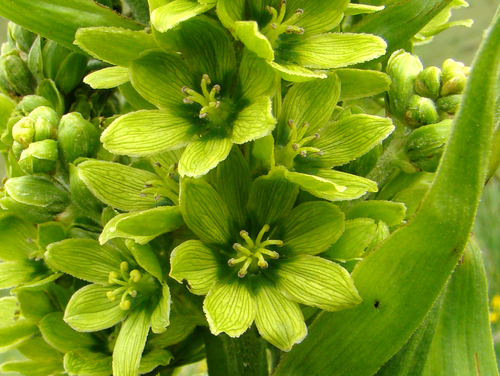
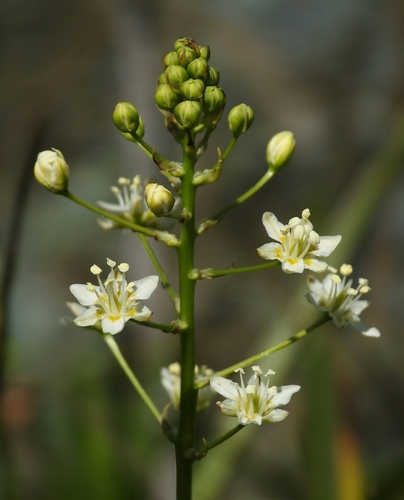
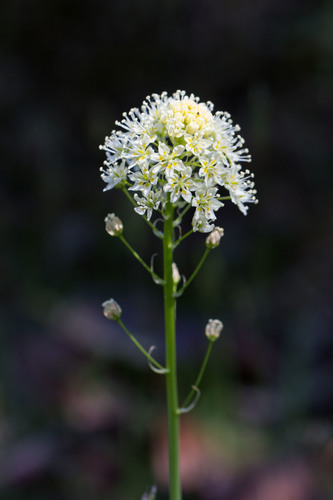
Toxicoscordion venenosum, also known as meadow death camas, is a bulb-bearing plant that reaches 20–70 centimeters (8–27+1⁄2 inches) in height when it flowers in spring or early summer. Its underground bulbs are ovoid (egg-shaped) and tunicate, formed from multiple layers and protected by dried outer layers similar to an onion. The plant produces narrow leaves very early in spring; most leaves are basal, growing directly from the ground, while just a few much smaller leaves grow attached to the flowering stem. Leaf blades measure 12–50 cm (4+1⁄2–19+1⁄2 in) in length and only 2–10 millimeters (1⁄8–3⁄8 in) in width. Unlike wild onion leaves, these leaves are sharply folded into a V-shape along their entire length, with a keel (a ridge at the bottom of the fold).
Meadow death camas is distributed across much of western North America. In Canada, it grows in the three western provinces: Alberta, British Columbia, and Saskatchewan. In the United States, it occurs from the West Coast to the Rocky Mountains, with the exception of Arizona; this range includes California, Colorado, Idaho, Montana, Nebraska, Nevada, New Mexico, North Dakota, Oregon, South Dakota, Utah, Washington, and Wyoming. It also grows in the Mexican state of Baja California. This species favors open, sunny habitats. The nominate variety T. venenosum var. venenosum grows in interior grasslands and open pine woodlands at elevations from 500 to 1,300 meters (1,600 to 4,300 feet). T. venenosum var. gramineum grows in well-drained grasslands and coastal areas from sea level up to 2,500 m (8,200 ft). Meadow death camas prefers wet areas, but can grow in much drier habitats than the related common camas (Camassia quamash), including hillsides in the Sierra Nevada. It can also be found in coniferous forest openings and among interior sagebrush.
The nectar of Toxicoscordion venenosum is poisonous. Controlled experiments have confirmed that honeybees can be fatally poisoned by its flowers, and this species or its close relatives are suspected of causing a small number of honeybee poisonings. The only bee known to tolerate the plant's toxins is a specialist mining bee, the death camas miner bee (Andrena astragali). This bee is an oligolege, meaning it specializes in feeding on pollen from only a few flower species: it specifically relies on meadow death camas and the closely related Toxicoscordion paniculatum. Bee visits to meadow death camas flowers significantly increase the plant's seed production. Researchers have theorized that the specialization and toxin tolerance of the death camas miner bee provides two main advantages: the bees face little competition for the food resources provided by the flowers, and like monarch butterflies, ingesting the plant's toxins makes the bees toxic, protecting them from predators and parasites. Though the death camas miner bee is the only bee that feeds on meadow death camas flowers, a fly species, Earomyia melnickae, was described in 2022 after being discovered feeding on the plant's flowers. As of 2024, it is unknown what larval host the fly uses or where its larvae feed. Extensive searches of the bulbs in the area where the adult flies were found found no signs of larval feeding or larvae. It is also unknown whether this fly contributes to pollinating meadow death camas at all. As a bulb plant, meadow death camas survives fires easily. Actively growing aboveground portions of the plant may be consumed by fire, but the underground bulb survives and regrows. Dormant bulbs appear to be completely unaffected by fire. This species grows across a wide range of fire regimes, from habitats with more than 400 years between fires to some ponderosa pine forests with fires as frequent as once per year.
Toxicoscordion venenosum has a well-earned reputation as a poisonous plant. Its main toxic compound is the alkaloid zygacine, and other esters of zygadenine develop in the plant as seed pods ripen. While the plant is not easily confused with other species when in bloom, its bulbs can easily be mistaken for edible bulbs such as those of the camas lily in the Pacific Northwest after leaves and flowering stems have faded. As few as two meadow death camas bulbs are enough to kill a fully grown human, and the plant's poisons are not broken down by cooking. Toxins remain stable when dried and stored, and collected bulbs can remain toxic for up to two decades after collection. The seeds and bulbs are the most toxic parts of the plant. A person who survived poisoning reported "My mouth got tingly, and later the sensation moved down my throat." Human poisonings are rare. Poisoning produces a range of symptoms: the first symptom is increased mouth watering, followed by numbness of the lips and mouth. Other gastric symptoms include thirst, nausea, stomach pain, vomiting, and diarrhea. Circulatory, nervous, and muscular symptoms may include headache, muscular weakness, confusion, slow and/or irregular heartbeat, low blood pressure, below-normal body temperature, difficulty breathing, convulsions, or coma. In severe cases, coma can lead to death. Symptoms begin between one and eight hours after consumption. A number of edible bulb species are commonly mistaken for meadow death camas, including blue camas, wild onions, and mariposa lily. The plant is also deadly to livestock, with sheep most commonly poisoned. Pigs are reported to vomit after consuming the plant and avoid fatal poisoning. The lethal dose of green plant material is between 0.6% and 6.0% of an animal's body weight. In experiments with sheep, T. venenosum ranked among the most poisonous species in its genus: just 0.4% of green plant material by body weight caused symptoms, close to the 0.2% lethal dose for Toxicoscordion nuttallii. Material from T. venenosum var. gramineum was almost equally fatal at 0.6% body weight, compared to 0.5% for T. nuttallii. Zygacine levels in the plant decrease as the plant develops toward flowering. Plants growing in dry locations, and in years with lower rainfall, tend to have higher poison levels.
Though indigenous Paiute people were well aware of the plant's poisonous nature, they used crushed bulbs as an external poultice for a range of ailments, in the same manner they used the closely related Toxicoscordion paniculatum (which they called by the same name). Poultices were used to treat burns, rattlesnake bites, rheumatism, and swellings. Naturalist Ira Noel Gabrielson ruled out this species and all of its relatives except Toxicoscordion fremontii as suitable garden plants, writing that they lacked "charm enough to take up room in a garden when so many more beautiful things are available". Despite this assessment, the species is occasionally grown in wildflower meadows or perennial borders for its spring flowers, and grows well in either full sun or partial shade. Due to the toxic nature of this species and all its relatives, gardeners are urged to use caution and avoid planting it where herbivores can access it. The Royal Horticultural Society's Manual of Bulbs lists the species as tolerating winter temperatures down to at least −15 °C (5 °F), and it is hardy in USDA zones 3b–9b.