About Toxicoscordion paniculatum (Nutt.) Rydb.
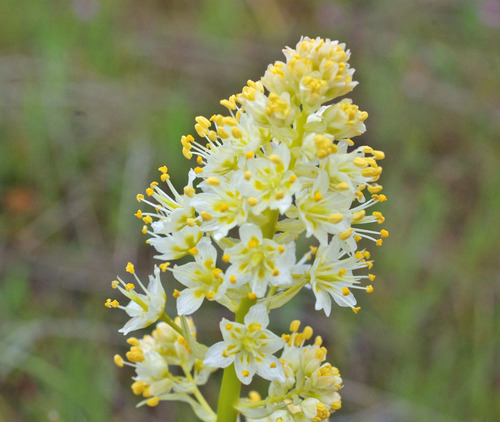
Toxicoscordion paniculatum, also called foothill death camas, is a flowering bulb plant that reaches 20–70 centimeters (8–28 inches) in height when blooming. Its bulbs are egg-shaped, measuring 1.8–4 centimeters in height and 1.2–3.5 centimeters in width. The bulbs are layered, do not grow in clumps, and are covered by a persistent papery coat that ranges from dark brown to black. Most leaves are basal, growing directly from the plant’s base at soil level, though some attach to the lower section of the flowering stem. Lower leaves are larger, 15–40 cm long and only 5–15 mm wide. Botanically, the leaves sheath the stem, and are arranged in three groups around the plant’s central axis. Flowers are densely packed on a panicle, an inflorescence that in this species has at least two branches below the main cluster of flowers. Total flower and bud counts range from ten to eighty. The flowers form a flattened, very open bell shape, and are colored white to light yellow-white. Each flower has six tepals: the outer three are broadly egg-shaped, with no claw or only a barely noticeable claw. The inner three are more spear-head shaped, 4–5 mm long with a claw less than 1 mm long. The small glands at the base of the tepals are somewhat heart-shaped and green. The six stamens are bright orange, and equal in length or slightly longer than the tepals. Flowering can start as early as April, with the last plants finishing blooming by the end of June. The fruit is a dry three-chambered capsule, measuring 5–20 millimeters long and 3–8 mm wide. While flowering arranged in a panicle is often used to distinguish Toxicoscordion paniculatum from closely related Toxicoscordion venenosum, Charles Leo Hitchcock and co-authors note in *Vascular plants of the Pacific Northwest* that more reliable distinguishing traits are the species’ more pointed tepals, and its production of both bisexual and unisexual flowers on the same plant.
This species grows in every state of the contiguous United States from the Rocky Mountains westward, and also extends into northern Mexico. In Colorado and New Mexico, it occurs almost entirely west of the Rocky Mountains, and only grows in a small number of scattered, isolated populations in Montana. West of the Rockies, it grows in every county of Utah and Nevada, and is mostly found in southern Idaho. It occurs in the drier eastern regions of both Washington and Oregon. In California, it is widespread in inland areas of the Northern Coast Ranges and Klamath Mountains north of San Francisco Bay, and grows throughout the Sierra Nevadas from the northern to southern end of the range. It is only found in the northern part of Arizona. In Mexico, it occurs in the states of Chihuahua and Sonora. Foothill death camas is a widespread but uncommon species. It is normally found scattered across landscapes, but sometimes grows in dense colonies. It most often grows on well-drained sites with sandy, gravelly, or rocky soils, but can also be found in wet loam or dry clay soils. It grows in open, seasonally dry areas, including ponderosa pine forests, small clearings within lodgepole pine stands, and sagebrush steppes. It generally occurs at lower elevations than Anticlea elegans.
The most frequent visitor to its flowers is the death camas bee; in some locations, it is also frequently visited by the bee-mimicking black-footed drone fly.
Toxicoscordion paniculatum is well known for its poisonous properties across the western United States. All parts of the plant are poisonous, and people have even been poisoned from consuming its flowers. The bulb is the most toxic part of the plant. Humans who have mistaken these bulbs for wild onions or camas bulbs and eaten them have suffered fatal poisonings. In 2003, eight people who misidentified the bulbs as those of the edible sego lily (Calochortus nuttallii) were poisoned in Juab County, Utah; six of these people required hospitalization for serious symptoms. Horses and cattle typically avoid the plant, so they are poisoned less often than sheep. Animals are most often poisoned when grazing pastures that contain foothill death camas early in spring, before other plants have leafed out.
Though indigenous peoples including the Shoshone, Paiute, and Washoe were well aware of the plant’s poisonous nature, they used crushed raw bulbs as a poultice to treat a range of ailments including rheumatism, sprains, limping, neuralgia, toothache, and swellings. The Paiute used this species interchangeably with Toxicoscordion venenosum, calling both species by the same name.
This species is occasionally cultivated for its early spring blooming flowers. It is grown in well-draining locations that are somewhat wet during the spring. It tolerates dry conditions, so it is preferred for naturalizing in dry climates. It can also be grown mixed with other bulb plants in perennial border gardens, and is hardy in USDA zones 3b–9b.