About Toxicodendron radicans (L.) Kuntze
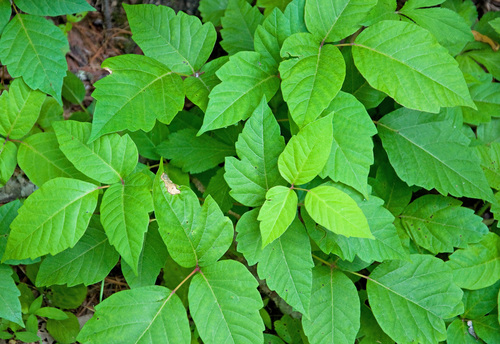
Toxicodendron radicans (L.) Kuntze, commonly known as poison ivy, has numerous recognized subspecies and/or varieties. All growth forms of this species have woody stems, and it can grow in three distinct forms: a climbing vine that attaches to trees or other supports, an upright shrub reaching up to 1.2 metres (4 feet) tall, or a short trailing vine 10–25 centimetres (4–10 inches) long. Its deciduous leaves are trifoliate, with three almond-shaped leaflets. Leaf color ranges from light green (most common in young leaves) to dark green when mature, and turns red, orange, or yellow in autumn; some sources note newly expanding leaves are also reddish before darkening to green. Leaflets are typically 3–12 cm (1+1⁄4–4+3⁄4 in) long, rarely growing up to 30 cm (12 in), and develop a slight shine at maturity. Each leaflet has few to no teeth along its edge, and the leaf surface is smooth. Clusters of leaflets grow in an alternate arrangement along the vine, and the plant has no thorns. Vines climbing on tree trunks attach firmly via numerous aerial rootlets. The species produces adventitious roots, and can also spread via rhizomes or root crowns. Its milky sap darkens after exposure to air. T. radicans reproduces both vegetatively and sexually, and is dioecious. Flowering occurs from May to July; the yellowish- or greenish-white flowers are typically inconspicuous, and grow in clusters located up to 8 cm (3 in) above the leaves. Its fruit is a berry-like drupe that matures between August and November, and is grayish-white in color. Four key characteristics are sufficient to identify poison ivy in most situations: clusters of three leaflets, alternate leaf arrangement, lack of thorns, and each group of three leaflets grows on its own stem connecting to the main vine, with the middle leaflet's stem being longer. The appearance of poison ivy can vary widely between different environments, and even within a single large area. Identification by even experienced people is often complicated by leaf damage, the plant's leafless state in winter, and unusual growth forms caused by environmental or genetic factors. Several mnemonic rhymes are used to remember poison ivy's key identifying features. The best-known and most useful is "Leaves of three, let it be", which applies to both poison ivy and poison oak, though some harmless non-toxic plants also have similar leaf arrangements. Other common rhymes include "Hairy vine, no friend of mine", "Berries white, run in fright", and "Berries white, danger in sight". T. radicans grows across most of North America. Its range includes the Canadian Maritime provinces, Quebec, and Ontario, all US states east of the Rocky Mountains, and mountainous areas of Mexico up to around 1,500 m (4,900 ft). It is most commonly found in wooded areas, particularly along edge habitats where tree cover opens to let in sunlight. It also grows in exposed rocky areas, open fields, and disturbed areas, and can grow as a forest understory plant, though it is only moderately shade-tolerant. It is extremely common in suburban and exurban areas of New England, the Mid-Atlantic, and the Southeastern United States. Similar related species occupy other regions: T. diversilobum (western poison oak) and T. rydbergii (western poison ivy) are found in western North America, while T. orientale occurs in Taiwan, Japan, Korea, and Sakhalin. T. radicans rarely grows at altitudes above 1,500 m (4,900 ft), though the upper altitude limit varies by location. When growing as a groundcover it reaches 10–25 cm (4–10 in) high, when growing as a shrub it reaches around 1.2 m (4 ft) tall, and when growing as a climbing vine it ascends various supports. Older vines growing on large supports produce lateral branches that can be mistaken for tree limbs at first glance. T. radicans grows in a wide range of soil types, tolerating soil pH from 6.0 (acidic) to 7.9 (moderately alkaline). It is not particularly sensitive to soil moisture, though it does not grow in desert or arid conditions. It can grow in areas that experience seasonal flooding, and can tolerate brackish water. It is more abundant now than it was when Europeans first arrived in North America. Real estate development adjacent to undeveloped wild land creates "edge effects" that allow poison ivy to form large, lush colonies in these areas. It is classified as a noxious weed in the US states of Minnesota and Michigan, and in the Canadian province of Ontario. Poison ivy is particularly sensitive to atmospheric carbon dioxide levels, and benefits greatly from higher atmospheric concentrations. Higher carbon dioxide levels increase the plant's growth rate, and cause it to produce more unsaturated urushiol, which triggers stronger allergic reactions in humans. Poison ivy's overall growth and urushiol potency have already doubled since the 1960s, and could double again once atmospheric carbon dioxide levels reach 560 ppm. The fruits of T. radicans are a favorite winter food source for some birds and other animals, including wild turkeys. Seeds are spread primarily by animals, and remain viable after passing through an animal's digestive tract. Birds may also spread seeds via regurgitation. Contact with urushiol from poison ivy causes an allergic reaction called urushiol-induced contact dermatitis. In extreme cases, the reaction can progress to anaphylaxis. Around 15 to 25 percent of people have no allergic reaction to urushiol, but most people experience stronger reactions with repeated or more concentrated exposure. The rash caused by urushiol oil typically lasts five to twelve days, but may last a month or longer in extreme cases. Over 350,000 people are affected by urushiol exposure annually in the United States. The allergic reaction is caused by pentadecyl catechols in the oleoresin found in the plant's sap; the mixture of pentadecylcatechols produced by the plant is collectively called urushiol. After the plant is injured, sap leaks to the plant's surface, where urushiol oxidizes and turns into a blackish lacquer. When urushiol contacts skin it binds to the skin surface, causing severe itching that develops into reddish inflammation, non-colored bumps, and then blistering. These lesions can be treated with Calamine lotion, Burow's solution compresses, dedicated commercial poison ivy itch creams, or therapeutic baths to relieve discomfort, though recent studies have found some traditional treatments to be ineffective. Dermatologists recommend over-the-counter itching products, or simple home remedies like oatmeal baths and baking soda, for poison ivy treatment. Jewelweed is often cited as a plant-based remedy for urushiol-induced contact dermatitis, but jewelweed extracts have shown no positive effect in clinical studies. Many argue that preventing lesions is straightforward: effective washing with plain soap, scrubbing with a washcloth, and rinsing three times within 2–8 hours of exposure stops urushiol from causing a reaction. Oozing fluid from scratched blisters does not spread the urushiol poison; blister fluid is produced by the body, and does not contain urushiol. A rash that appears to be spreading usually occurs because some areas of skin received more poison and reacted earlier than others, or because of continued contact with objects that still carry the original urushiol contamination. People affected by urushiol can unknowingly spread the oil inside homes, transferring it to phones, doorknobs, couches, counters, desks, and other surfaces, leading to repeated contact that extends the duration of the rash. If contamination occurs on surfaces, wipe surfaces clean with bleach or a commercial urushiol removal agent. Blisters and oozing form when gaps develop in blood vessels that cause fluid to leak through the skin; cooling the skin constricts blood vessels and reduces fluid leakage. If urushiol-containing plant material is burned and the smoke is inhaled, a rash can develop on the lining of the lungs, causing extreme pain and possibly fatal respiratory difficulty. If poison ivy is eaten, it can damage the mucous lining of the mouth and digestive tract. An urushiol rash usually develops within one week of exposure and can last 1–4 weeks, depending on severity and treatment. In rare cases, urushiol reactions require hospitalization. Urushiol oil can remain active for several years, so handling dead poison ivy leaves or vines can still cause an allergic reaction. Oil transferred from the plant to other objects such as pet fur can also cause a rash if it later contacts skin. Clothing, tools, and other objects exposed to urushiol should be washed to prevent further reactions.