About Townsendia hookeri Beaman
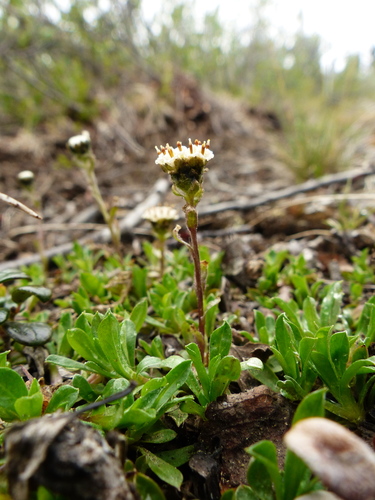
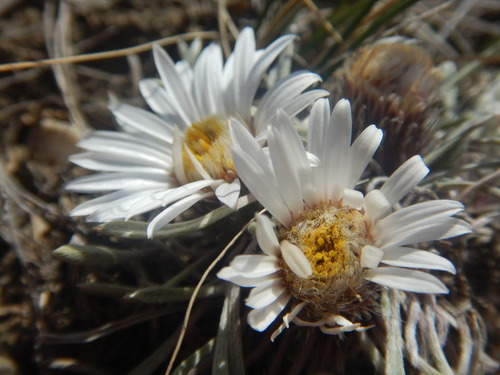
The most noticeable morphological features of Townsendia hookeri include linear, strigose leaves, and sessile or "stemless" flowers that form in early spring. These flowers are most often cream to faintly pink. When the plant reaches maturity, it grows into a mat-forming shape. While species in the genus Townsendia are famously difficult to identify through taxonomic keys, there are several clear distinguishing features that separate T. hookeri from its similar-looking relative T. exscapa. The bracts of T. hookeri end in tiny tufts of hair, which the bracts of T. exscapa lack. In addition, the disk pappus of T. hookeri only extends just past the disk petals, while the disk pappus of T. exscapa reaches well beyond the petals. A hand lens is usually required to correctly identify these two species. Townsendia hookeri is native to North America, growing primarily along the Rocky Mountain corridor. In the United States, its confirmed native range covers the states of Alaska, Idaho, Montana, Wyoming, North Dakota, South Dakota, Nebraska, Colorado, and Utah. It can also be found in the Canadian provinces of Yukon, British Columbia, Alberta, and Saskatchewan. It grows most commonly on well-draining talus slopes, gravel, and exposed areas, including human-caused disturbed sites such as road cuts.