About Townsendia grandiflora Nutt.
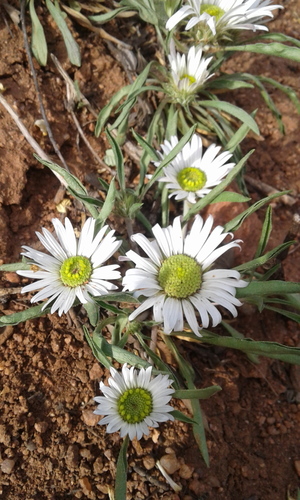
Townsendia grandiflora Nutt. is a small herbaceous plant that most often grows 3–15 centimeters tall; in exceptional cases it may reach 30 centimeters or grow as a flat mat just 2 centimeters above ground. Its stems grow from a large, woody taproot. Most stems branch near the base of the plant, though occasional branching occurs higher up the stem. Stems may be erect or prostrate, and are covered in strigose hairs—hairs that all point in the same direction. The distance between leaf nodes on stems is usually 2–25 millimeters, and can reach up to 50 millimeters. Leaves attach to both the plant’s base and its stems, and can be spoon-shaped (spatulate), oblanceolate (shaped like a reversed lance head, with the widest portion beyond the midpoint), or narrow like a grass blade. Leaves are typically 2–4 centimeters long (rarely up to 9 centimeters) and 0.1–0.5 centimeters wide, and may occasionally reach 1 centimeter in width. Leaf surfaces are mostly smooth, sometimes with sparse hairs, and have rough midribs. Each stem bears exactly one flowering head at its tip. The involucre—the bract-covered base that supports the clustered florets of the flower head—is hemispherical, usually 10–14 millimeters in diameter, and can be as small as 8 millimeters. The bracts are longer than they are wide, widest at the middle, and taper to a long acuminate point, covered in bristly hairs. Bracts are usually 8–10 millimeters long, and occasionally grow longer than 12 millimeters. Each flower head holds 20 to 40 ray flowers arranged around its outer edge, with showy ray petals 7–15 millimeters long, which can occasionally exceed 20 millimeters. Ray petals are mostly white, often with a faint pink or purple tint, and may even be distinctly violet. Each ray petal tip has a single very small notch. The tightly clustered disk flowers at the center of the head are yellow, sometimes described as greenish-yellow. There are usually 80 to over 120 disk flowers, and occasionally as few as 60. Disk flower petals measure 4–6 millimeters long. In its native habitat, T. grandiflora blooms from June through August, with occasional late blooms continuing into September. Its seeds are technically called cypselae (often incorrectly referred to as achenes), and measure 3.5 to over 4 millimeters long. They have a hairy surface and a persistent pappus that is longer than the seed itself. The species that most closely resemble T. grandiflora are Townsendia eximia and Townsendia formosa. Townsendia eximia grows in Colorado and New Mexico, and has slightly more, longer bracts (usually 12–13 mm) on a moderately larger involucre (12–25 mm). The ranges of T. grandiflora and T. formosa overlap only in a very small area of New Mexico. T. formosa generally has larger flowers, with longer petals (10–15 mm) and a wider disk (12–18 mm), and its bracts have a blunt to pointed end that does not taper to a long tip. Townsendia grandiflora grows in the western United States, at elevations from 1300 to 2400 meters, and is found wild across five states: South Dakota, Nebraska, Wyoming, Colorado, and New Mexico. In South Dakota, it has only been recorded in the southwest of the state. In Wyoming, it occurs in eastern Wyoming, particularly toward the south, and in western areas of Nebraska. In Colorado, it grows in the foothills and high plains near the Rocky Mountain foothills in the eastern half of the state. In New Mexico, it is primarily found in the northern part of the state’s northernmost counties, plus one central county. It is most commonly found on dry foothill and mesa slopes, in grasslands, and on eroded shales containing gypsum. In Nebraska and Wyoming, it often grows in sandy soils; in Colorado, it often grows on steeply sloped clay banks. The effects of cattle grazing on T. grandiflora remain unclear. One study found the species present in both ungrazed and intensely grazed rangelands after 55 years, but found no plants in lightly or moderately grazed areas. The roots of the partially parasitic plant Comandra umbellata (bastard toadflax) attach to the roots of T. grandiflora, along with most other perennial plants in the species’ range. T. grandiflora is a host for the rust species Puccinia hordei. Largeflower ground-daisy, the common name for this species, is grown in rock gardens even outside its native range. It requires well-drained soil, and is often grown in troughs in wet climates to better control soil conditions and moisture levels. When suitable natural soil is not available, it can be grown in a mixture of equal parts well-composted leaf mold and sand. It prefers half-sun conditions, where it receives direct sun for only part of the day, or a west-facing position with shade from the south. It is propagated by seed. All ground-daisies, including largeflower ground-daisy, are short-lived plants.