About Townsendia eximia A.Gray
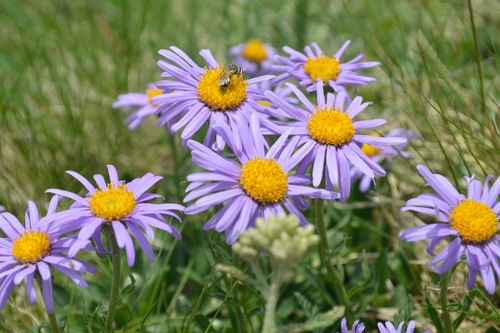
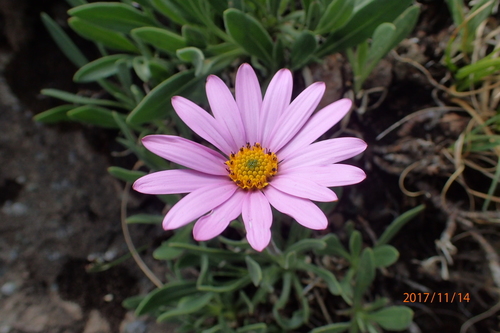
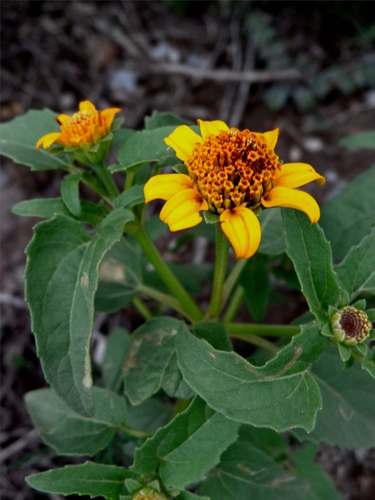
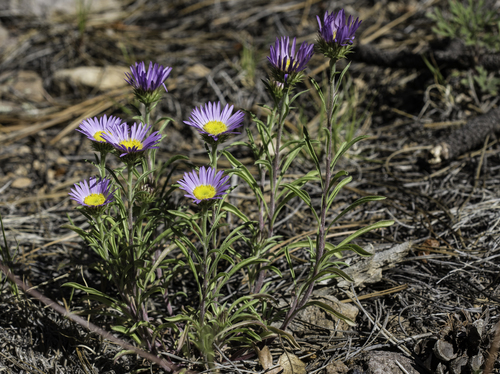
Townsendia eximia A.Gray is a herbaceous plant that can grow as either a biennial or perennial, though it most commonly grows as a biennial. Plants are typically 6 to 15 centimeters (2.4 to 5.9 inches) tall, and occasionally reach up to 30 centimeters (12 inches) tall. Their stems are more or less erect, strigose (covered in hairs that all point the same direction), and may occasionally be rhizomatous. Stems are usually unbranched and often reddish in color. This species is very similar to Townsendia grandiflora (showy townsendia), but grows taller than that species. It produces both cauline leaves (attached to stems) and basal leaves (growing directly from the base of the plant), which range in shape from spatulate to oblanceolate. Leaves are typically 1.5 to 6 centimeters long and 2 to 6 millimeters wide, but can grow up to 12 centimeters long and 10 millimeters wide. Leaf surfaces are usually hairless, though they sometimes have sparse hair coverage, while leaf margins are strigoso-ciliate (edged with straight hairs). Its flowering heads are large and showy; Asa Gray originally described this as "the most striking species of the genus". Each flowering head grows singly at the end of a leafy stem. The involucre, the structure on the underside of the flowering head that supports the ray and disk flowers, is shaped like a half sphere or slightly broader. It is normally 12 to 25 millimeters in diameter, though it can occasionally be as small as 8 millimeters. A single flowering head can have as few as 15 ray flowers, or 55 and more. Ray flowers measure 8 to 20 millimeters long and are blue or somewhat purple in color. This species grows only in the U.S. states of New Mexico and Colorado. The majority of its range lies in central New Mexico, extending south to Socorro and Torrance counties and north to the New Mexico-Colorado state line. In Colorado, it is found only in four counties near the New Mexico border: Conejos, Costilla, Huerfano, and Las Animas. Townsendia eximia is associated with yellow pine habitats including ponderosa pine forests and piñon-juniper woodlands, and also grows on gravelly banks and canyon walls. It most commonly occurs at elevations between 2,100 and 2,500 meters (6,900 to 8,200 feet), but can occasionally be found as low as 1,900 meters (6,200 feet) or as high as 3,300 meters (10,800 feet). Commonly called tall townsend daisy, this species is cultivated and sold as a garden plant, especially for western native plant gardens and rock gardens. Rock gardeners consider this species easy to grow from seed, similar to Townsendia parryi and Townsendia exscapa.