About Tortula muralis Hedw.
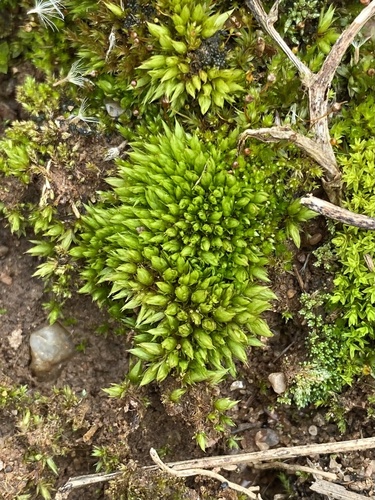
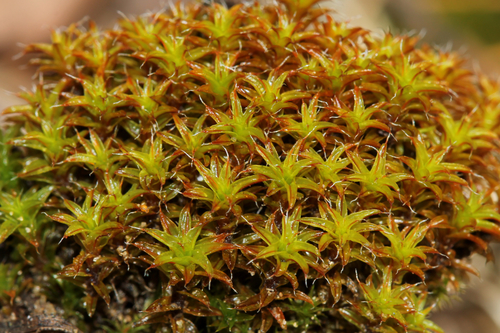
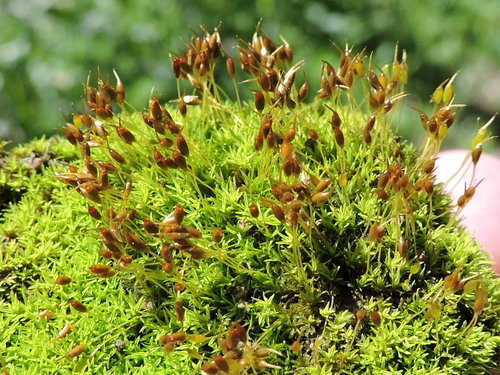
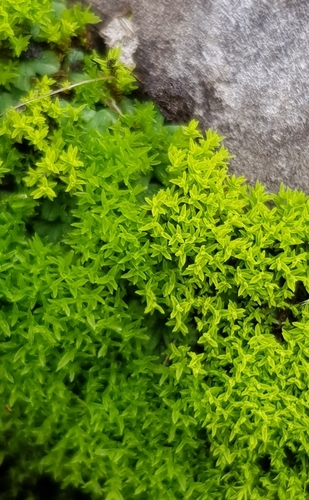
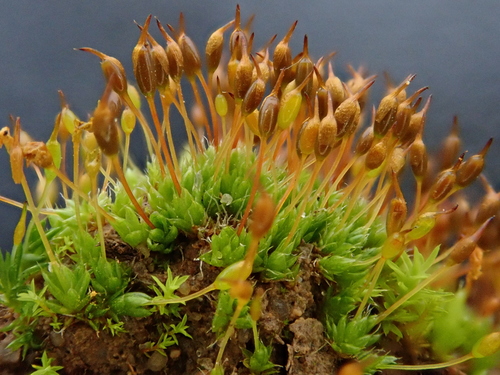
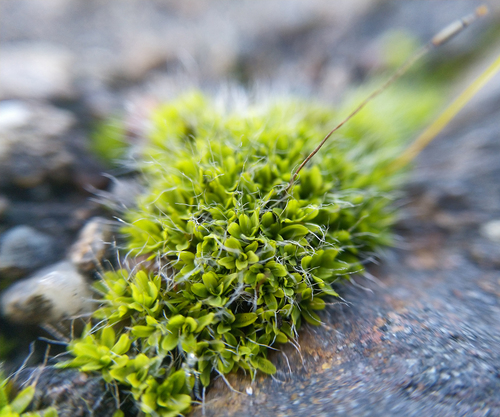
Tortula muralis Hedw. forms greyish-green cushions no taller than 1 cm (0.39 in). It has tongue-shaped leaves with acute to rounded leaf apices that approach a point. Leaf margins are narrowly recurved near the apex, and distally bordered by two to four thicker rows of cells that may or may not bear papillae. The costae are long, sometimes excurrent, lack an adaxial pad of cells, and are narrow distally. Distal laminal cells are hexagonal, 10–15 μm wide, and bear many papillae. This moss is autoicous, with exerted sporophytes. Its setae measure 0.6–1.5 cm (0.24–0.59 in). The capsules are erect, cylindrical, stegocarpic, and not systylius; the urn measures 1.5–2.7 mm, and the peristome measures 300 μm. Spores are spherical, either very finely papillose or nearly smooth, and measure 8–12 μm. This moss can be told apart from similar species by its erect cylindrical capsules and "hair-pointed" leaves. Related Barbula species lack hair-pointed leaves, while Grimmia species, which do have hair-like apices, have short ovoid capsules. Other Tortula species are morphologically similar to T. muralis, but none are as abundant. Microscopically, T. muralis differs from other Tortula species by its recurved leaf margins and smooth hair-apex. T. muralis is most commonly found at moderate elevations in urban areas, growing on concrete, brick walls, soil, rocks, or trees. It has a cosmopolitan distribution, meaning it is widely spread across the globe and can tolerate a range of conditions. It has been recorded in North America, South America, Europe, Asia, Africa, Atlantic islands, New Zealand, and Australia. Like all bryophytes, T. muralis undergoes alternation of heteromorphic generations, alternating between gametophyte and sporophyte life stages.