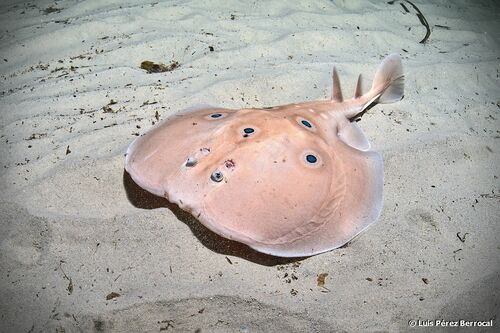
About Torpedo torpedo (Linnaeus, 1758)
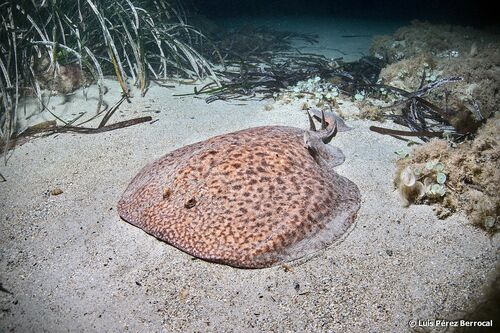
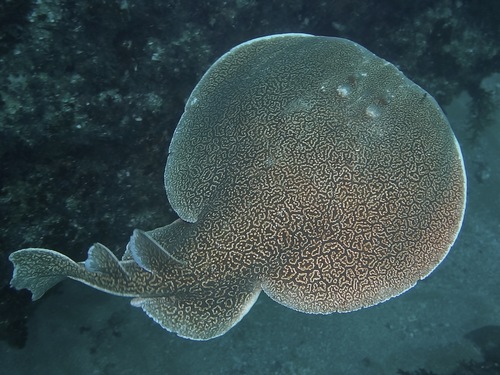
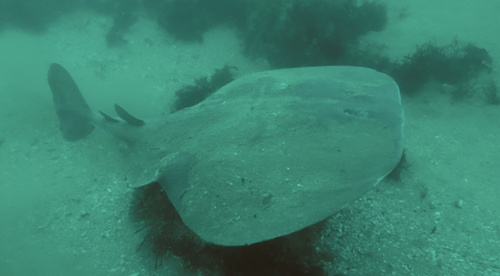
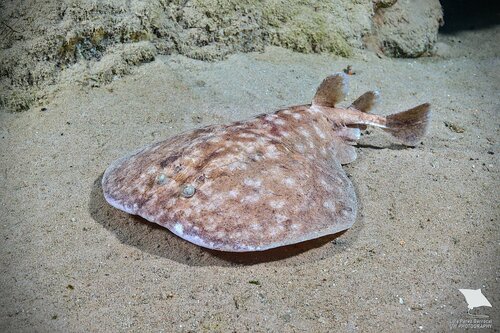
The common torpedo, with the scientific name Torpedo torpedo (Linnaeus, 1758), has an almost circular pectoral fin disc that measures around 1.3 to 1.4 times wider than it is long. The front margin of the disc is nearly straight. Two large, kidney-shaped electric organs are visible under the skin on either side of the ray's head. Its eyes are small, and are followed by spiracles of a similar size. Small, low knobs run along the lateral and posterior rims of the spiracles; these knobs shrink in size as the ray ages, and may not be distinguishable in larger individuals. A pair of prominent mucous pores sits on the "nape" behind the spiracles. A wide, quadrangular flap of skin between the nostrils almost extends to the mouth. The ray's teeth are small, arranged in a dense quincunx pattern, and each tooth has a single sharp cusp. There are approximately 22 to 24 tooth rows in the upper jaw, and 20 to 22 tooth rows in the lower jaw. Five pairs of gill slits are located on the underside of the disc. The pelvic fins are separate from the disc and have rounded outer margins. The ray's short, thick tail has skin folds along either side, and two dorsal fins on its upper surface. The first dorsal fin is slightly larger than the second. The well-developed caudal fin is triangular with blunt corners, and is roughly as long as the distance between the caudal fin and the first dorsal fin. The skin is smooth and soft, and has no dermal denticles at all. The common torpedo's dorsal color ranges from rusty orange to reddish brown, with distinctive large spots called ocellae on the disc. Each ocellus is blue, and surrounded by darker and lighter rings. Most individuals have five ocellae arranged symmetrically, in one row of three and another row of two. Rays with 0 to 4 ocellae are less common, and those with more than five are even rarer. An unusual male with eight ocellae was caught off Tunisia, and another with nine ocellae was caught off southern France. When a sixth ocellus is present, it matches the size of the first five and sits at their center. Any additional ocellae are usually smaller than the first six, and placed asymmetrically toward the snout. The ray's underside is cream-colored, with dark margins along the disc. One adult albino female has been captured off Tunisia. Males typically grow to 30 cm (12 in) long, while females typically reach 39 cm (15 in) long. The largest individual on record measured 60 cm (24 in) long. Common torpedos from off the coast of West Africa grow larger than those found in the Mediterranean. The common torpedo is native to the eastern Atlantic Ocean, where it occurs from the Bay of Biscay south to Angola. It is also found throughout the Mediterranean Sea, with higher population densities in the western part of the basin. A single recorded sighting in Belgian waters is most likely incorrect. In European waters, this species is encountered less often than other electric ray species. It prefers warmer water temperatures, and is rare north of the Mediterranean. Within the Mediterranean, it is more common off the coast of North Africa than off southern Europe. This is a bottom-dwelling species that is usually found close to shore at depths of 2 to 70 m (6.6 to 229.7 ft), though it has occasionally been reported as deep as 400 m (1,300 ft). It lives in soft-bottomed habitats such as sandy flats and seagrass beds. Like other members of its family, the common torpedo can subdue prey and deter threats using strong electric shocks produced by a pair of large electric organs. Each organ is derived from muscle tissue, and made up of 400 to 500 columns. Each column is a stack of around 400 jelly-filled disks called electroplaques, and the columns work together like batteries connected in parallel. The electric discharge can reach up to 200 volts, and may be released as a single shock or in bursts called trains. In vitro experiments show that the nerves that control the electric organ stop working at temperatures below 15 °C (59 °F). Since winter water temperatures regularly drop below this threshold in the wild, this suggests the ray may not use its electric organs for part of the year, or has an as-yet-undiscovered physiological adaptation that allows the organ to function in colder conditions. The common torpedo is solitary and nocturnal, and spends much of its time resting on the sea floor, often buried in sediment. It is an ambush predator that lunges at prey and stuns it with electricity, a process that takes less than a second. After prey is immobilized, the disc moves it into the ray's mouth, where it is swallowed whole. Adult common torpedos feed almost entirely on small benthic bony fishes, including soles, herring, mullet, gobies, goatfishes, porgies, dragonets, and jack mackerels. Large decapod crustaceans are a minor secondary food source, and skates are consumed only very rarely. Juveniles are less strictly piscivorous than adults, and also eat a range of invertebrates. The most common prey species changes by season and geographic location. For example, in the Tyrrhenian Sea, juvenile common sole (Solea solea) are by far the most important prey item in autumn and winter, but become less available in spring and summer, so other fishes make up more of the ray's diet. Known parasites of this species include the tapeworm Phyllobothrium lactuca, and the monogeneans Amphibdella paronaperugiae and Amphibdelloides benhassinae.