About Torpedo sinuspersici Olfers, 1831
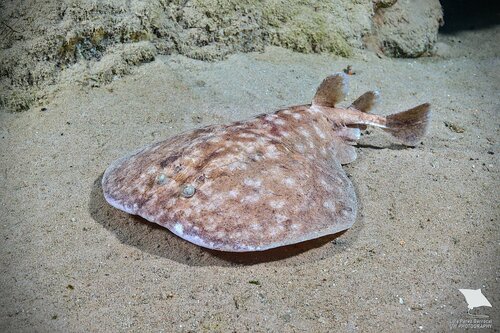
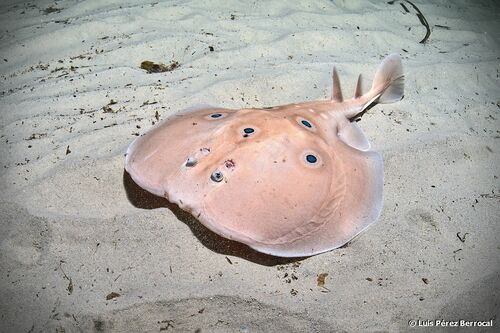
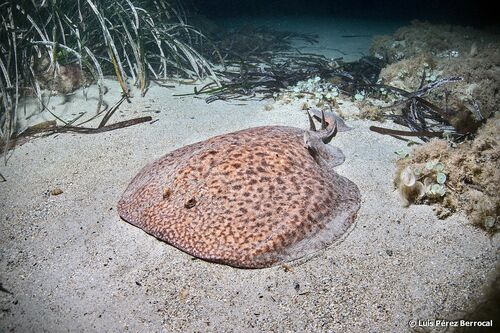
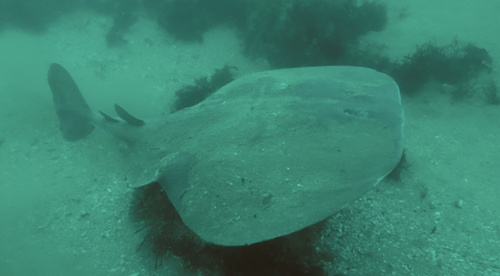
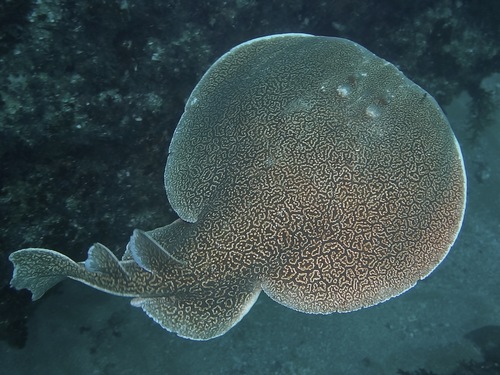
Torpedo sinuspersici Olfers, 1831, commonly called the Gulf torpedo, has a rounded pectoral fin disc that is 84% as wide as it is long. Its tail is short and stocky, and bears two small, subtriangular dorsal fins positioned very close together; the second dorsal fin is three-quarters the size of the first. The pelvic fins are fleshy and partly fused to the disc, while the caudal fin is small and broadly rounded. The eyes are small; in adults, the spiracles are larger than the eyes and have 9-10 papillae on their rim. The skin is smooth. The mouth is wide and holds small, sharply cusped teeth. The Gulf torpedo can reach a maximum length of 130 cm, though most individuals are less than 100 cm long. The angling record for this species from South Africa is 13 kg. This species has distinctive dorsal coloration, with a brown base color overlaid by strong, thick cream or white vermiculations across the disc, pelvic fins, and tail. It also has many irregular cream-colored spots, no larger than the diameter of an eye, on the anterior and lateral regions of the disc. Coloration varies somewhat within the species: some specimens have cream-colored brain-shaped figures or rosettes over the disc and tail, which become smaller towards the disc margins, alongside small spots on the lateral sides of the disc and the front of the snout. The Gulf torpedo is the most widespread electric ray in the western Indian Ocean, with a patchy range that extends to South Africa, Somalia, the Red Sea, the Arabian Sea, the Persian Gulf, Sri Lanka, and the Andaman Sea. There are also less reliable reports of it occurring in other locations, including Madagascar, the Seychelles, and the Laccadive Islands. It was first recorded in the Mediterranean Sea in 2002, but its presence there needs clarification because it strongly resembles Torpedo marmorata, a species that is well established in the Mediterranean. The Gulf torpedo is found in shallow sandy areas, on and near coral reefs, and offshore down to a depth of 150 meters. It often buries itself in the sandy bottom of gullies and estuaries. Little is known about the life history of the Gulf torpedo. It is a sluggish predator of bony fishes. It hunts actively at night, sculling slowly through the water around one meter above the bottom; during the day it usually rests on the bottom and opportunistically ambushes unwary prey. It uses its broad pectoral fins to envelop target fish before delivering an electric shock to stun them. The Gulf torpedo is usually solitary, but individuals may form groups during the mating season. Its reproduction is aplacental viviparous: developing embryos initially survive on their yolk sacs, then rely on enriched uterine fluid produced by the mother. Litters of 9-22 young are born in the summer. Newborns have a disc width of about 10 cm; males reach maturity at a disc width of 39 cm, and females reach maturity at 45 cm.