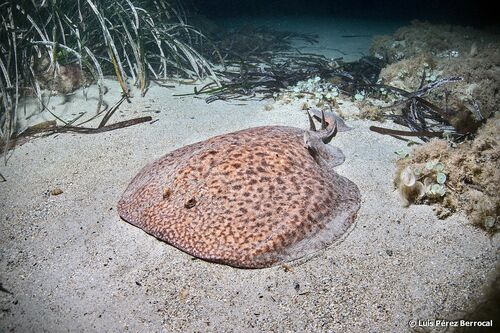
About Torpedo marmorata Risso, 1810
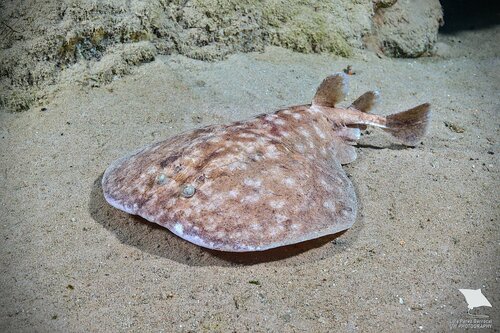
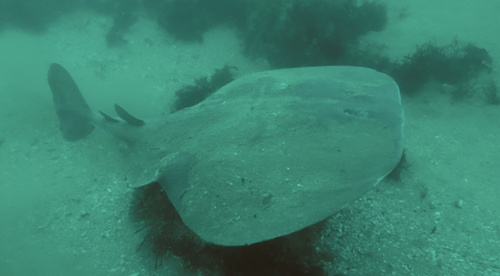
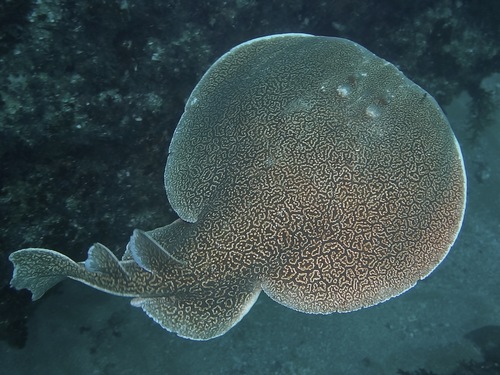
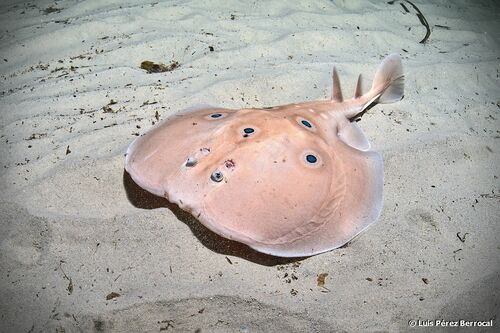
Marbled electric ray (Torpedo marmorata Risso, 1810) has a soft, flabby body that is completely lacking in dermal denticles. Its thick pectoral fin disc is nearly circular, and makes up 59–67% of the ray’s total total length. Outside of the ray’s small eyes, paired kidney-shaped electric organs are visible under the skin. Right behind each eye sits a large oval spiracle, and the rim of each spiracle has 6–8 long, finger-like projections that almost meet at the center. On the nape behind the spiracles, there are 5–7 prominent mucous pores. Between the nostrils, there is a quadrangular curtain of skin that is much broader than it is long, and this curtain almost reaches the ray’s small, arched mouth. The teeth are small with a single pointed cusp, and they are arranged in a quincunx pattern to form a pavement-like band in each jaw. The five pairs of gill slits are small and located underneath the disc. The two dorsal fins have rounded apexes and are positioned close together; the base of each dorsal fin measures around two-thirds of the fin’s height. The rear end of the first dorsal fin’s base sits behind the rear end of the pelvic fin bases, and the second dorsal fin is only slightly smaller than the first. The short, robust tail has skin folds running along each side, and ends in a large caudal fin shaped like a triangle with blunt corners. The upper surface has a dark mottled pattern over a light to dark brown background; some individual marbled electric rays are entirely uniform brown. The underside is plain off-white, with darker margins along the fins. This species can grow up to 1 m (3.3 ft) long, though few males exceed 36–38 cm (14–15 in) and few females exceed 55–61 cm (22–24 in) long. Females reach much larger sizes, which can be attributed to the resource investment required for reproduction. There appears to be little geographic variation in the species’ maximum size, and the maximum recorded weight is 3 kg (6.6 lb). The marbled electric ray is widely distributed in the eastern Atlantic Ocean, where it occurs from Scotland and the southern North Sea southward to the Cape of Good Hope, and north at least as far as Durban, likely further, in South Africa. It also occurs throughout the Mediterranean Sea, with higher population densities in western areas of the sea. It prefers water temperatures cooler than 20 °C (68 °F). This species is typically found at depths of 10–30 m (33–98 ft) off the coasts of Britain and Ireland, 20–100 m (66–328 ft) off Italy, and down to 200 m (660 ft) off Tunisia. It has been recorded as deep as 370 m (1,210 ft). The marbled electric ray generally occurs at deeper depths than the common torpedo (T. torpedo), which shares the southern part of its range. It is a bottom-dwelling species that inhabits rocky reefs, seagrass beds, and adjacent areas with sandy or muddy bottoms. During warm summer months, pregnant females migrate into Arcachon Bay in northwestern France, where they are commonly found in very shallow, muddy pools close to oyster beds. This species may also migrate northward into the waters of the British Isles during summer and autumn. The marbled electric ray is a solitary, slow-moving animal that may stay motionless for several days at a time. It is more active at night, and spends most of the day buried in sediment with only its eyes and spiracles exposed. Matching its sluggish lifestyle, the marbled electric ray has a low blood oxygen carrying capacity and a low heart rate of 10–15 beats per minute, and consumes less oxygen than other sharks and rays of similar size. It is highly tolerant of oxygen deprivation (hypoxia), which lets it cope with deoxygenated bottom waters or being stranded in small pools by falling tide. The ray stops breathing entirely when the oxygen partial pressure in the water drops below 10–15 Torr, and can survive this state for at least five hours. It handles extreme hypoxia by combining anaerobic glycolysis with additional energy-producing pathways in its mitochondria, which slows the buildup of potentially harmful lactate in its cells. Like other members of its family, the marbled electric ray can produce a strong electric shock for attack and defense, generated by a pair of electric organs that develop from muscle tissue. Each electric organ is made up of 400–600 vertical columns, and each column consists of a stack of roughly 400 jelly-filled "electroplates" that act essentially like a battery. This ray has been measured producing up to 70–80 volts, and the maximum potential of its electric discharge has been estimated to reach as high as 200 volts. The strength of the electric shock gradually declines as the ray becomes fatigued. In vitro experiments have found that the nerves that connect to the electric organ stop functioning almost entirely at temperatures below 15 °C (59 °F). Because wild water temperatures regularly drop below this threshold in winter, the ray may not use its electric organ for part of the year. It is also possible that the ray has an as-yet-undiscovered physiological mechanism to adapt electric organ function to cold temperatures. Documented parasites of the marbled electric ray include the tapeworms Anthocephalum gracile and Calyptrobothrium riggii, the leeches Pontobdella muricata and Trachelobdella lubrica, the monogeneans Amphibdella torpedinis, Amphibdelloides kechemiraen, A. maccallumi, A. vallei, Empruthotrema raiae, E. torpedinis, and Squalonchocotyle torpedinis, and the nematodes Ascaris torpedinis and Mawsonascaris pastinacae.