About Torenia crustacea (L.) Cham. & Schltdl.
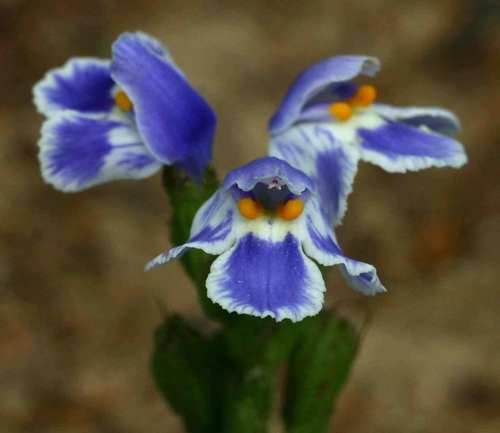
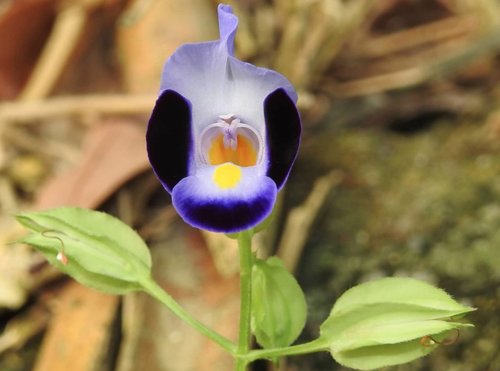
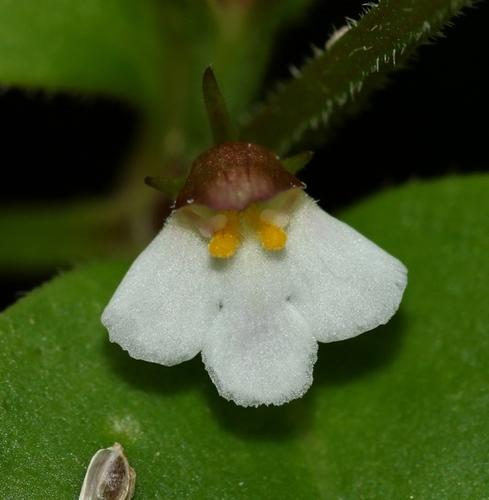
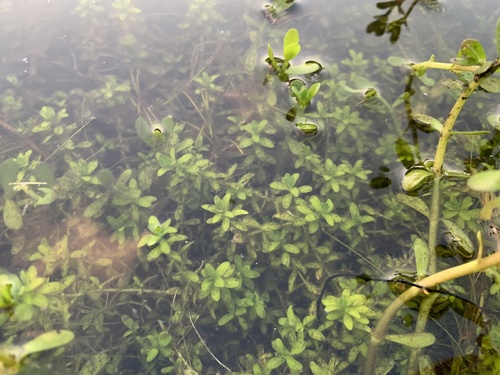
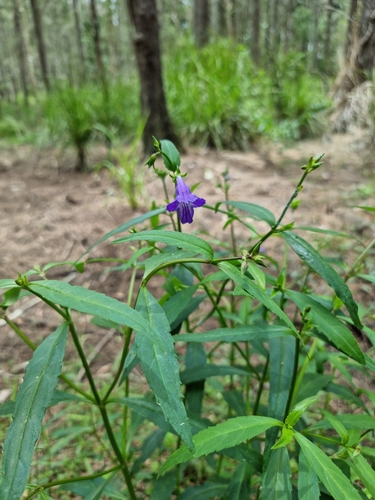
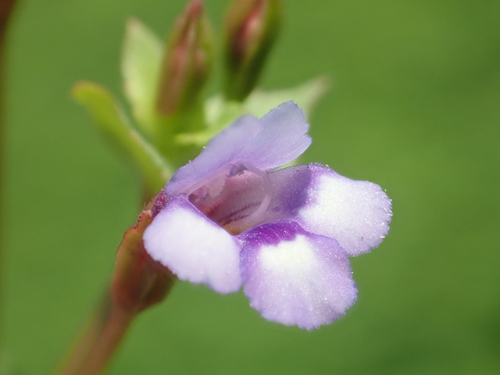
Torenia crustacea (L.) Cham. & Schltdl. is a small herb that grows prostrate to erect, reaching 5–20 cm (2.0–7.9 in) tall. Its stems are much-branched and widely spreading, four-angled (quadrangular) with deep grooves, mostly hairless (glabrous), often purplish, and readily root at nodes when they touch moist soil. Leaves are opposite, simple, and shaped ovate to broadly triangular, 1–2 cm (0.39–0.79 in) long and 0.5–1.1 cm (0.20–0.43 in) wide. They have short petioles up to 8 mm (0.31 in) long, shallowly crenate or serrate margins, and obtuse to subacute tips. Leaf surfaces are mostly hairless, with only sparse hairs along veins on the underside. Flowers are small, around 1 cm (0.39 in) across, borne singly in leaf axils or in short terminal racemes on slender 5–22 mm (0.20–0.87 in) long pedicels. The calyx is urn-shaped, 3–5 mm (0.12–0.20 in) long, with five shallow triangular-ovate lobes. The corolla is 5–8 mm (0.20–0.31 in) long, two-lipped, purple with a yellow or white spot in the throat; the lower lip is three-lobed with a larger middle lobe, while the upper lip is ovate and sometimes shallowly two-lobed. This species has four stamens and no staminodes. Its fruit is a globose to broadly ellipsoid capsule, 3–5 mm (0.12–0.20 in) long, that holds numerous minute cylindric seeds. Pollen grains are round, with a diameter of approximately 23.5 micrometres. The plant flowers year-round in suitable climates. Torenia crustacea is native to tropical and temperate Asia, including China, India, Japan, Malaysia, Indonesia, and the Philippines. It has been widely introduced and naturalized across tropical and subtropical regions worldwide, including Africa, Australia, the Pacific Islands, Central America, South America, the Caribbean, and the southeastern United States. The first recorded collection of this species in North America was made in 1916 in Lee County, Florida, and it has continued spreading across the southeastern United States, where it is now found in Alabama, Arkansas, Florida, Georgia, Louisiana, Mississippi, North Carolina, South Carolina, and Texas. It typically grows in wet or moist habitats from sea level up to 1,500 m (4,900 ft) elevation, and occasionally reaches 3,000 m (9,800 ft). It favours wet ditches, depressions, rice paddies, river beds, roadsides, moist disturbed areas, wet pastures, and edges of cultivated land. When left undisturbed on bare wet soil, it can form dense monospecific carpets covering several square metres. Torenia crustacea is classified as a minor weed of rice cultivation in tropical regions. It is an annual or short-lived perennial that can reproduce both by seed and vegetatively via stems that root at the nodes. Its flowers are visited by several butterfly species, including Pseudozizeeria maha and Zizeeria labradus. In the southeastern United States, it is classified as a non-native species that requires caution and management to prevent escape from cultivation, though its invasive potential is still under assessment. Torenia crustacea has a long history of use in traditional medicine across Asia, particularly in Indonesia, Malaysia, India, and China, where it is one of the most common medicinal plants sold in Chinese pharmacies. Traditional uses include treatment of fever, dysentery, ringworm, skin disorders (including boils, itching, and herpes-like sores), earache, and injuries. In Peninsular Malaysia, a leaf decoction is given to women after childbirth, while in the Moluccas, leaf preparations are applied topically to boils, itching, and wounds caused by forest ticks. In Indochina, the plant is considered to have emetic and cathartic properties, and has been used to treat bilious disorders, amenorrhoea, and hepatitis. In Brunei, powdered plant material mixed with rice water is drunk to relieve diarrhoea, vomiting, and cholera. In Taiwan, it is used as a folk remedy for herpes virus infections. Modern pharmacological studies have confirmed multiple bioactive properties for the species, including antiviral, antibacterial, antifungal, antioxidant, anti-inflammatory, analgesic, and antipyretic activities. Phytochemical analysis has identified bioactive compounds including flavonoids, anthraquinones, phenylpropanoids, and tannins. Research has demonstrated significant activity against the Epstein–Barr virus, which provides scientific support for the plant's traditional antiviral uses.