About Tonna pennata (Mörch, 1853)
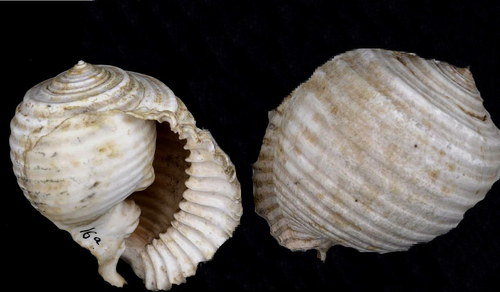
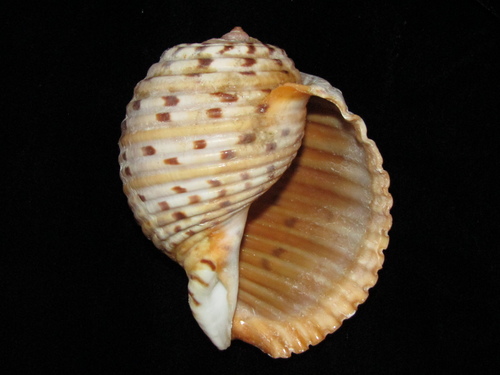
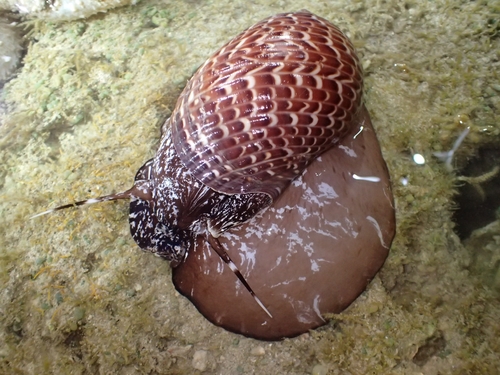
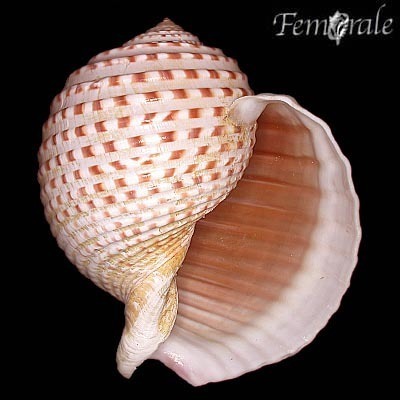
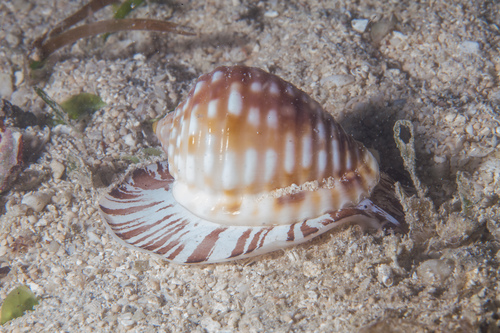
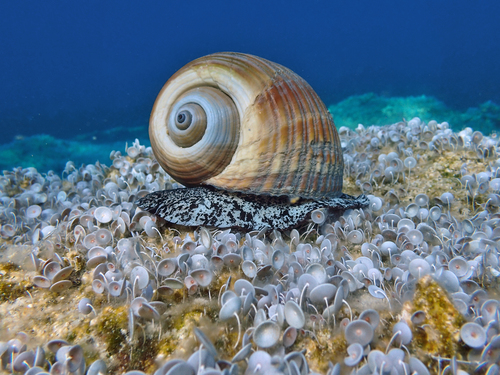
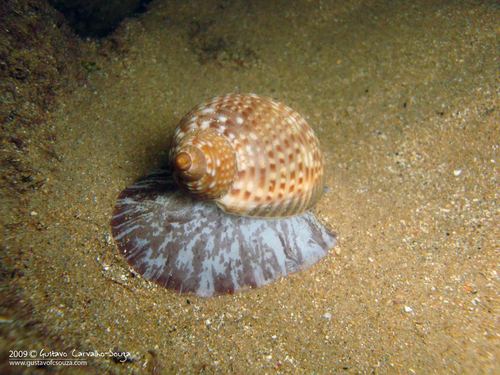
Tonna pennata (Mörch, 1853) has a shell that ranges in color from beige to dark brown, with highly variable whitish markings. This high variation is likely the reason for the large number of existing synonyms for the species. The shell is pear-shaped, with a moderately blunt apex. The wide, flared aperture has a thin lip, and makes up around three-quarters of the shell’s total length. The umbilicus is open, and the columella is twisted. The shell surface has fine striae, with shallow grooves between the ribs. The largest whorl has approximately twenty ribs, and the species has no operculum. The maximum recorded length of this shell is about 15 cm (6 in). In living individuals, the mantle is white with brown markings, and flares widely when the animal moves. This species can be confused with Tonna galea, but Tonna galea is more globular and has a blunter apex. Eudolium bairdii is another similar species, but it typically lives at much greater depths. Tonna perdix is a similar species native to the Pacific Ocean, and the two may form part of a single species complex.
Tonna pennata is distributed in shallow tropical waters: it occurs in the western Atlantic Ocean, the Caribbean Sea, the Gulf of Mexico, and in the eastern Atlantic off the Canary Islands, Madeira, and the West African coast. It is most often found in reef areas, on coral and rock, and also in sandy areas and seagrass meadows. Recorded depths for this species range from 0 m to 13 m.
Tonna pennata is a predatory sea snail that specializes in preying on sea cucumbers, particularly members of the family Stichopodidae. It also preys on bivalve molluscs and fish. It has a long eversible proboscis, which it uses to wrap around smaller prey, or press against larger prey. It secretes saliva that contains sulphuric acid, which paralyzes its victim and initiates digestive processes. It is able to attack prey much larger than itself, including the slow-moving sea cucumber Isostichopus badionotus, which can grow up to 50 cm (20 in) in length. This sea cucumber has a specific defensive strategy to rid itself of the attacker: it stiffens the tissue around the injury, then softens the area, and muscular contractions cause a patch of integument to autotomise, or detach, from its body.