About Tonna galea (Linnaeus, 1758)
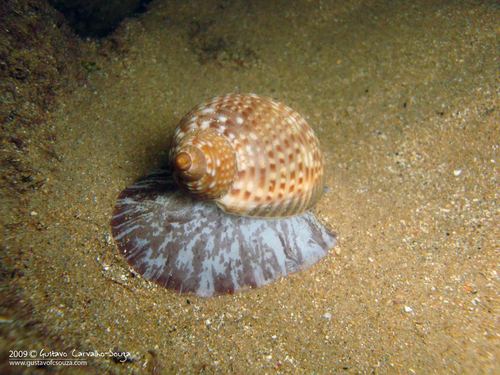
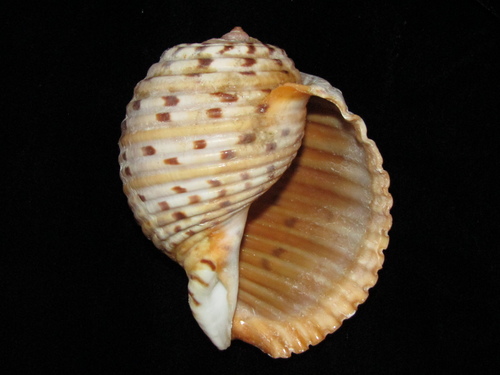
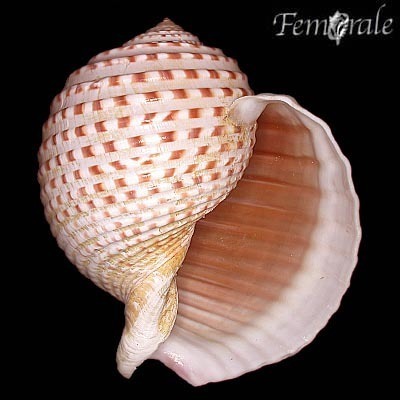
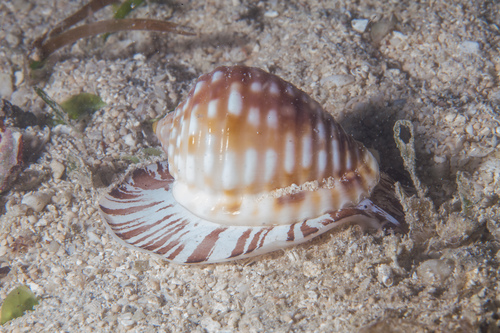
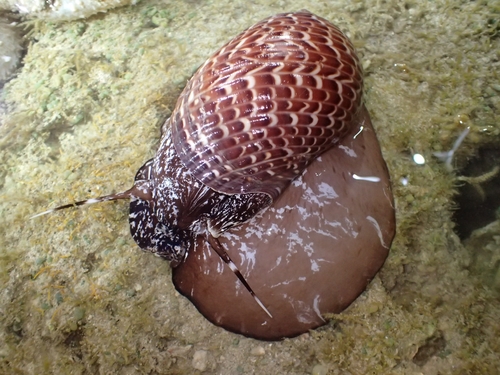
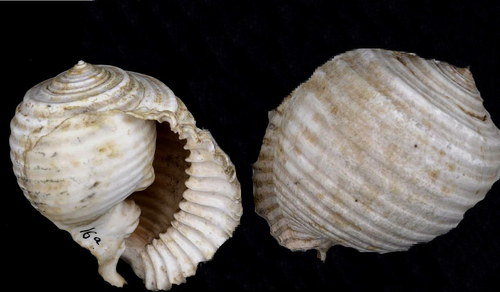
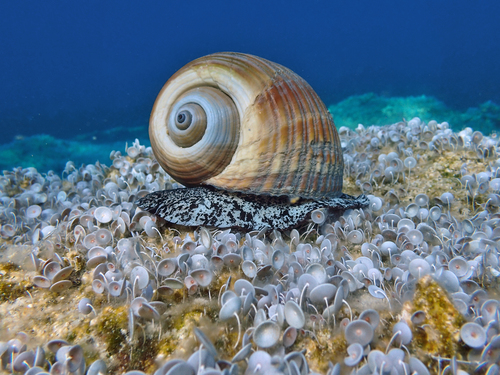
Description: The adult Tonna galea has a very large, ventricose shell, with an average height of 6 inches (150 mm). Some recorded specimens are as large as a man’s head. The shell is thin and inflated, yet still relatively solid and durable. Young Tonna galea have almost diaphanous shells; at this stage, the transverse ribs on the shell surface are only indicated by lines of a slightly darker shade. Despite the shell’s thinness, it is far lighter than the shells of most other large sea snails. The shell’s aperture is distinctly round and wide. Its conical spire is made up of six convex, clearly defined whorls, which bear wide, flat, slightly raised external ribs separated by narrow, shallow furrows. The spire whorls are separated by a deep, channeled suture. The body whorl is rounded and very ventricose. The large, subovate aperture is reddish on the inside, and marked with transverse ribs that match the external furrows. The outer lip is expanded and wavy, with a black or deep brown tint along its edge. The inner lip is whitish, spread as a very thin plate across the body of the body whorl. The columella is smooth and polished, forming a thick rib to the left of the umbilicus marked with transverse striae, which ends at the emargination of the shell base. The outer surface of the shell is a uniform reddish fawn color; the ribs are patterned with wide spots or irregular brown and white blotches that are quite distinct. The soft body of Tonna galea is a clear brownish red with no spots, and its tentacles have a wide reddish-brown ring around them near the tip. The underside of the foot is dark violet, with a deep brown edge. Tonna galea has large salivary glands. The structure of these glands was first described in detail by Heinrich Weber in 1927. This species, commonly called the giant tun, is also luminescent, an extremely rare trait among prosobranch gastropods. The animal emits green-white light when it moves through water with its foot fully extended. Distribution and habitat: This large sea snail occurs in the North Atlantic Ocean (specifically around the Canary Islands and Madeira), the Mediterranean Sea, the Caribbean Sea, and waters off the coasts of Angola, Cape Verde, and West Africa. It prefers muddy or sandy seabeds with seagrass beds. In the Mediterranean, these snails are typically found at depths from just below the surface down to 120 metres (390 ft). Tonna galea is listed on Annex II of both the Berne Convention on the Conservation of European Wildlife and Natural Habitats and the Protocol of the Barcelona Convention for Protection against Pollution in the Mediterranean Sea. Despite these protective designations, the species continues to be exploited. Ecology: Information on the biology and life history of Tonna galea is limited, as the species has rarely been studied. It is carnivorous, and uses two proboscises located on the top of its head to envelop its prey, which primarily consists of sea cucumbers. To a lesser degree, it also feeds on sea urchins, starfish, fish, bivalves, and crustaceans. As a defense mechanism when disturbed, the snail squirts highly acidic saliva, which contains approximately 2–5% sulfuric acid; this acid is also used to kill prey. The presence of this acid was first recorded by Franz Hermann Troschel in 1854. Females lay eggs in wrinkled rosette-shaped clusters on sandy seabeds.