About Tonicella marmorea (O.Fabricius, 1780)
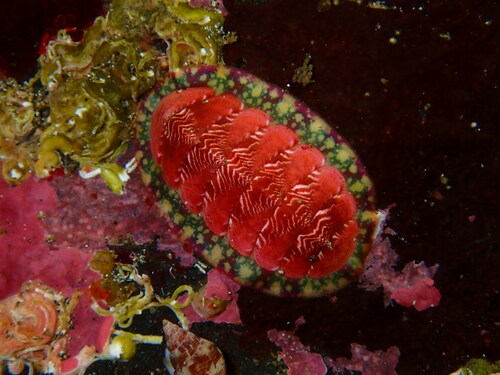
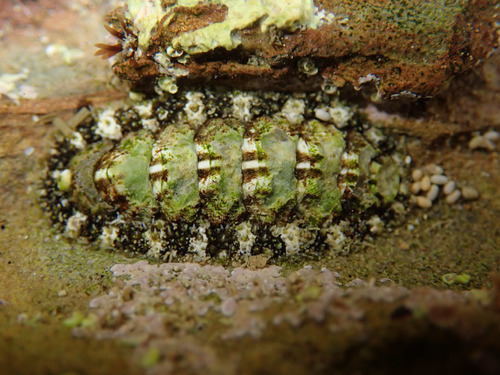
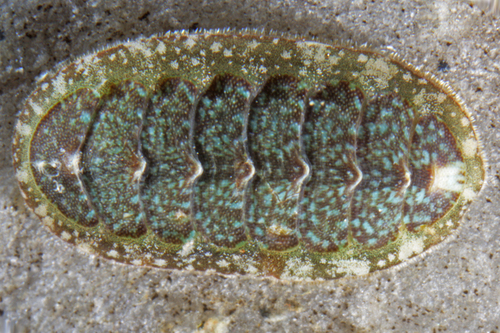
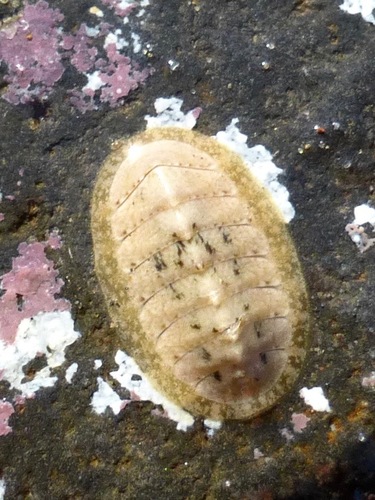
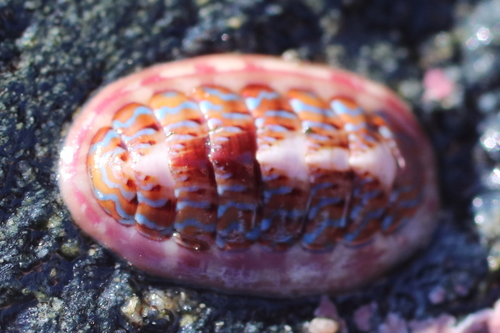
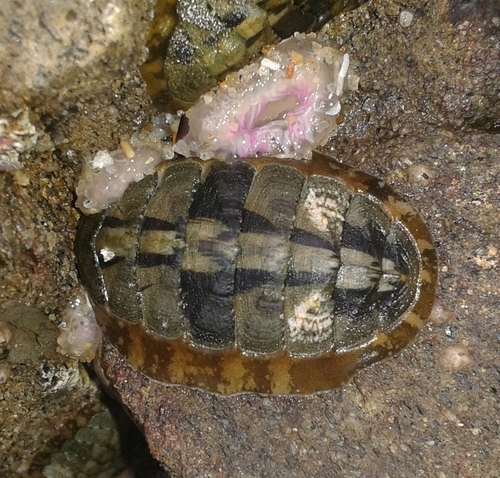
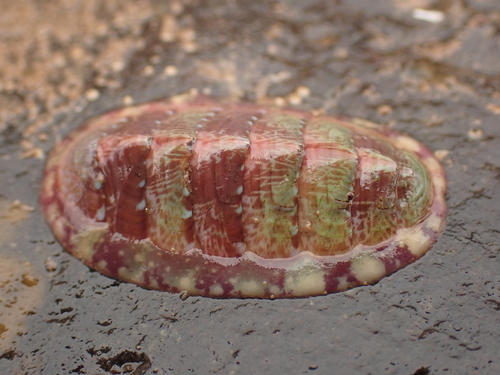
Tonicella marmorea is broadly oval, growing to around 4 cm (1.6 in) in length. Its shell is made of eight smooth, glossy, reddish-brown plates, marbled or patterned with intricate pale brown or white zigzag lines. The wide, thin, leathery girdle surrounding the shell is also reddish-brown, and has small, flattened spines in red, purple or green along its margin, sometimes marked with paler bands. This species has between 17 and 25 pairs of gills, which are usually located in the posterior section of the mantle groove, though they may sometimes be scattered along the full length of the groove. On its ventral side is a yellowish muscular foot, with the mouth at the anterior end and the anus at the posterior end. Colouring can vary in the northwestern Atlantic. This species is found in the Arctic Ocean and the North Atlantic Ocean. Its range covers the eastern coast of North America, Greenland, Norway, Sweden, and Britain, where it is largely restricted to Scotland, Northern Ireland and northern England. It is quite common in Scottish sea lochs, and was previously common in Strangford Lough, where it is now becoming less common. It inhabits rocks, and areas on and under pebbles at depths ranging from the littoral zone down to around 200 m (660 ft). Tonicella marmorea has a strong muscular foot that allows it to grip the substrate firmly. Its individual plates each have bundles of muscle fibres, enabling the chiton to conform to irregularities in the rock surface. If it detaches from the substrate, it can defensively roll itself into a ball. It has no eyes or sensory organs on its head; instead, it has sensory organs called aesthetes on its plates and girdle, which function as a dispersed compound eye. Under the mantle, cilia on the gills generate a water current for respiration, and this current also carries away waste products. In feeding habits, this chiton grazes on algae like a gastropod, using a reinforced radula. It differs from gastropods in having a long, coiled gut and producing faecal pellets, which are expelled with the water current. The sexes are separate in this species. Gametes exit the body with the water current and are released into the sea. In many chiton species, gamete release is synchronized to the phase of the moon and the tides. The larvae are planktonic; when they are sufficiently developed, they settle on the seabed and undergo metamorphosis directly into juveniles, with no intervening veliger stage.