About Tomopterna tandyi Channing & Bogart, 1996
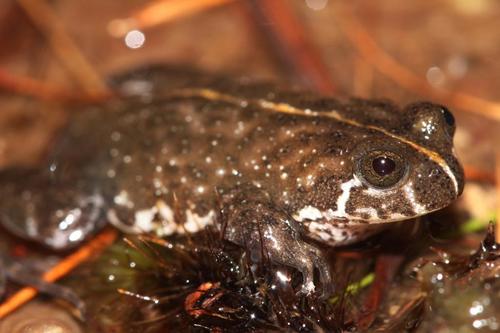
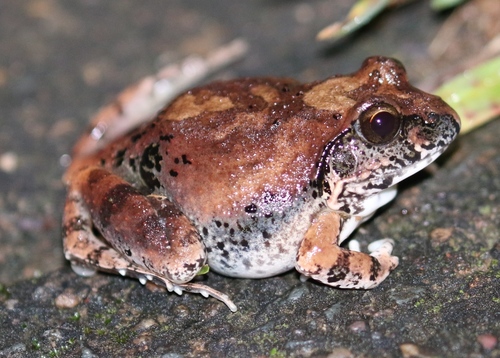
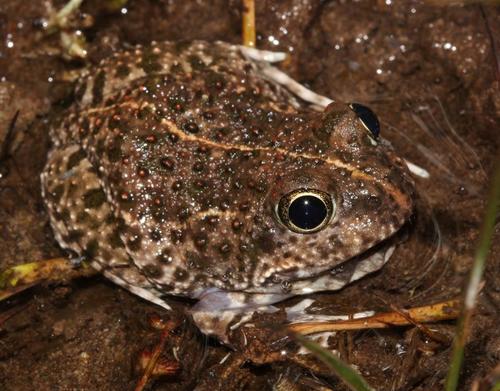
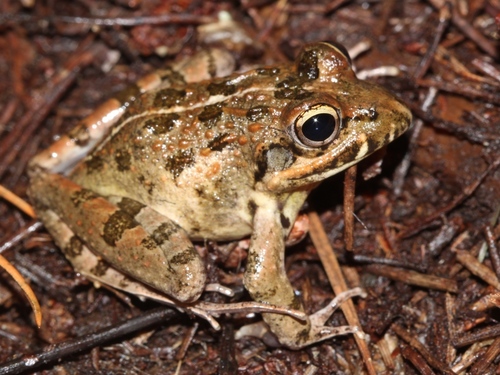
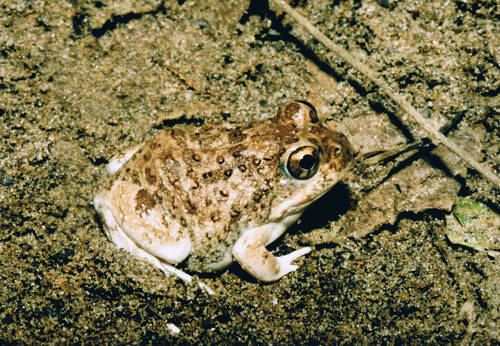
The holotype of Tomopterna tandyi is an adult male that measures 38 mm (1.5 in) in snout–vent length. The tympanum of this species is visible. Its fingers have no webbing, while its toes are only partially webbed. The species' dorsum has patches of grey or olive over a lighter base color; its dorsal warts are reddish brown with black markings. Most individuals have a dark interocular bar. The male advertisement call of Tomopterna tandyi consists of a series of continuously repeated notes. The call has a rate of roughly 7–8 notes per second, and its emphasized frequency is approximately 2700–2800 Hz. This call is distinct from the calls of T. delalandii and T. cryptotis.
Tomopterna tandyi, commonly called Tandy's sand frog, lives in dry savanna, bushland, and grassland at elevations below 1,800 m (5,900 ft). It is often found in agricultural areas, and is associated with loose sandy soils where seasonal pans form. When individuals emerge from their burrows at the start of the rainy season, breeding occurs in ephemeral shallow water, ditches, streams, and dams. Eggs are laid in rain-formed pools, where the tadpoles then complete development. This is an adaptable species that is locally common across parts of its range. It is unlikely to face any threats beyond localized impacts, and it is thought to occur in many protected areas.