About Tomistoma schlegelii (Müller, 1838)
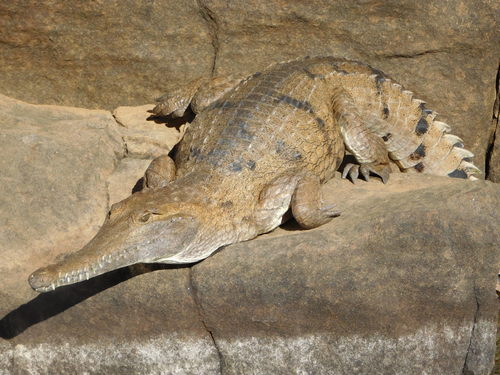
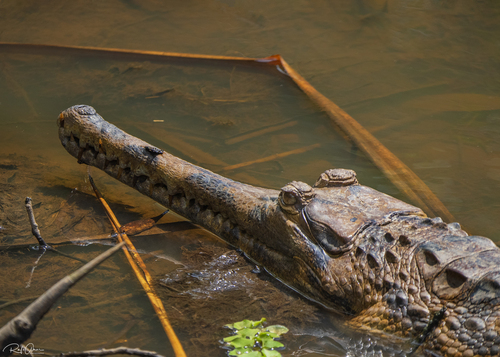
Characteristics of the false gharial (Tomistoma schlegelii): Adults are dark reddish-brown on their upper side, with dark brown or black spots and cross-bands across the back and tail. Their ventral (belly) surface is grayish-white, with some dark mottling along the sides. Juveniles have black mottling on the sides of their jaws, body, and tail. The false gharial’s snout is extremely long and slender, has smooth, unornamented skin, and runs parallel-sided, with a length 3.0 to 3.5 times its width at the base. All of its teeth are long and needle-shaped, interlock inside the jaws, and are set in individual sockets. Dorsal scales are broad at midbody and extend onto the sides of the body. The digits are webbed at their base. Integumentary sensory organs are present on the scales of the head and body. Scales behind the head often form a slightly enlarged single pair; some individuals also have a number of adjoining small keeled scales. The scalation is divided along its midline by soft granular skin. Three transverse rows of two enlarged nuchal scales connect continuously to the dorsal scales, which consist of 22 transverse rows of six to eight scales that are broad at midbody and extend onto the sides of the body. Nuchal and dorsal rows combined add up to a total of 22 to 23 rows. The false gharial has 18 double-crested caudal whorls and 17 single-crested caudal whorls. On each flank, there are one or two longitudinal rows of six to eight very enlarged scales. The false gharial has one of the slimmest snouts of any living crocodilian; its slenderness is comparable to that of the slender-snouted crocodile and the freshwater crocodile, and only the gharial has a noticeably slimmer snout. Three mature males held in captivity measured 3.6 to 3.9 m (12 to 13 ft) long and weighed 190 to 210 kg (420 to 460 lb), while one measured female was 3.27 m (10.7 ft) long and weighed 93 kg (205 lb). Females can grow up to 4 m (13 ft) in total length. Males can reach up to 5 m (16 ft) in length and weigh up to 600 kg (1,300 lb). The false gharial appears to have the largest skull of any living (extant) crocodilian, a trait partially due to the great length of its slender snout. Out of the eight longest crocodilian skulls from living species held in museums around the world, six belonged to false gharials. The longest recorded skull from an extant crocodilian belongs to this species, measuring 84 cm (33 in) in total length with a mandibular length of 104 cm (41 in). Most holders of these large skulls have no confirmed, or even anecdotal, full body measurements for the animals, but based on the species’ known skull-to-total length ratio, the animals would have measured approximately 5.5 to 6.1 m (18 to 20 ft) long. Three individuals ranging from 2.9 to 4.05 m (9 ft 6 in to 13 ft 3 in) in length and 79 to 255 kg (174 to 562 lb) in weight had a measured bite force of 1,704–6,450 N (383–1,450 lbf). Distribution and habitat: The false gharial is native to Peninsular Malaysia, and the islands of Borneo and Sumatra. It is locally extinct in Java and Thailand. It lives in peat swamps and lowland swamp forests. Before the 1950s, false gharials occurred in freshwater ecosystems along the entire length of Sumatra east of the Barisan Mountains. The species’ current distribution in eastern Sumatra has been reduced by 30-40% due to hunting, logging, fires, and agriculture. As of 2010, the total population is estimated to include fewer than 2,500 mature individuals. Reproduction: The false gharial is a mound-nesting crocodilian. Females lay small clutches of 13–35 eggs per nest, and this species appears to produce the largest eggs of any living crocodilian. False gharials reach sexual maturity when they grow to around 2.5 to 3 m (8 ft 2 in to 9 ft 10 in) in length, a larger size at maturity compared to most other crocodilians. Courtship occurs during rainfall periods between November and February, and again between April and June.