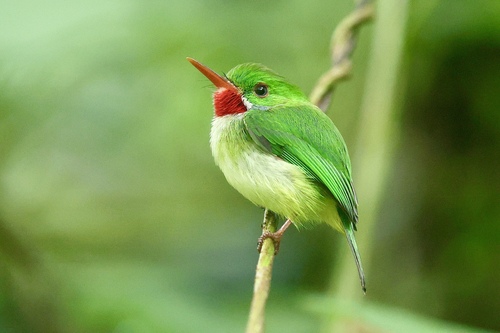
About Todus todus (Linnaeus, 1758)
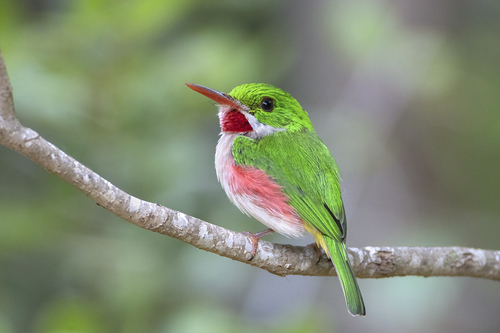
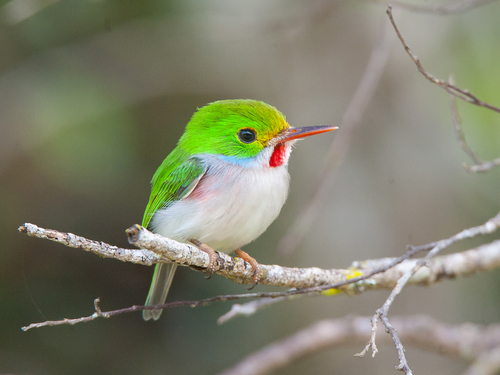
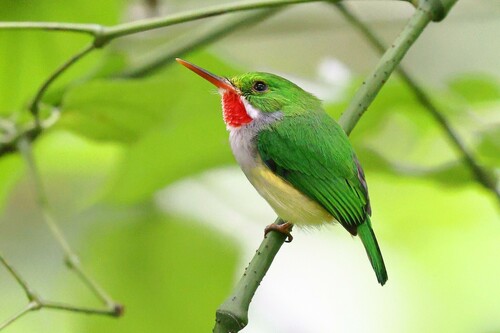
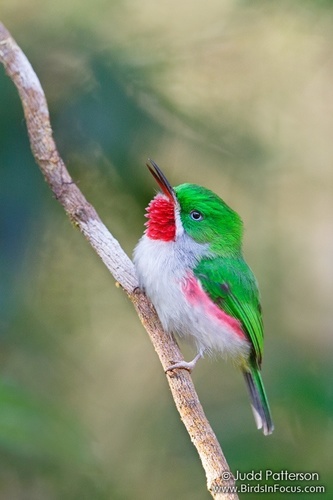
The Jamaican tody, Todus todus, is a small, chunky bird with an average length of about 9 cm (4.25 inches) and an average weight of around 6.4 grams. Across all tody species, wing lengths fall between 42.8mm and 50.3mm; the Jamaican tody has an intermediate wing length of about 46mm, larger than the smaller wings of Cuban and Puerto Rican todies, and smaller than the largest wings of the broad-billed tody. This wing length correlates to an average flight distance of about 1.5 meters and a maximum flight distance of 26 meters. The species has a bright green head, red throat, and a long, broad, flat red bill. It closely resembles the Puerto Rican tody (Todus mexicanus), but differs in plumage: it has a whitish breast blended with green, which becomes slightly yellow on the abdomen and under the tail-coverts, plus blue-gray subauricular feathers. Its legs and feet are reddish brown. The entire Todus genus is generally sexually monomorphic. While some tody species show different eye colors between males and females, male and female Jamaican todies have indistinguishable iris color. Jamaican todies are very quiet during non-breeding months, and are heard much more frequently in spring and summer. Their vocalizations are most commonly a loud nasal beep sound and a throat-rattle. The loud beep is similar in length to the loud beep of the Puerto Rican tody. The throat-rattle is a rapid, harsh noise often produced during territorial defense. The Jamaican tody is endemic to the island of Jamaica, where it occurs across the entire island. It can be found in both semi-arid coastal areas and humid mountains, generally travels in pairs, and is most common in forested areas. It inhabits second-growth and undisturbed habitats, including mesic limestone forests, arid limestone forests, montane forest, shaded coffee plantations, and mangroves. It is most visible during spring and summer, and is more silent and easier to find in fall and winter. Like other West Indian Todus species, the Jamaican tody uses a sit-and-watch foraging strategy to catch prey. It feeds almost entirely on insects and insect larvae, and only occasionally eats fruit. Most foraging activity takes place below nine-tenths of the forest's maximum canopy height, occurring in both dry and wet forests. From a perch, the bird scans the undersides, and sometimes the uppersides, of leaves for insects. It swoops up or down respectively to capture detected prey. Smaller insects are swallowed mid-air, while larger insects are smashed against twigs before being eaten. The Jamaican tody feeds almost continuously throughout the day, eating approximately 1 to 2 insects per minute when prey is available. Its drinking behavior has never been observed, but it is assumed the species gets most of its required water from leaf droplets and consumed food.