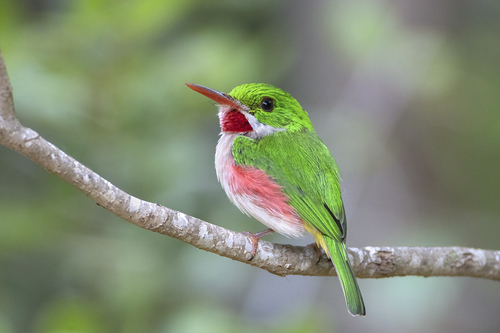
About Todus subulatus G.R.Gray, 1847
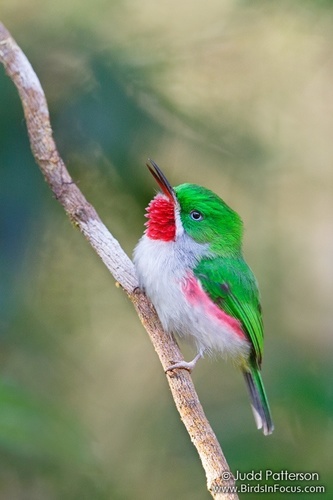
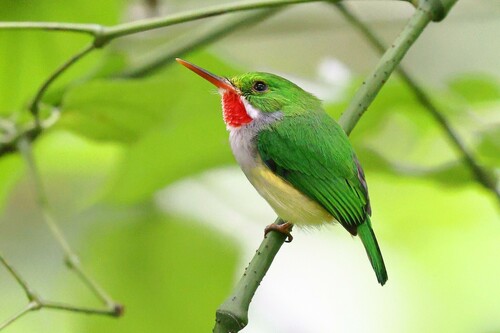
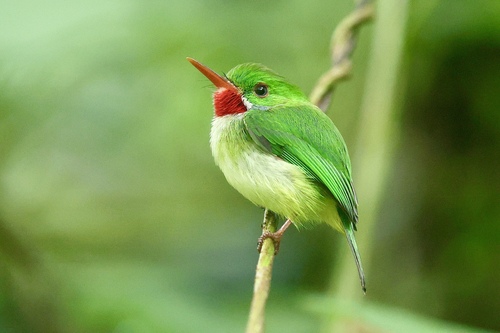
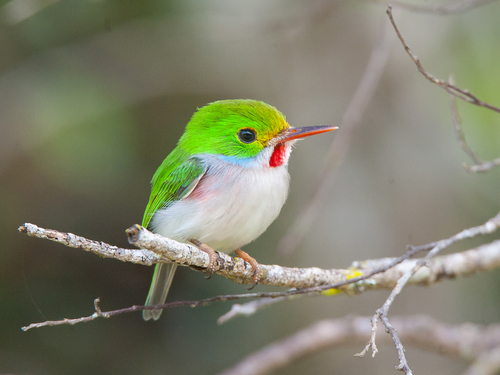
The broad-billed tody (Todus subulatus G.R.Gray, 1847) is a small, rotund bird with a short tail. It has distinctive bright green feathers on its back, head, and wings, plus a plain white breast tinged with yellow. It also features a striking red throat, pale pink flanks, slate-colored irises, and bright yellow coloring on its underside where the body meets the tail. This species has the widest bill of any todie in the tody family, measuring 0.6 cm wide and 2.1 cm long; the upper bill is black, while the lower bill is entirely red. Its short, rounded feathers are not streamlined for efficient flight. Adults measure 11.5 cm in length and weigh approximately 7.5 grams, making it the largest bird in the genus Todus. Adult females and males are nearly indistinguishable. Juveniles can be told apart by their lack of a full red throat: they have pale yellow throats lightly tinged with red, along with shorter bills and gray-streaked breasts. Tody eggs are the smallest eggs of any species in the order Coraciiformes, measuring 1.6 centimeters by 1.4 centimeters and weighing about 1.4 grams. The eggs are glossy white with no natural markings, but they often gain a reddish tint from dirt stains, and a rosy tint from the large orange-red yolk inside the egg, which is needed to support the species’ unusually long incubation period. The broad-billed tody is endemic to the island of Hispaniola, which is shared by the Dominican Republic and Haiti. It shares the island with the related narrow-billed tody, though the two species are geographically separated across most of the island. They can only be found flocking together in specific pine forests and mangroves. The broad-billed tody lives primarily at low elevations, ranging from sea level up to 1700 meters, and it is more common in the Dominican Republic than in Haiti. It prefers arid habitats including lowland scrubs, sub-desert areas with abundant cacti and agave, shaded coffee plantations, and pine forests. Though it is a tropical bird, it is rarely found in dense rainforest and avoids wet conditions. This species is completely sedentary and does not migrate. During the breeding season, breeding pairs stay within the same territory for the full season. In non-breeding months, todies forage slightly further from their home range and may temporarily join mixed flocks with narrow-billed todies. When the breeding season starts again, the species returns to and maintains its original territory year after year. Juveniles also do not travel far after leaving the nest; the first territory they claim is only a few kilometers away from where they hatched. Like other Coraciiformes, broad-billed todies dig burrows in embankments to hold their nests. Nest openings measure 3.7 centimeters wide and 4.0 centimeters high, and burrows can reach up to 60 centimeters deep. Both males and females take part in burrow construction, which can start as early as September and continue until June. The breeding season runs from April to July, and begins with males courting females through a variety of behaviors. Males may chase females in mid-air, performing flights and tumbles while the female chases them back; they may also hop agitatedly on perches while fluffing their feathers. A key courtship behavior is the ‘flank display’, where the male puffs up his pink flank feathers to different levels of intensity. At the peak of the display, he fully inflates his body, appearing as a round green puffball with no visible wings, and his pink flank feathers extend out over his back. Males that can display more flank feathers, extending pink color farther over the back, are the most attractive to females. Finally, males also flick their wings to produce a rattling sound, a courtship trait unique to todies. Broad-billed todies are seasonally monogamous: once a pair forms, they typically stay together until the end of the breeding season, though multiple matings and multiple clutches have been observed. Females signal they are ready for copulation by flapping their wings, spreading them, and lifting their tail. Females usually lay one clutch of one to four eggs per breeding season. Incubation takes about two to three weeks, and both the male and female take turns incubating eggs, though the female incubates for a larger percentage of the time. The broad-billed tody is considered an inattentive parent because it spends less than a quarter of daylight hours incubating eggs. Parents do not perform greeting rituals when returning to the nest, and are mostly silent when with their young. Despite this, the species is extremely diligent when feeding its young; one study recorded 420 feedings per day for a clutch of three, which is a higher rate than any other insectivorous bird. After hatching, nestlings remain in the burrow for another two to three weeks before leaving. Once they leave the nest, the breeding pair separates, and young birds survive independently.