About Todus mexicanus R.Lesson, 1838
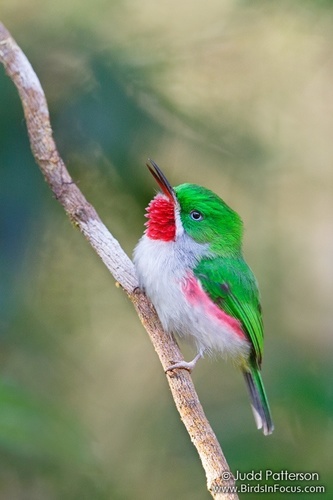
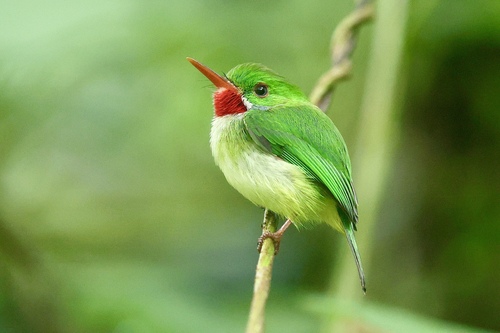
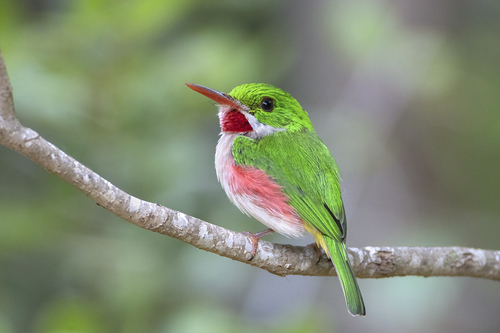
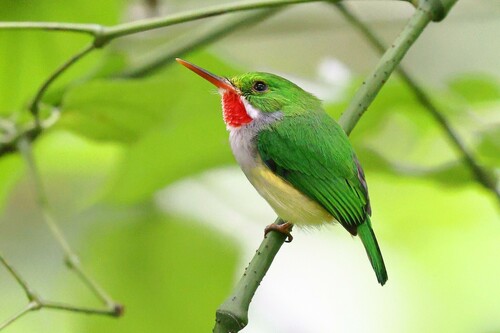
Todus mexicanus R.Lesson, 1838, commonly known as the Puerto Rican tody, is a small, brightly colored non-passerine forest bird. It is one of the smallest species in the order Coraciiformes, with an average body length of 11 cm and an average weight of 5 to 6 g. This bird has emerald green upperparts, light-yellow flanks and underside tail coverts, and a white belly and chest. Known locally as "San Pedrito" or "Medio Peso", it has a red throat and a red lower mandible; its bill is long and broad, equal to or longer than the length of its head, and half as long as its wing. Its legs and feet are brownish, and the tarsus is roughly the same length as the bill. Both males and females have a short tail that measures between two-thirds and three-quarters the length of the wings. The species is not sexually dichromatic, meaning males and females have identical plumage; their only visible difference is eye color: males have gray eyes, while females have white eyes. Juvenile Puerto Rican todies have similar feather coloration to adults, but they lack the species' characteristic red markings, have a grayish belly, and shorter bills. Unlike all other tody species, the Puerto Rican tody has no pink or yellow-green feathers on its flanks. The Puerto Rican tody is found across the main island of Puerto Rico. It occurs predominantly in forested areas, especially in high-altitude damp forests with high insect concentrations, and also lives in dense thickets such as those found in Guánica Forest in southern Puerto Rico. This species is monogamous and produces only one brood per breeding season. Courtship activity peaks between February and May, and takes place in the breeding area not far from the nesting site. The courtship ritual involves pairs chasing each other while rattling their wings. Both males and females perform a flank display before copulation, fluffing out their flank feathers to create a spherical, ball-like shape. The female lifts her tail and adopts a submissive posture to allow copulation. During courtship, the birds' vocalizations become agitated and accelerated.