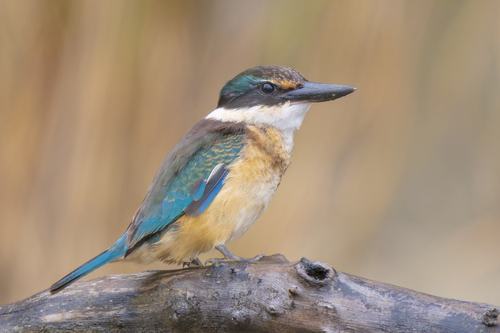
About Todiramphus sanctus (Vigors & Horsfield, 1827)
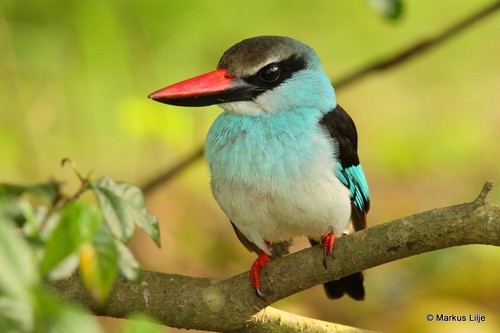
The sacred kingfisher, with the scientific name Todiramphus sanctus (Vigors & Horsfield, 1827), has distinct plumage coloration: most of its upper body is blue-green to turquoise, while its underparts and collar feathers are white. It also has a black mask and buff-colored lores. The two sexes look similar overall, though females are typically greener, duller, and have less buff color on their underparts. Juveniles have buff or mottled brown edges on their collar, underparts, and upper-wing coverts. Adult sacred kingfishers measure 20 to 23 cm (7.9 to 9.1 in) in total length. Males weigh between 28 and 61 g (1.0 to 2.2 oz), and females weigh between 28 and 56 g (1.0 to 2.0 oz).
Sacred kingfishers are distributed across Australia, New Zealand, Lord Howe Island, Norfolk Island, New Guinea, eastern Indonesia, most of northern and western Melanesia, and the Kermadec Islands. This species breeds across most of Australia, excluding the dry interior, as well as throughout New Zealand, New Caledonia, and locally in New Guinea. Populations living in the southern two-thirds of Australia migrate north at the end of the breeding season, reaching as far as New Guinea, east to the eastern Solomon Islands, and west to Indonesia. They become uncommon to very sparse in areas further west, all the way to Sumatra. These migrating birds return south to Australia in August and September. This species has also been recorded as a vagrant on Indian Ocean Christmas Island, in Malaysia, the Marshall Islands, the Federated States of Micronesia, and Nauru. A pair was spotted in Pampanga, Philippines in April or May 2016.
In Australia, the sacred kingfisher inhabits open eucalypt forests, melaleuca swamps, mangroves, mudflats, wetlands, river and lake margins, farmland, parks, and gardens. In New Zealand, the subspecies T. sanctus vagans performs altitudinal migration: after breeding, individuals move from higher altitudes to the coast, and also from forest areas to the coast and open lands.