About Todiramphus pyrrhopygius (Gould, 1841)
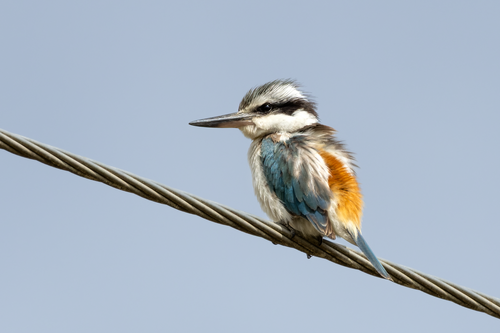
The red-backed kingfisher, whose scientific name is Todiramphus pyrrhopygius (Gould, 1841), measures between 20 and 24 cm (7.9 to 9.4 in) in length. Males weigh 45–70 g (1.6–2.5 oz), while females weigh 41–62 g (1.4–2.2 oz). This species has a streaked green and white crown, bluish-green wings and tail, and chestnut lower back, rump, and upper tail coverts. Its nape, breast, and abdomen are all white. A black band runs from the bill through the eyes to the ear coverts. Females are overall duller in coloration: their crown is more heavily streaked, their wings are a dull turquoise instead of brighter bluish-green, and their white areas show more buff tone. The species has dark brown irises, and dark grey legs and feet. Immature red-backed kingfishers resemble adult females, but have a dull green back and mantle, plus speckling on the breast.
The red-backed kingfisher is native to most of Australia, excluding Tasmania and the extreme southwest and extreme southeast of the Australian mainland. It is a summer visitor to southeast Australia, and resident year-round across the rest of its range. It occupies a wide range of environments, from dry forests, mulga country, and mallee country to spinifex landscapes and almost completely treeless country, and it often lives far from water. During the breeding season, it moves to river courses to dig nesting burrows into the earthy river banks. Populations that breed in southern Australia are partly migratory, returning to northern parts of the continent for winter. This kingfisher ranges from moderately common to uncommon, a pattern linked to its irregular nomadic movements that likely depend on the occurrence of erratic rainfall.